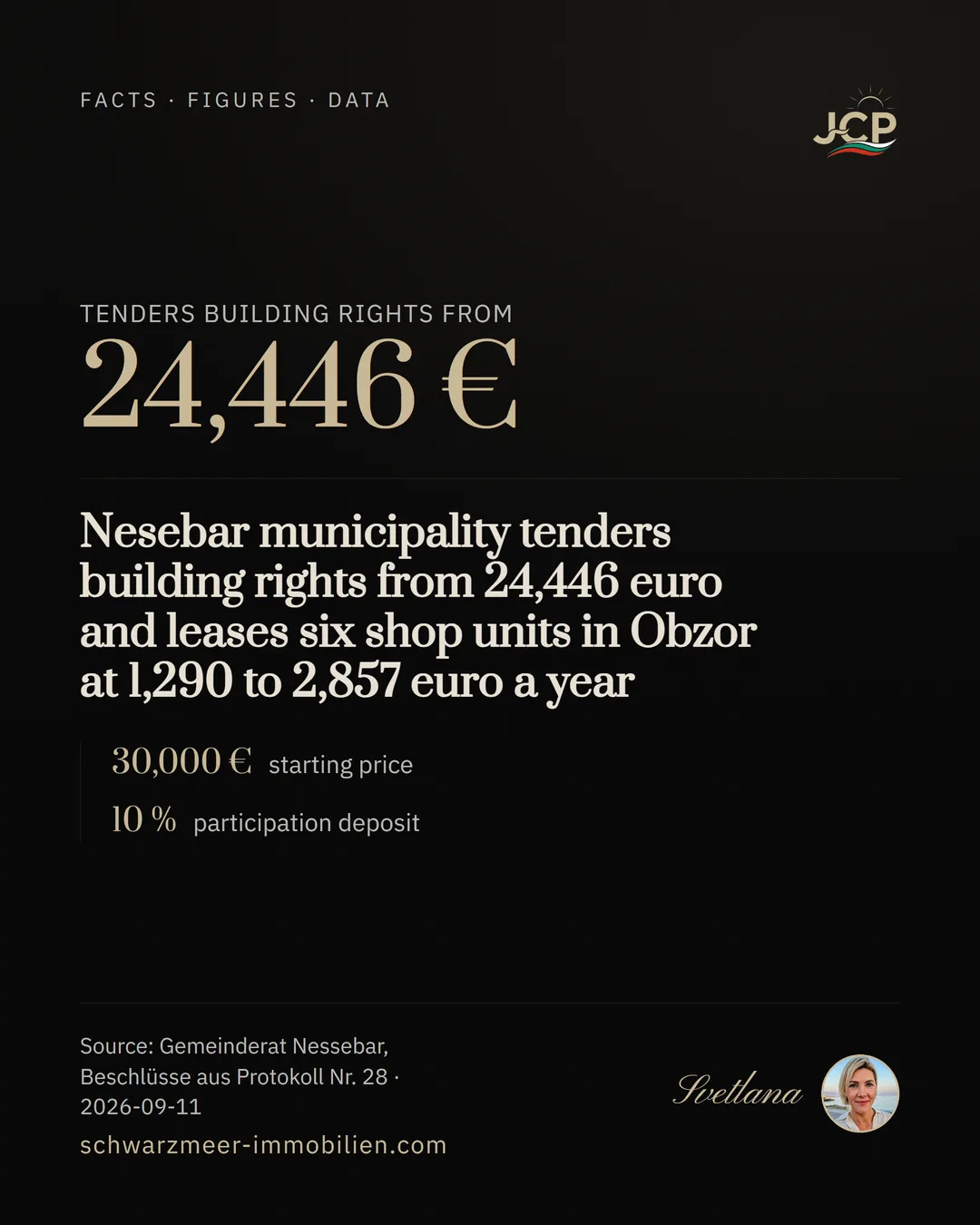
Nesebar municipality tenders building rights from 24,446 euro and leases six shop units in Obzor at 1,290 to 2,857 euro a year
On 4 September Nesebar municipal council resolved on two public tenders. The first awards building rights on two municipal non-residential plots: UPI I-obsht in block 53a in Ravda with a starting price of 30,000 euro and UPI VIII-182,183 in Sunny Beach West at 24,446 euro, intended for a leisure and sports facility and an office building respectively. The second leases six shop units in the building with identifier 53045.502.593.2 in Obzor for five years, with annual rents from 1,290.24 to 2,856.96 euro including VAT and a participation deposit of 10 per cent. The same session approved two smaller sales of co-ownership shares: 230 square metres of plot 51500.58.3 for 1,877 euro and 80 of 680 square metres of plot 39164.502.686 for 3,458 euro.
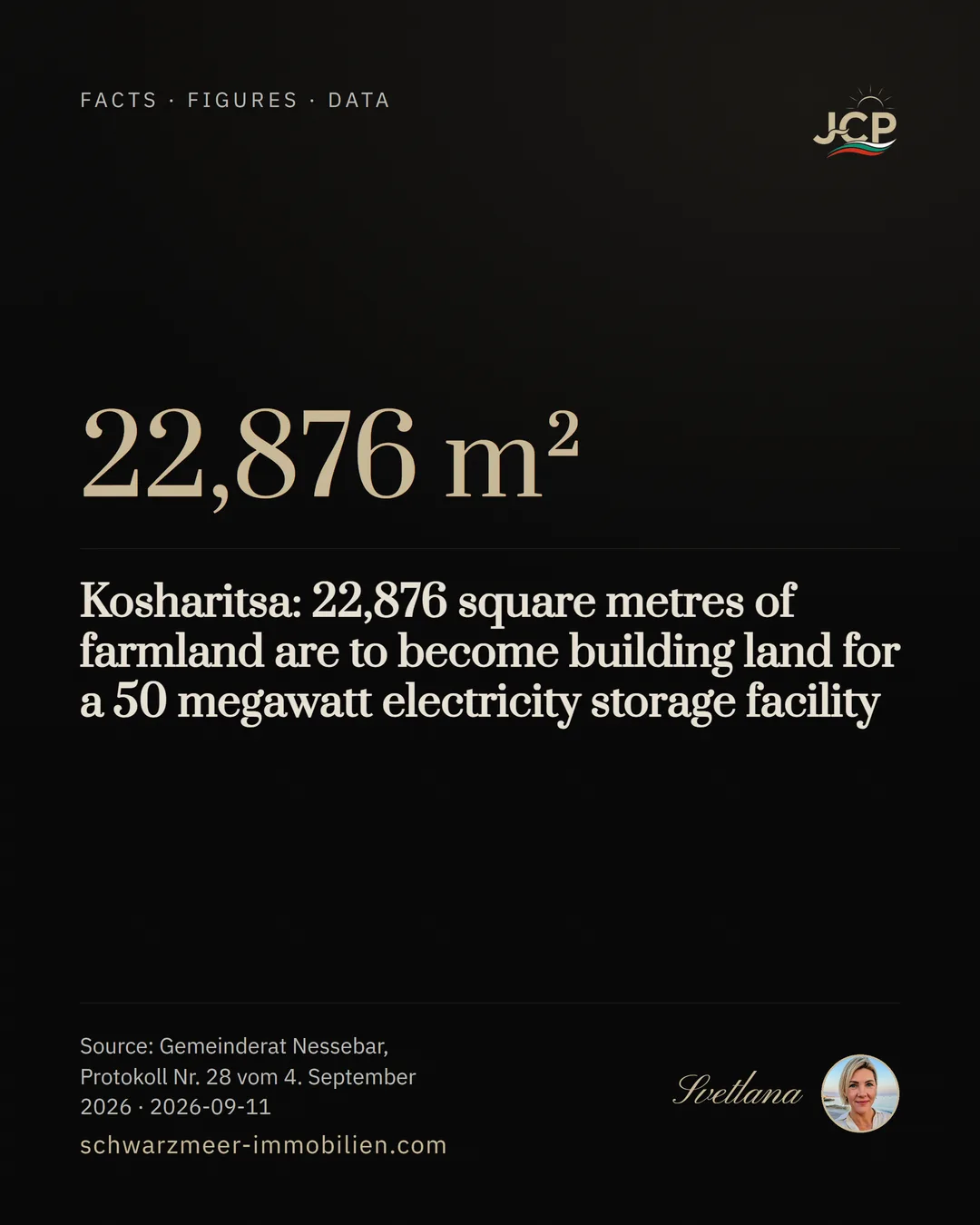
Kosharitsa: 22,876 square metres of farmland are to become building land for a 50 megawatt electricity storage facility
On 4 September 2026 Nesebar municipal council, by decision No. 789, permitted the drafting of a detailed development plan for plot 39164.13.63 in the Drakta locality near Kosharitsa. The 22,876 square metres move from agricultural use into urbanised territory, the purpose being a 50 megawatt electricity storage facility. The legal basis is Art. 21 (1) 11 of the Local Self-Government Act and Art. 124a (1) of the Spatial Development Act. At the same session, decision No. 783 approved the acquisition of a ten-year easement for reconstructing the water main from the Kosharitsa-Kuchkarnika pumping station to the Hanska Shatra reservoir: 4,047 euro for plot 51500.200.8, 2,061 euro for 51500.201.227 and 833 euro for 51500.201.164, 6,941 euro in total. Nineteen councillors attended.
Sunny Beach West: draft plan converts plot IX-493 from resort to residential use, available for inspection at Nesebar town hall
By notice No. N2-UT-6695 of 10 September 2026 Nesebar municipality announced a draft amendment to the development plan for plot UPI IX-493 in block 2601 of Sunny Beach West; its cadastral identifier is 51500.507.291. The zone changes from «Ok» for resort construction to «Zhs» for residential construction, with the designated use following suit. The parameters remain unchanged: height up to 15.00 metres over at most five storeys, density 30 per cent, floor area ratio 1.50, minimum green space 50 per cent. The documents are available for inspection at the municipality's spatial planning department, 10 Edelweiss Street, third floor, room 35.
Assessment: The draft is the preliminary stage of what the council has already decided for three neighbouring plots, and it shows that the conversion in Sunny Beach West is not an isolated case. For owners in block 2601 the inspection period is the moment when an objection still achieves something; after that only litigation remains. I see this as an opportunity rather than a risk for buyers, because residential use widens demand. Anyone affected should inspect the draft in person, since the notice states neither a deadline nor a procedure for objections.
Medovo: mineral water pipeline for a hotel complex approved, routes of 99.50 and 205.97 metres published in the State Gazette
On 8 September Pomorie municipality announced that two development plans for technical infrastructure had been published in State Gazette No. 80 of 1 September 2026. They rest on decisions No. 885 and No. 886 of Pomorie municipal council, minutes No. 53 of 23 July 2026. The first plan brings mineral water from borehole No. B-73 of the Medovo deposit to a hotel complex with outdoor pools, underground parking, a transformer station and its own treatment plant in the village of Medovo; the route crosses plots 47651.7.25 and 47651.7.127 over a combined 99.50 metres and encumbers 0.129 decares. The second plan secures the supply line over 205.97 metres on plot 47651.7.127 alone, encumbering 0.266 decares. Objections may be lodged within 30 days of publication, through the municipality, with the Burgas Administrative Court.
Labour productivity in the second quarter: 8,272.6 euro per person employed and 21.2 euro per hour worked
For the second quarter of 2026 the National Statistical Institute reports output of 8,272.6 euro per person employed and 21.2 euro per hour worked, a real increase of 3.1 per cent on the same quarter of the previous year. Employment stood at 3,661.8 thousand people and 1,428.3 million hours were worked. By sector, gross value added per person employed is 7,898.2 euro in industry, 7,298.4 euro in services and 1,305.8 euro in agriculture. The data are preliminary and were published on 7 September 2026.
CHECKLIST: The D visa is applied for only at your place of permanent residence – a third country only with reasons given and return guaranteed
The foreign ministry's briefing note on the long-stay visa states that the application is submitted solely at the diplomatic or consular mission at the applicant's permanent place of residence, or at the mission accredited for that state. Anyone legally staying in a third country may apply there by way of exception, must set out the reasons and must guarantee return to the state of permanent residence. No exception is made from the personal interview. Under Article 15(1) of the Foreigners Act the visa is valid for up to six months with a right to stay of up to 180 days. For the residence permit that follows, the same note requires accommodation, compulsory health insurance and own means for the entire stay, at least at the level of the statutory minimum monthly wage or the minimum pension.
Assessment: This rule regularly costs buyers a trip. Anyone still in the country after the notary appointment who wants to file on the spot is turned away, because jurisdiction follows the place of residence, not the location of the property. In practice: the purchase can be completed on site, the visa application belongs at home and needs an appointment booked in advance, since the personal interview is mandatory. For buyers with two residences I check beforehand which mission is accredited, because waiting time and the document list depend on it. For an assessment of the individual case Svetlana draws on her local network of notaries, tax advisers and lawyers.
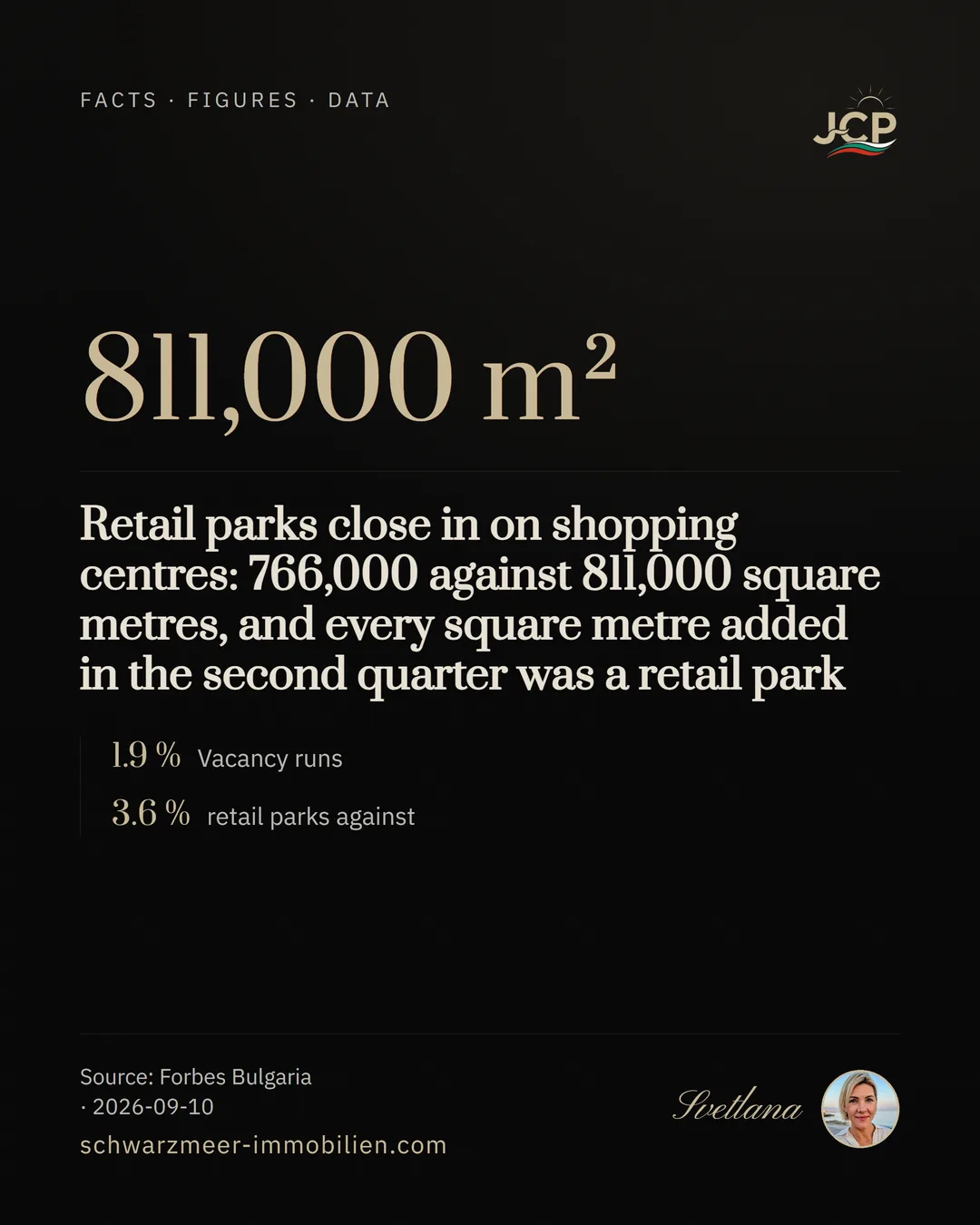
Retail parks close in on shopping centres: 766,000 against 811,000 square metres, and every square metre added in the second quarter was a retail park
At the end of June 2026 Bulgaria had roughly 766,000 square metres of retail park space against roughly 811,000 square metres of shopping centre space, 1.58 million square metres in total, a split of 49 to 51 per cent. All 16,700 square metres of retail space completed in the second quarter were retail parks, and eleven further schemes across eight cities are under construction, totalling 131,000 square metres. Vacancy runs at 1.9 per cent in retail parks against 3.6 per cent in the capital's shopping centres, where rents stand at 48.50 euros per square metre and month compared with 13 euros. The figures come from the quarterly report by Cushman and Wakefield Forton.
Assessment: For coastal owners the finding is less exotic than it sounds. Retail parks are built where year-round purchasing power exists, and they are the most reliable early signal of local shopping provision in a residential area. Anyone assessing a flat in Burgas or along the Pomorie to Sveti Vlas corridor should look at what is being built within two kilometres: a retail park in walking distance changes winter lettability noticeably. With rents of 13 against 48.50 euros per square metre, it is also clear which format keeps growing over the next few years.
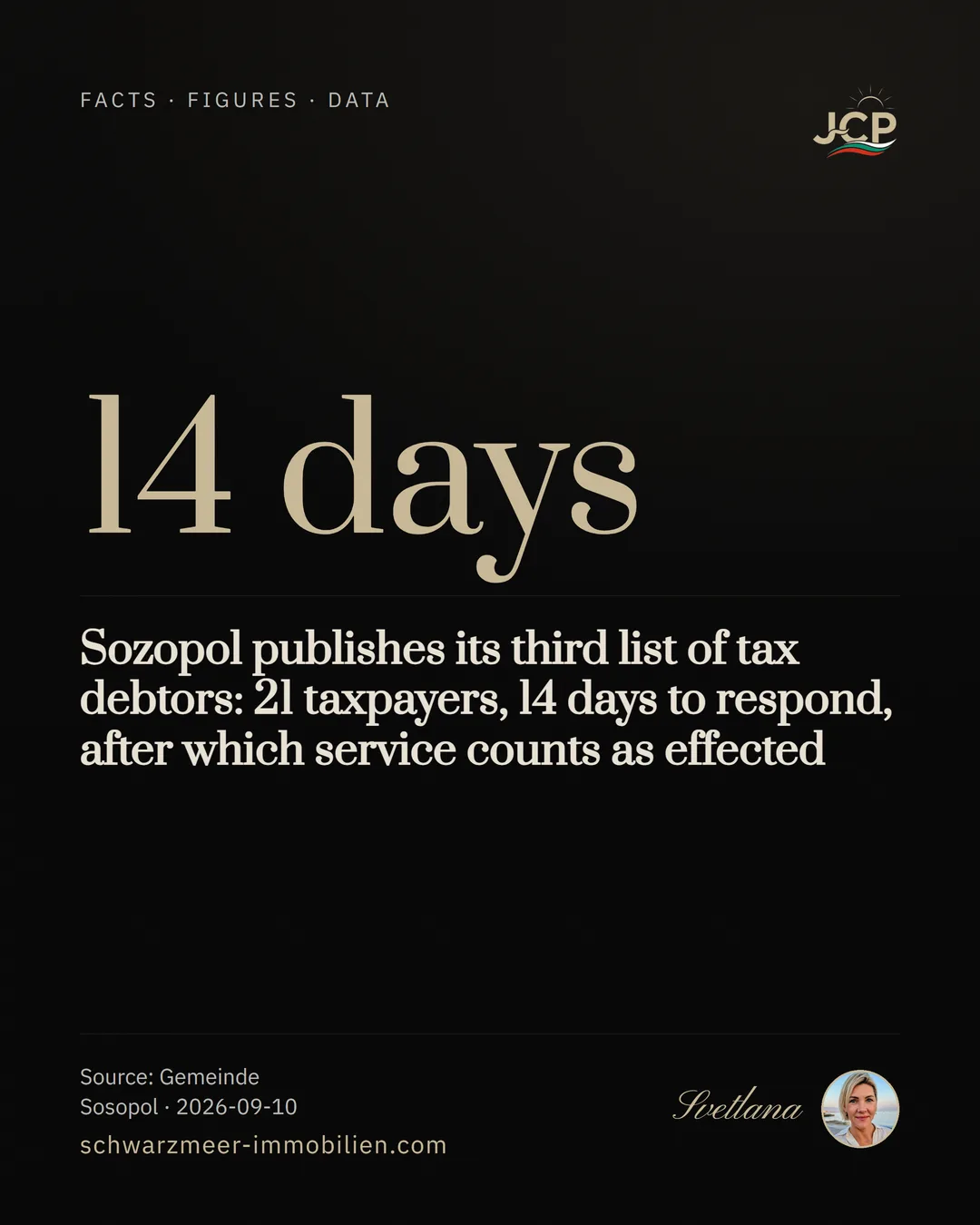
Sozopol publishes its third list of tax debtors: 21 taxpayers, 14 days to respond, after which service counts as effected
Sozopol municipality published list number 3 of debtors under the Local Taxes and Fees Act on 10 September. It names 21 individuals and companies whose outstanding amounts concern property tax and the waste collection fee. Those listed have 14 days from publication to report to the local taxes and fees department at Han Krum Square 2, between 08:30 and 17:15. If no one appears, the document is placed on file under Article 32(6) of the Tax and Social Insurance Procedure Code and counts as duly served. The list is posted from 10 to 24 September.
Assessment: This deemed-service rule is where foreign owners are regularly caught out. Anyone who does not live in Bulgaria and has given no address for service in the country often learns of a case only once interest and enforcement costs are already running. Two things help: register a permanent address for service with the municipality, and settle property tax and the waste fee in one spring payment rather than four instalments. For flats used only in summer I also check whether an exemption from the waste fee applies and whether the declaration was filed on time.
Second reading on consumer protection for distance financial services: a withdrawal function in the online interface becomes mandatory
The National Assembly is debating and voting at second reading on amendments to the Consumer Protection Act; the report was only partly read out in the chamber the day before. The amendments introduce a minimum level of protection for consumers using financial services: they govern pre-contractual information requirements, the right of withdrawal from financial services contracts concluded at a distance, and the cases in which that right does not apply. The draft also sets out what traders must disclose before a distance financial services contract is concluded and imposes specific requirements on the online interfaces of firms offering such services electronically. For every distance contract, including those for financial services, a dedicated function for exercising the right of withdrawal will have to be provided. The same agenda includes ratification of the Convention on Mutual Administrative Assistance in Tax Matters as amended by the protocol in force since 1 June 2011.
Assessment: For buyers who open an account, take out insurance or sign a loan online from abroad, this is the rule that matters: a withdrawal button you can actually find beats a complaint nobody reads. The ratification of the assistance convention in turn concerns anyone holding accounts in two countries, because it widens the exchange of data between tax administrations. Read together, the two lead to the same conclusion I draw: check contracts calmly, note the deadlines and keep the tax return clean in both countries.
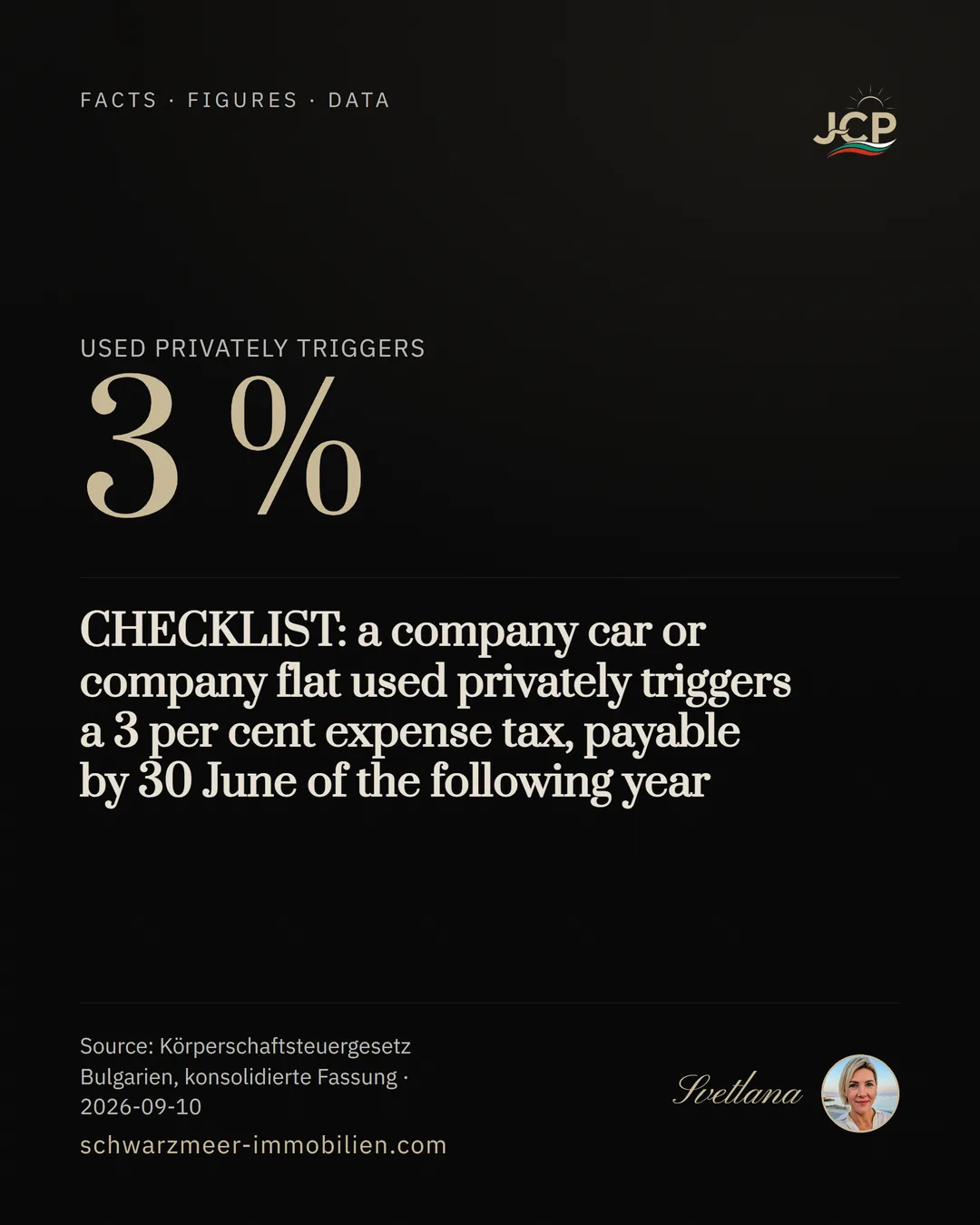
CHECKLIST: a company car or company flat used privately triggers a 3 per cent expense tax, payable by 30 June of the following year
Anyone holding property through a Bulgarian company should know Article 204 (1) point 4 of the Corporate Income Tax Act: it taxes in-kind expenses on owned, rented or otherwise available assets that are made available for private use by a managing director, an employee or a person providing personal labour. The rate under Article 216 (2) is three per cent, while corporate income tax under Article 20 is ten per cent. Under Article 206 (2) this expense tax is final; the expense and the tax are recognised in the year they are booked and create no timing difference. It is declared under Article 217 (1) with the annual corporate tax return and paid under Article 217 (2) by 30 June of the following year. The practical order is: fix the share of private use in writing before the first invoice, have electricity, water and internet invoiced to the company name with its identification number, document the mileage log or the floor area split, and set aside the reserve for 30 June month by month.
Commission tables Affordable Housing Act: a common framework for housing measures, with tourist destinations named explicitly
On 9 September the European Commission tabled its Affordable Housing Act. It has two parts: a regulation creating a common framework for assessing and justifying housing-related measures, with requirements on proportionality, transparency and review, and a recommendation supporting an expansion of supply. It targets areas where demand significantly exceeds supply, and the Commission counts islands and tourist destinations among them alongside cities and metropolitan areas. The draft now enters the ordinary legislative procedure.
Four conditions before a municipality may restrict short-term rentals, including three years of documented effect
The EU act tabled on 9 September allows restrictions on short-term rentals under four conditions only. The activity must demonstrably reduce the long-term housing stock, the adverse effect on affordability and availability must have persisted for at least three years, less restrictive alternatives must have proved ineffective, and the requirements of the EU Short-Term Rental Regulation must be applied. Authorities identify areas under housing stress using a standardised methodology and show that any restriction is targeted, necessary and proportionate. Eurobarometer data cited in the proposal puts the share of city dwellers who see housing as an immediate and urgent problem at more than 50 per cent.
Reporting duty for crypto-asset service providers: user data due to the revenue agency each year by 30 June
Amendments to the Tax and Social Insurance Procedure Code were adopted at second reading on 9 September, transposing Directive (EU) 2023/2226. Providers of crypto-asset services must register and report electronically once a year who trades with them: name, address, date and place of birth, state of tax residence, tax number, and the values and unit numbers of transactions, split into purchases, sales, exchanges, payments for goods and services, and transfers. The deadline is 30 June of the following year, and the exchange with the tax administrations of member states and partner jurisdictions takes place within nine months of the year end. Anyone who fails to supply the required details after two requests and a 60-day period has their transactions restricted by the provider.
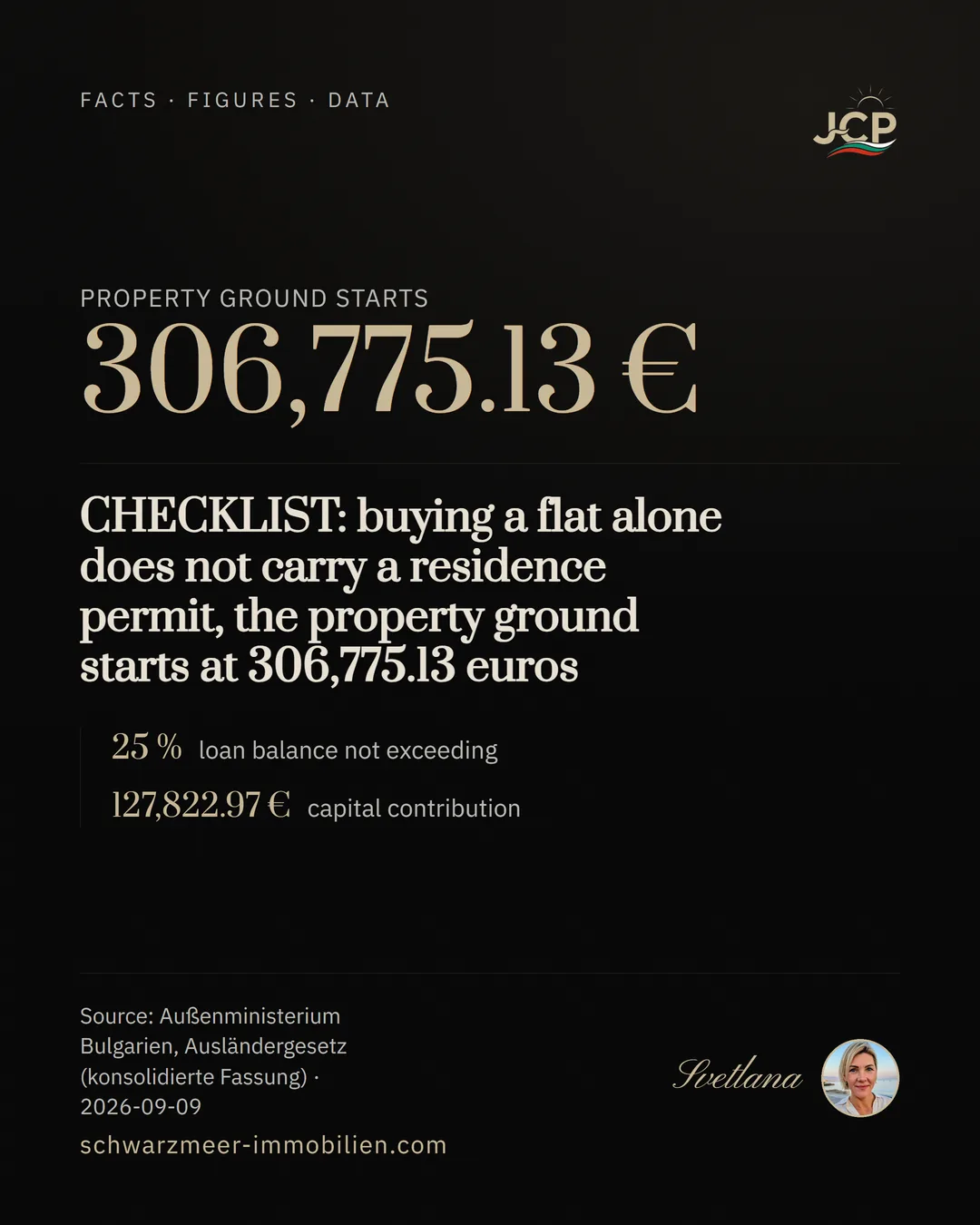
CHECKLIST: buying a flat alone does not carry a residence permit, the property ground starts at 306,775.13 euros
Article 24 (1) of the Aliens Act sets out an exhaustive list of the grounds on which long-term residence is granted, and in every case a visa under Article 15 (1), applied for at the consulate in the country of residence, comes first. Property ownership qualifies only under point 19, and only from an investment of no less than 306,775.13 euros per person, with the sum paid in full by the date of application, credited to an account at a bank licensed in Bulgaria, and any outstanding loan balance not exceeding 25 per cent. The route through one's own company under point 2 requires at least ten full-time jobs for Bulgarian citizens, maintained for the duration of residence, and that requirement applies to each shareholder and each managing director separately. Point 20 lowers the threshold to a capital contribution of 127,822.97 euros together with new fixed assets of the same value and five jobs, but applies only in economically disadvantaged regions; whatever the ground, paragraph 2 additionally requires secured housing, compulsory health insurance and sufficient own means without recourse to the social system.
CHECKLIST: in a gated holiday complex the management contract binds the buyer too, check the register page before the notary appointment
In gated residential complexes, Article 2 of the Condominium Management Act provides that management of the common parts is governed by a written contract with notarised signatures between the developer and the owners. The developer registers that contract with the Registry Agency on the file of each individual unit, and it is expressly enforceable against later acquirers; an electronic search of that file costs 0.51 euros and requires an account on the agency portal, or the notary obtains it. For obligations towards the owners' association that fell due before the transfer of ownership, Article 30 (1) makes the former owner liable unless something else is agreed at the transfer, which is why this clause belongs in the purchase contract and not in a side conversation. Anyone staying no more than 30 days in the calendar year pays, under Article 51 (1), only the amount set for one person towards management and maintenance costs, but a diverging contract under Article 2 can override that relief, so it is read word for word before any deposit.
Assessment: The annual fee in a coastal complex is not a minor item; it changes the return over the whole holding period and passes to the buyer, because the contract attaches to the unit rather than to the person. Two perspectives help: an owner-occupier who comes for a few weeks benefits from the statutory 30-day rule and loses it if the developer's contract uses floor area as the yardstick, while a landlord should build the fee into the price per square metre before comparing two offers at all. My advice is to obtain the register page before the preliminary contract, not after, because once it is signed the clause on old debts is no longer negotiable.
CHECKLIST: apply for the EORI number before the first import from a third country, free of charge and within three working days
Anyone importing furniture, fittings or trade goods from a country outside the Union through their own Bulgarian company needs an EORI number first. It is issued by the Customs Agency, costs nothing and, according to the official service entry, is available within three working days of application; submission runs through the agency's electronic portal, the secure electronic delivery system, e-mail to the competent customs office, or on paper at any customs office, for the southern coast at the Burgas territorial directorate. The legal basis is Article 9 of Regulation (EU) 952/2013 together with Bulgarian Ordinance H-9 of 2018, and operators established outside the Union may use a number issued in another member state. In practice: EORI and VAT registration come before the order, not after it, and the forwarding instruction states the company number, the VAT number and the EORI in writing, so that the customs declaration names the company as importer rather than the forwarder.
CHECKLIST: look up official fees in the service register before paying, the figures differ when exchanging a driving licence
The national register of administrative services gives the fee for exchanging a foreign driving licence as 14.00 euros for applicants under 58, 5.62 euros from 58 to 70, 1.53 euros for a degree of disability of 50 per cent or more, and no fee from 70; processing takes up to 30 days, or up to ten under the expedited procedure. The tariff version available on the traffic police site still lists the same items in the currency that applied before 2026, and converting it produces a different figure from the official entry, so anyone who brings the register entry in print does not argue at the counter but simply presents it. The same register clears up a common misunderstanding: a psychological fitness certificate is required only for categories C1, C, D1, D and T, whereas the general practitioner's medical card is required generally. Three steps before any administrative act: open the entry in the service register, note the amount and the currency, and ask at the till for a receipt showing the sum.
Burgas: Regional Business Conference on 17 September 2026 from 15:00 with three investment strands
On 17 September 2026 from 15:00, Burgas Free University acts as host and strategic partner of the Lider.BG Regional Business Conference, held under the patronage of Dimitar Nikolov, mayor of Burgas Municipality. The programme is structured around three discussion strands: investment and growth, the digital future of business, and economic security and resilience. Partners include the Bulgarian Investment Agency (BIA), the Burgas Chamber of Commerce and Industry and the Burgas Industrial and Logistics Park; attendance is free after mandatory registration and places are limited.
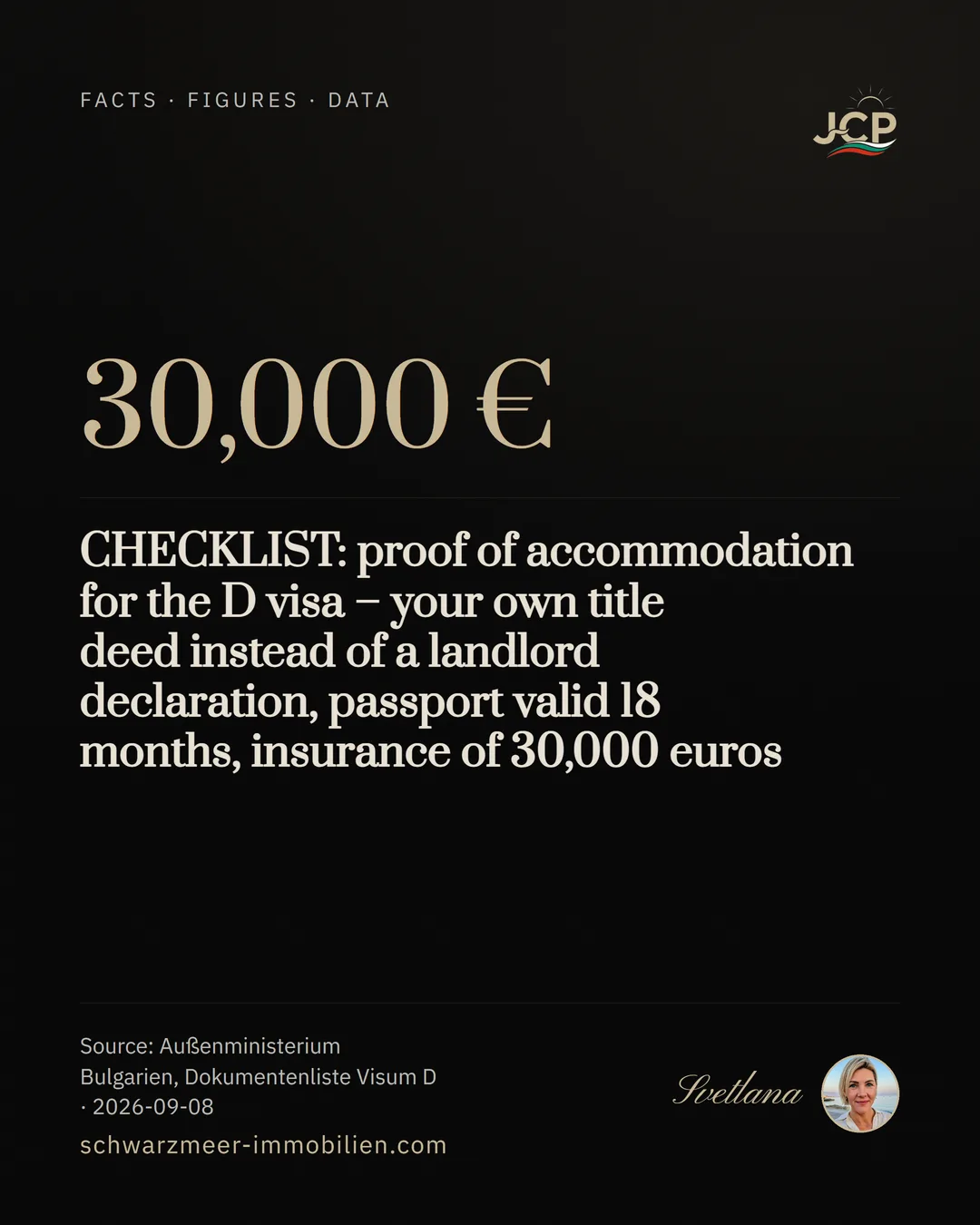
CHECKLIST: proof of accommodation for the D visa – your own title deed instead of a landlord declaration, passport valid 18 months, insurance of 30,000 euros
The Foreign Ministry lists two options as proof of accommodation for the long-stay D visa: a notarised rental contract or a notarial title deed. With a rental contract the document list also asks for a notarised declaration by the owner that he provides the registration address. That declaration depends on the landlord being willing and reachable, and it is needed again at every renewal; with your own deed it falls away entirely. The same list requires a passport with at least 18 months of remaining validity, medical insurance of at least 30,000 euros and, for a first application, a certificate of good conduct. Checklist: anyone buying on the southern coast anyway should place the notary appointment before the visa application, have the deed entered in the property register, check that the address of the property and the address in the application match character for character, and file two certified copies for later renewals.
Commercial register has converted all company capital into euros ex officio, the 30 September annual accounts deadline stands unchanged
The Registry Agency has converted the capital shown in the commercial register for all limited liability companies, joint stock companies and cooperatives into euro, ex officio and free of charge. Owners need file nothing and pay nothing for it. The founding documents themselves, that is the articles and the partnership agreement, are only adapted with the next filing that is due anyway. Publication of the annual accounts is expressly unaffected: it must be filed by 30 September, regardless of whether the capital conversion paperwork has been brought up to date.
Commercial register reports longer processing times and advises filing shareholder resolutions earlier
The Registry Agency reports that processing in the commercial register and in the register of non-profit legal entities is currently taking longer than usual. The reason is the increased volume of filings arising from the duties of merchants under the Law on the Introduction of the Euro in the Republic of Bulgaria. The agency advises all merchants and non-profit legal entities planning a general meeting to submit their filings as early as possible. The notice gives no figure for the actual duration.
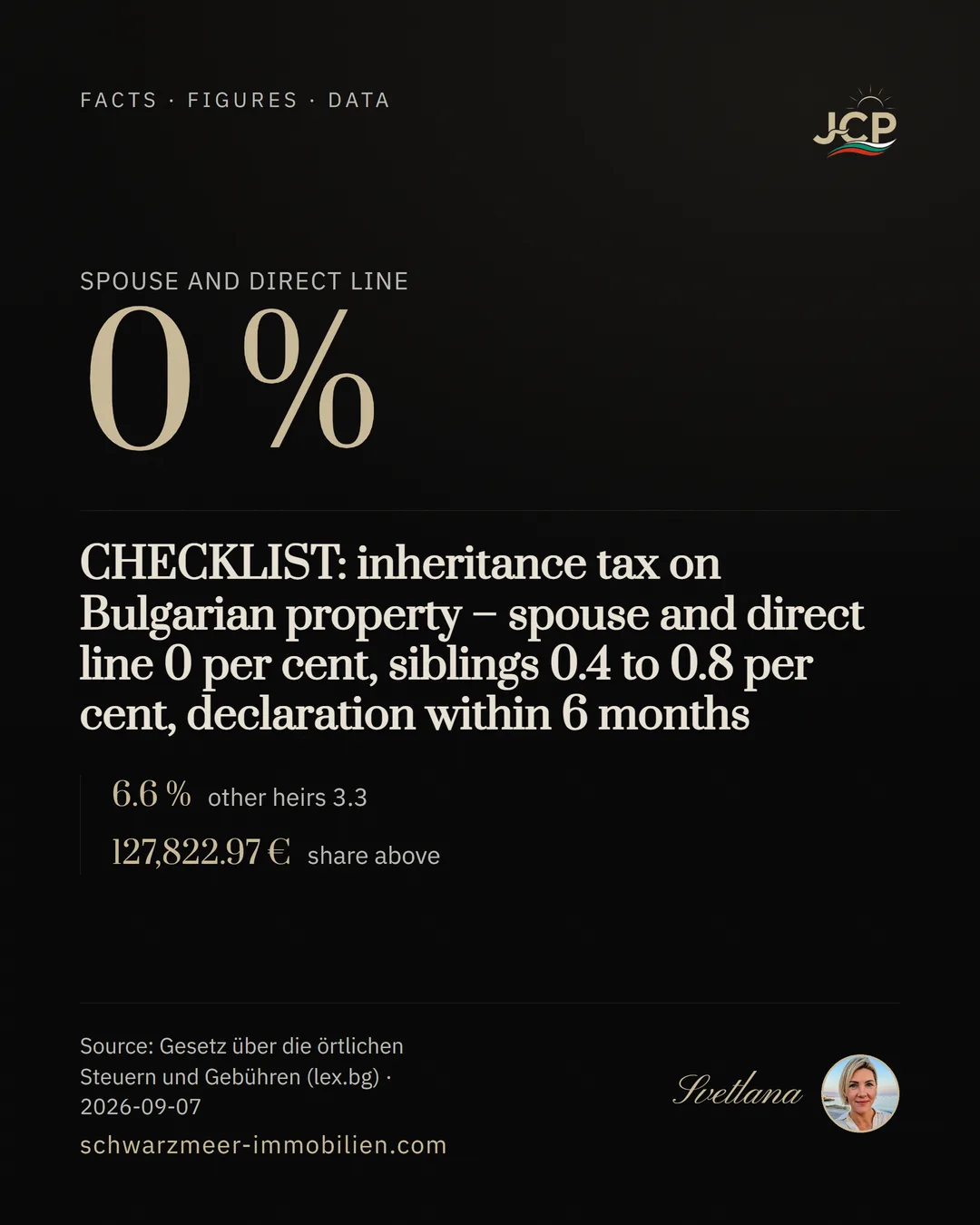
CHECKLIST: inheritance tax on Bulgarian property – spouse and direct line 0 per cent, siblings 0.4 to 0.8 per cent, declaration within 6 months
The Local Taxes and Fees Act exempts the surviving spouse and the heirs in the direct line from inheritance tax without limit (Art. 31 para 2). Siblings and their children pay 0.4 to 0.8 per cent, all other heirs 3.3 to 6.6 per cent, and only on the part of the share above 127,822.97 euros; the council sets the exact rate within that band (Art. 36). The declaration goes within six months to the municipality of the deceased person's last residence, or, where that residence was abroad, to the municipality holding the larger part of the estate (Art. 32). Since 1 January 2026 the estate is valued in euros, property according to the tax valuation under Annex 2, and funeral costs of 511.29 euros are deductible (Art. 33, Art. 34). Balances on accounts of a deceased person and payments under a life policy are released by the bank only against a municipal certificate; where the tax is unpaid, the bank withholds it and transfers it to the municipality within one month (Art. 41). The thresholds still appear in the statute in the former currency and are converted here at the official rate 1 EUR = 1,95583 BGN.
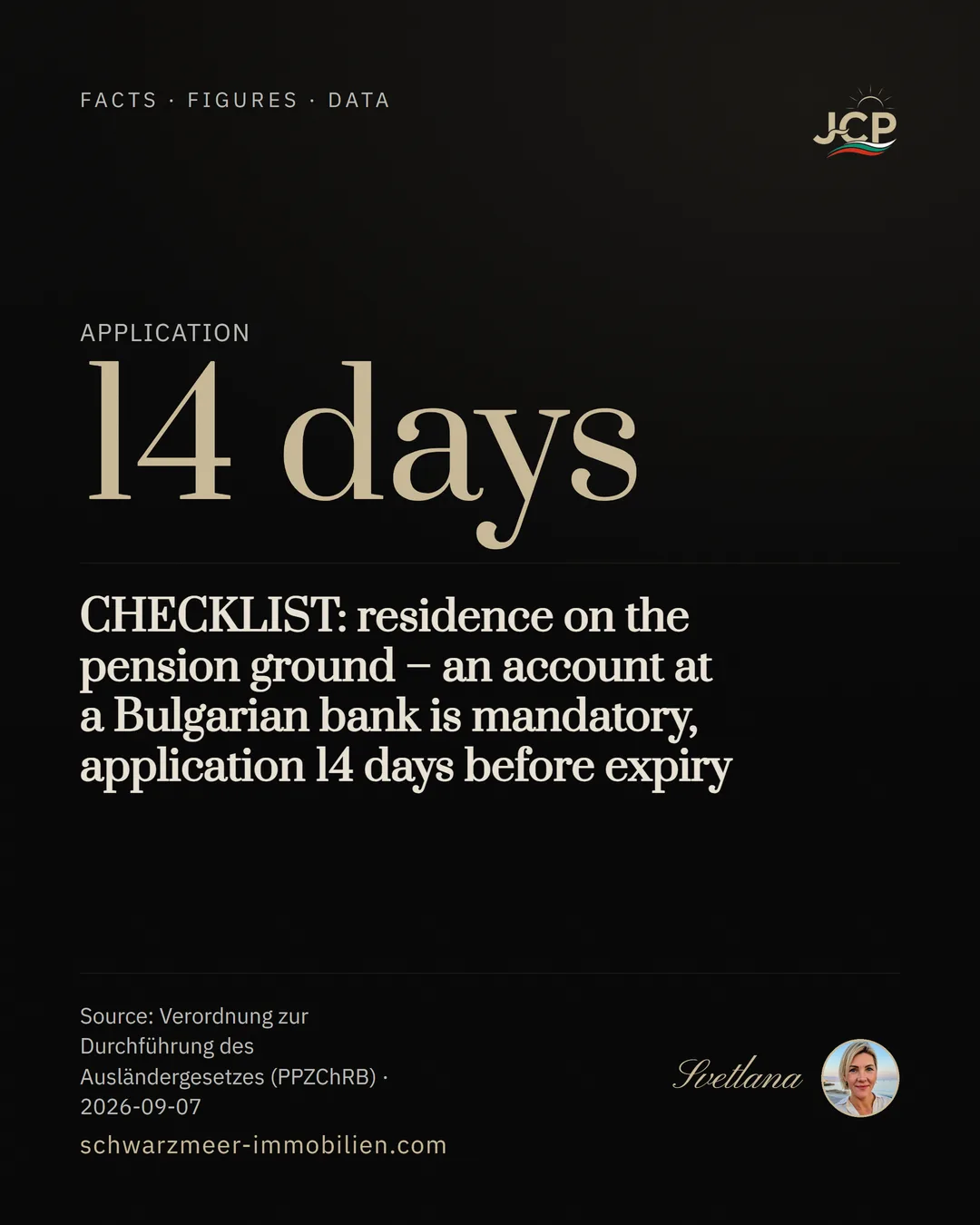
CHECKLIST: residence on the pension ground – an account at a Bulgarian bank is mandatory, application 14 days before expiry
The regulation implementing the Aliens Act requires two documents on top of the general list for residence on the pension ground: proof from the competent authority of the home state that a pension has been granted, and a document from a bank on Bulgarian territory confirming an existing account into which the pension transfers will be paid (Art. 23). The general list in Art. 14 para 1 covers the application lodged in person at the Migration Directorate or the regional interior directorate, the passport copy showing the visa and the last entry stamp together with the original for comparison, the receipt for the state fee under Art. 10 para 3 of Tariff No. 4, proof of secured accommodation, compulsory health insurance valid in Bulgaria for anyone not covered under the Health Insurance Act, proof of stable and regular means at least equal to the monthly minimum wage or the minimum pension, and a police clearance certificate on first application. The application must be lodged no later than 14 days before the permitted stay expires and is decided within 14 days (Art. 14 para 2). For the accommodation proof the regulation prescribes no particular type of document; ownership and tenancy both qualify.
Visa D: stays of up to 360 days for staff posted for a certified investment, interview without exception
The foreign ministry leaflet on visa D sets out two variants. The standard one is valid for up to six months and allows a stay of up to 180 days (Art. 15 para 1 of the Aliens Act). Validity of up to one year with a right of stay of up to 360 days may be granted to researchers, students on programmes of up to one academic year, specialising trainees and interns, and to people posted by a foreign employer to control and coordinate a contract for tourism services or to carry out investments certified under the Investment Promotion Act (Art. 15 para 2). The application must be lodged solely at the diplomatic or consular mission covering the applicant's permanent residence; in a third country only by way of exception, with reasons given and a guaranteed return. The interview with the applicant is mandatory, no exceptions are allowed, and the visa D lapses once a residence permit is issued.
CHECKLIST: check the building manager in the official register under Art. 47b of the Condominium Management Act before buying
The regional development ministry keeps a public register of professional managers of condominium property under Art. 47b of the Condominium Management Act. Each entry shows the running number, the company identification code EIK, the company name and legal form, the registered and correspondence address, the management, the owners of the capital, and the number and validity period of the certificate. Certificates are issued for five years; one entry in the register runs from 2 April 2026 to 2 April 2031. Three steps before the preliminary contract: note the name of the management company from the property particulars, match it in the register against the EIK and the certificate number, and check that the certificate runs beyond the planned completion date. If the company is not listed there, that proves no irregularity, but it is reason enough to read the wording of the complex's management contract before paying a deposit.
Assessment: In gated holiday complexes on the coast the management decides on costs and on the condition of the property, often for decades. The register check takes a few minutes and shows whether a vetted company with a valid certificate stands behind the management or a developer construction without authorisation. I see this above all as a price factor: a complex with cleanly run management resells more easily later than one with disputed fees.
CHECKLIST: putting a new building of the fourth and fifth category into operation – service 2062 of Burgas municipality, 30 days processing
For buildings of the fourth and fifth category the certificate of putting into operation is issued not by the national construction supervision but by the municipality. In Burgas this runs as service 2062 on the basis of Art. 177 para 3 of the Spatial Planning Act and Regulation No. 2 of 31 July 2003 on putting buildings into operation and on minimum warranty periods. The processing period is 30 days; the application with annexes, the title document and the final report of the construction supervisor have to be filed, and the certificate issued has no expiry. Payment is in cash at the counter, by card at the terminal, electronically or by bank transfer using payment code 448001. Filing is possible in person, by email or by post.
Bulgaria close to leaving the FATF grey list: action plan substantially completed, decision due in Paris in October 2026
Bulgaria has been on the list of jurisdictions with strategic deficiencies in anti-money-laundering supervision kept by the Financial Action Task Force since October 2023. In June 2026 the task force recorded that the agreed action plan had been substantially completed; what remains is a final on-site assessment intended to show that the reforms hold. According to the Ministry of Justice the decision on removal falls in Paris in October 2026. The ministry states that the listing has significantly hindered foreign investment in Bulgaria.
Cutting red tape for business: 16 departments and 26 agencies table 102 proposals on digitising procedures and 101 on collecting data once
Sixteen departments and 26 agencies have submitted proposals for reducing the administrative burden on business: 102 concern the digitisation of procedures, 101 the principle of collecting data once and sharing it between authorities thereafter. The measures named include shorter processing deadlines, fewer documents to be filed, more electronic services, one-stop handling and the application of tacit consent, so that a missed deadline does not work against the applicant. The proposals are to be consolidated over the coming weeks and put to the National Assembly as legislative amendments. No firm dates for entry into force have been given so far.
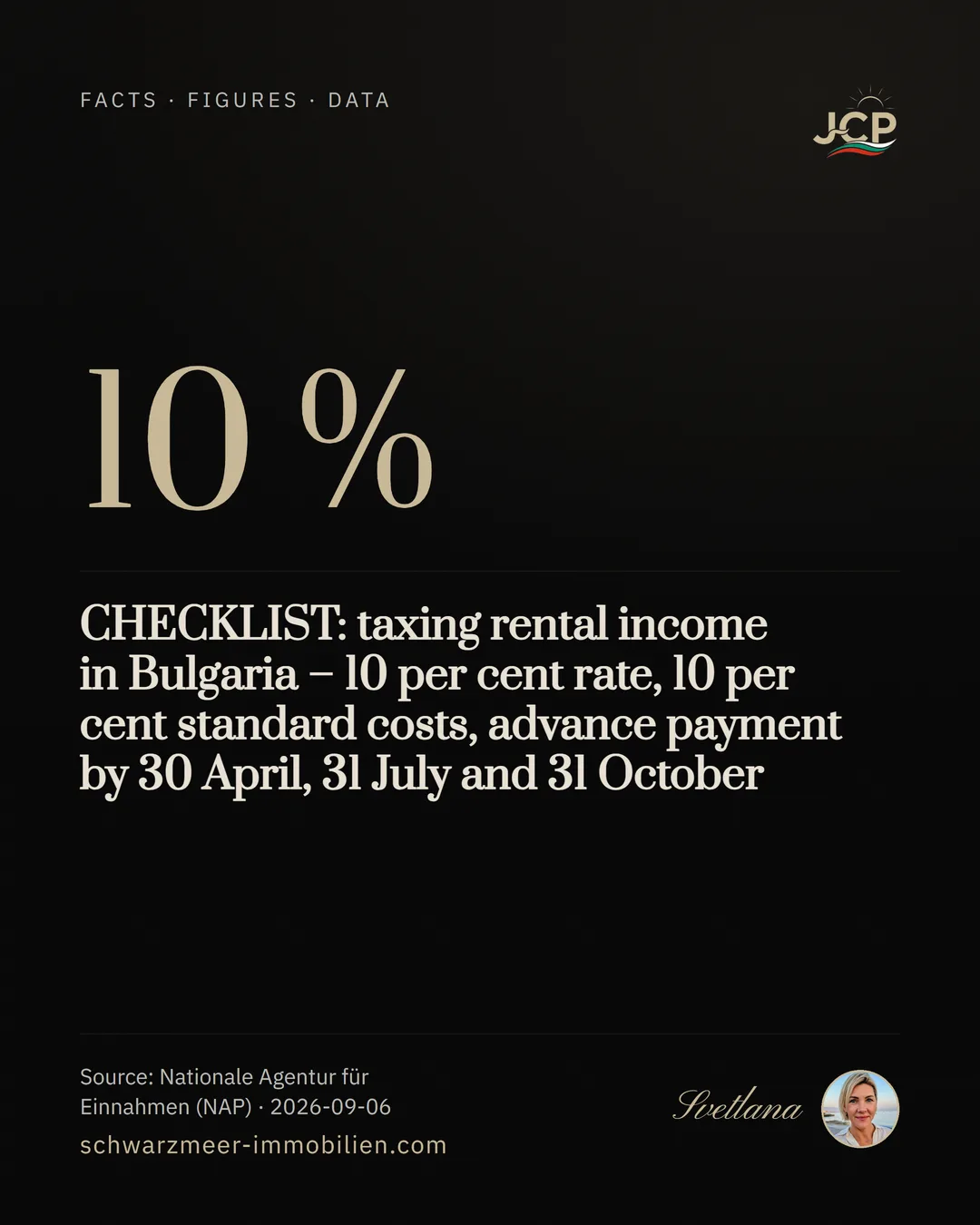
CHECKLIST: taxing rental income in Bulgaria – 10 per cent rate, 10 per cent standard costs, advance payment by 30 April, 31 July and 31 October
The National Revenue Agency sets the tax on income from letting at 10 per cent of taxable income. Before the calculation, 10 per cent of statutory recognised costs may be deducted; for properties in condominium ownership with joint management this deduction does not apply. If the tenant is a company or a self-insured person, the tenant withholds and remits the tax; if a private individual rents, the landlord pays it. Checklist: establish which of the two groups your own tenant falls into; submit the advance payment and declaration for quarters one to three by 30 April, 31 July and 31 October; file the annual return under Article 50 of the Personal Income Tax Act with annex no. 4 between 10 January and 30 April of the following year; request and keep the tenant's records of amounts withheld.
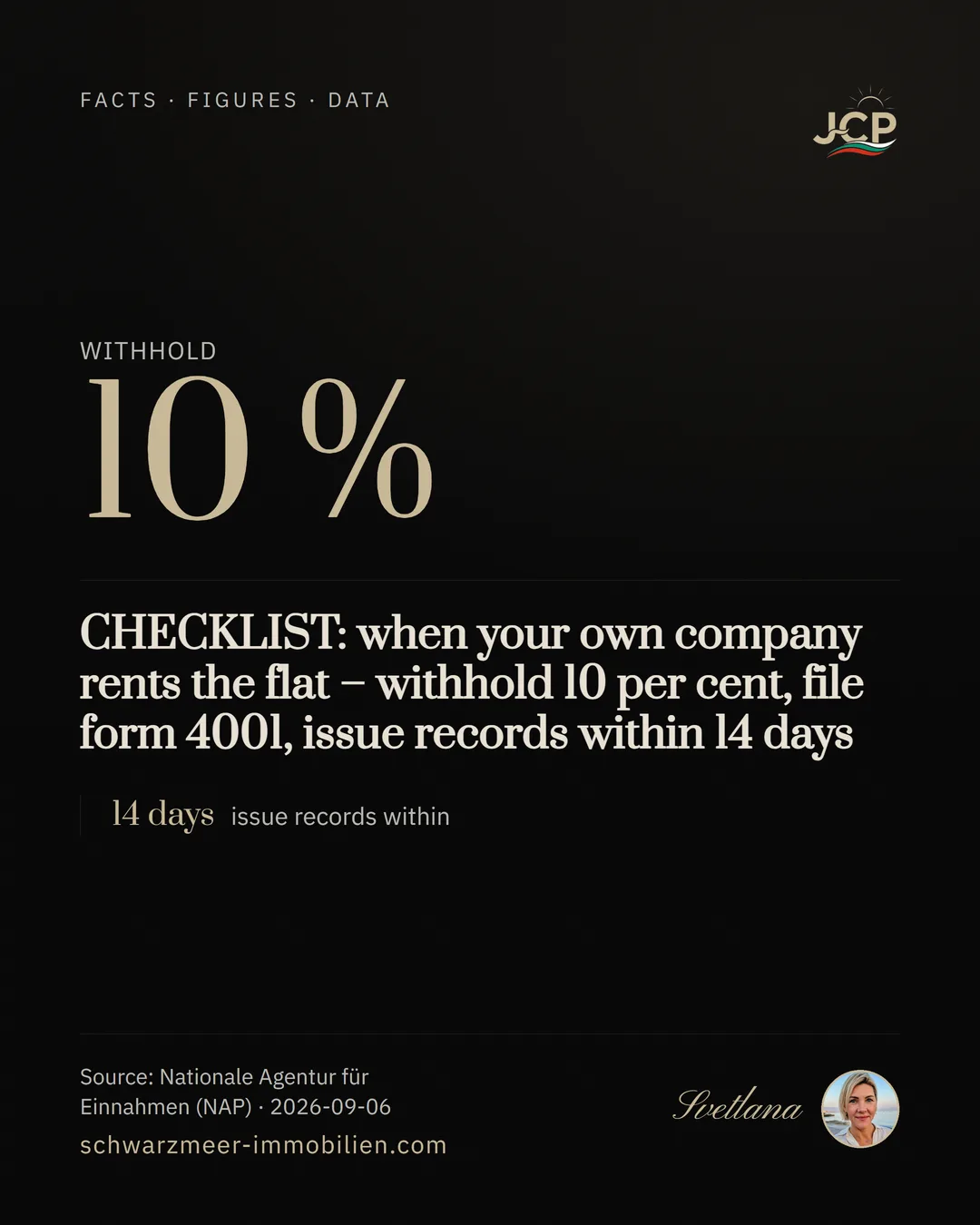
CHECKLIST: when your own company rents the flat – withhold 10 per cent, file form 4001, issue records within 14 days
Where a company or a self-insured person pays rent to a private individual, the duty falls on the payer, not on the recipient. The National Revenue Agency sets the rate at 10 per cent of taxable income and requires the declaration on form 4001, which rests on Article 55 paragraph 1 of the Personal Income Tax Act and Article 201 paragraph 1 of the Corporate Income Tax Act. Payment and declaration fall due by the end of the month following the quarter. Checklist: before the first transfer, establish whether your own company is the payer; set up the withholding in the accounts; file form 4001 quarterly; issue the record of amounts paid out within 14 days of a request.
Assessment: This constellation is more common than one might think: anyone who invests through a Bulgarian company and uses a room of their own flat for business becomes the payer and with it the party bound by the procedure. The mistake I see again and again is that an invoice is demanded which a private individual cannot issue at all. Plan the withholding and the form from the outset and the effort stays small, while the back payment that otherwise shows up at the first inspection is avoided.