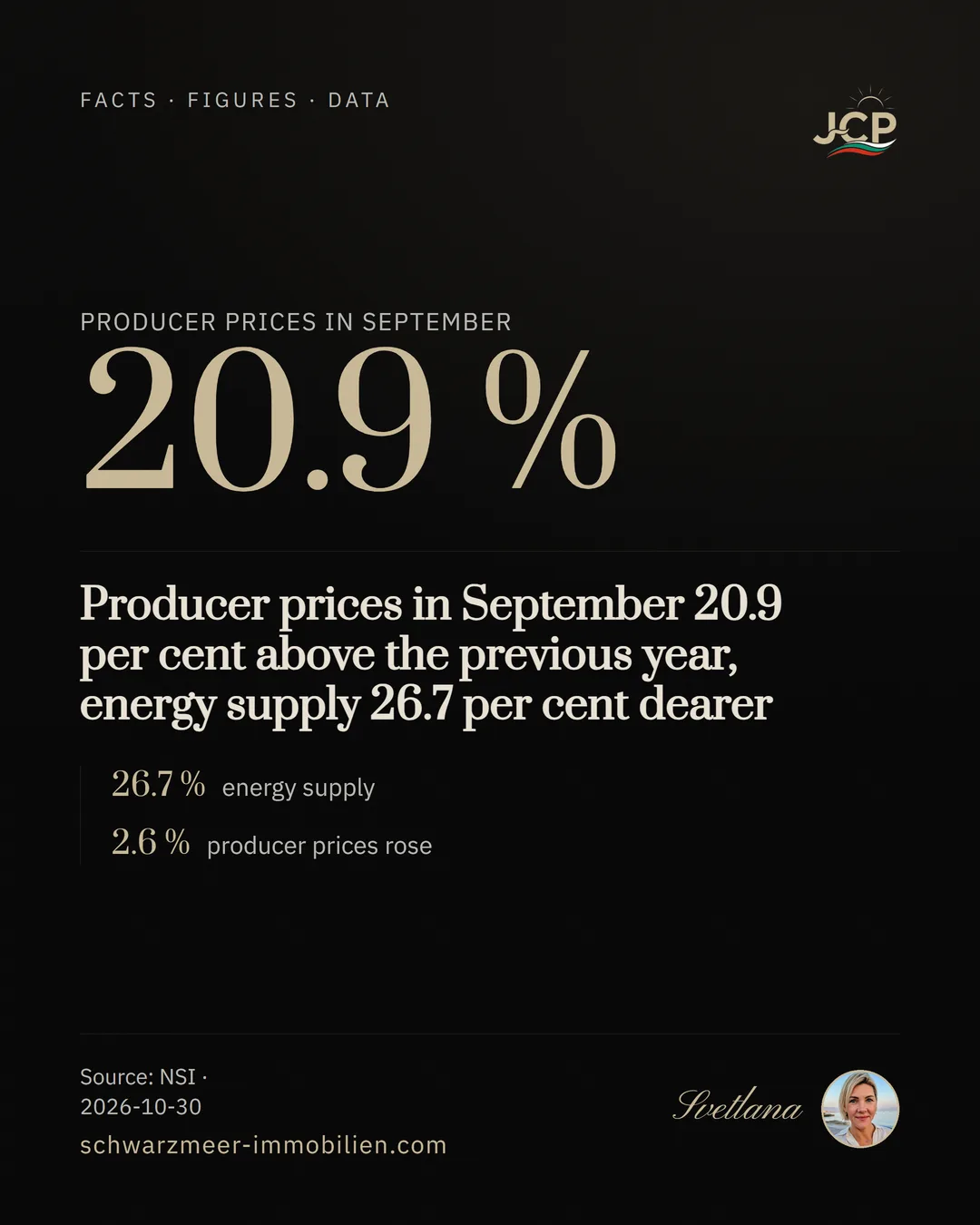
Producer prices in September 20.9 per cent above the previous year, energy supply 26.7 per cent dearer
On 30 October 2026 the NSI reports that industrial producer prices rose by 2.6 per cent in September compared with August and by 20.9 per cent compared with September 2025. The domestic market shows 4.6 and 22.9 per cent, the non-domestic market minus 0.6 and plus 17.6 per cent. Electricity, gas and steam supply became 8.8 per cent dearer on the month and 26.7 per cent on the year, manufacturing 0.5 and 10.6 per cent. Basic metals stand 28.8 per cent and chemical products 11.2 per cent above the previous year.
Assessment: The annual rate rises from 17.4 per cent in August to 20.9 per cent in September and is driven by energy supply rather than manufacturing. Anyone buying a new build with payment by construction progress should ask for a fixed price clause in the preliminary contract, because metals and chemicals are items that developers pass on. The index measures industrial prices, not construction prices; the source does not show a pass-through to individual properties.
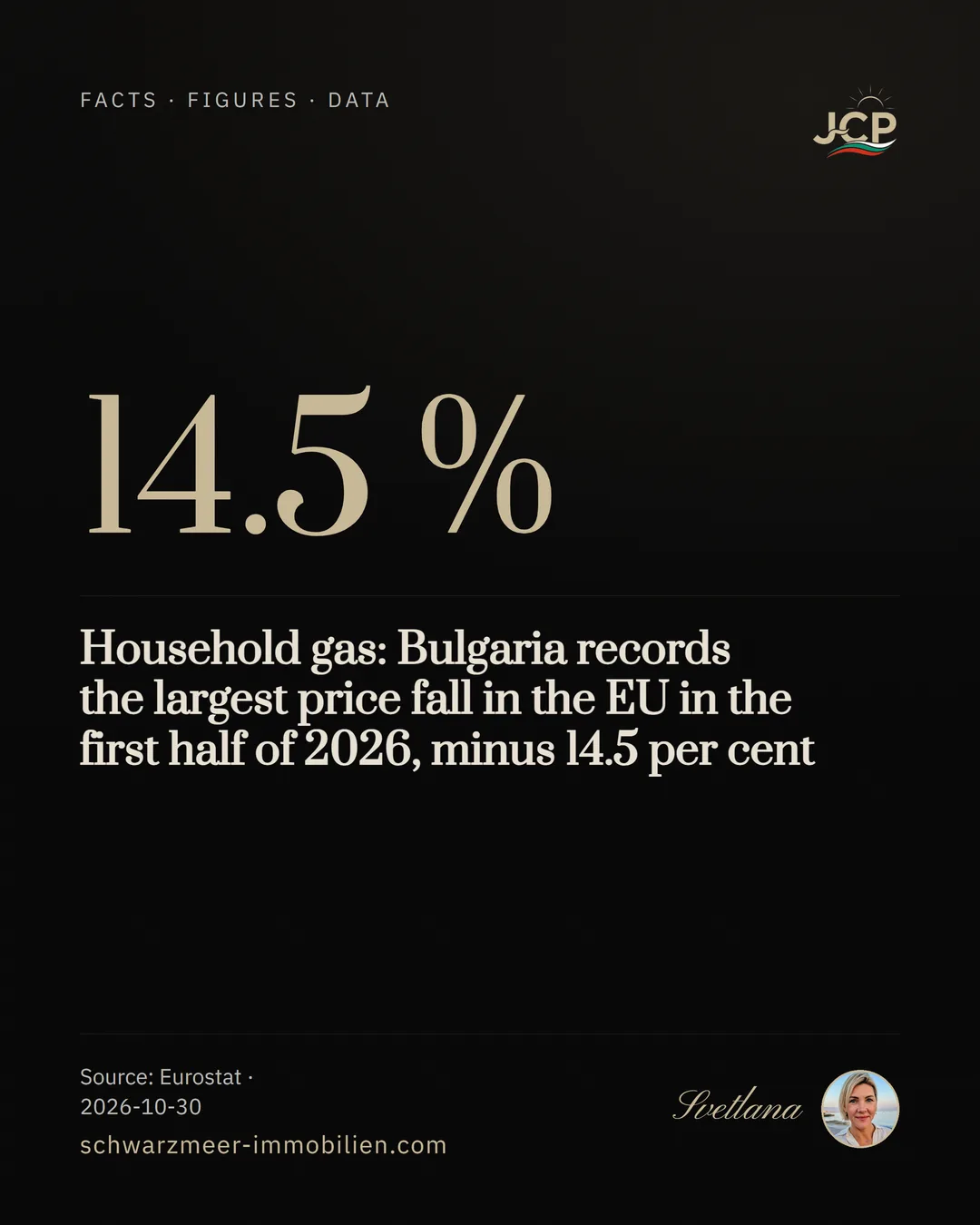
Household gas: Bulgaria records the largest price fall in the EU in the first half of 2026, minus 14.5 per cent
Eurostat puts the average household natural gas price in the EU for the first half of 2026 at 0.1103 euro per kilowatt-hour. In Bulgaria the price falls by 14.5 per cent compared with the first half of 2025, both periods measured in euro; this is the largest decline among the member states. The statistics cover household tariffs for one half-year, and the next update is planned for April 2027.
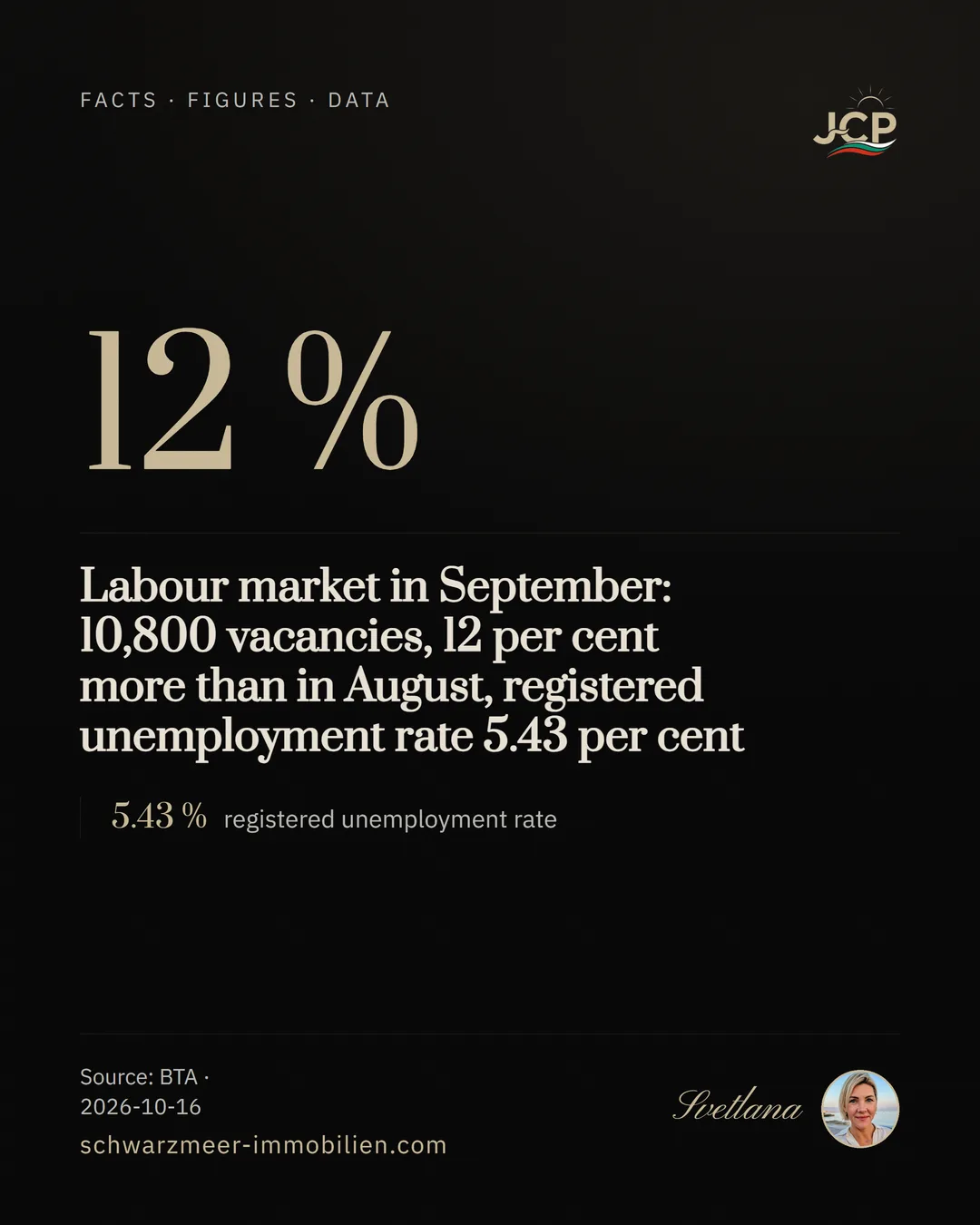
Labour market in September: 10,800 vacancies, 12 per cent more than in August, registered unemployment rate 5.43 per cent
The Employment Agency reports for September 2026 that 13,836 unemployed people started a job through the labour offices, nearly 14,000 including further placements. 10,800 vacancies were registered on the primary labour market, 1,141 or 12 per cent more than in August. At the end of September 154,096 unemployed people were registered, and the registered unemployment rate stood at 5.43 per cent. 505 members of disadvantaged groups started subsidised employment.
Assessment: Anyone having a building project done on the coast, running a hotel or looking for staff for letting and property management is planning with a vacancy supply that grew by 1,141 positions month on month. The registered rate of 5.43 per cent counts only unemployed people registered with the labour offices and cannot be compared with the Eurostat rate of 3.6 per cent for July, which is collected by a different method. The source gives no figures for the Burgas region.
New businesses: registrations fell by 31.0 per cent in the third quarter, bankruptcies by 22.1 per cent
The National Statistical Institute (NSI) counts 7,968 newly registered legal units nationwide in the third quarter of 2026, 31.0 per cent fewer than in the same quarter of 2025. 791 units were declared bankrupt, 22.1 per cent fewer than a year earlier. Trade and motor-vehicle repair account for 6,727 of the new registrations (84.4 per cent) and 712 of the bankruptcies (90.0 per cent). Construction shows 225 new registrations against 12 bankruptcies; financial, real-estate, professional and administrative activities together record 392 new registrations and 23 bankruptcies.
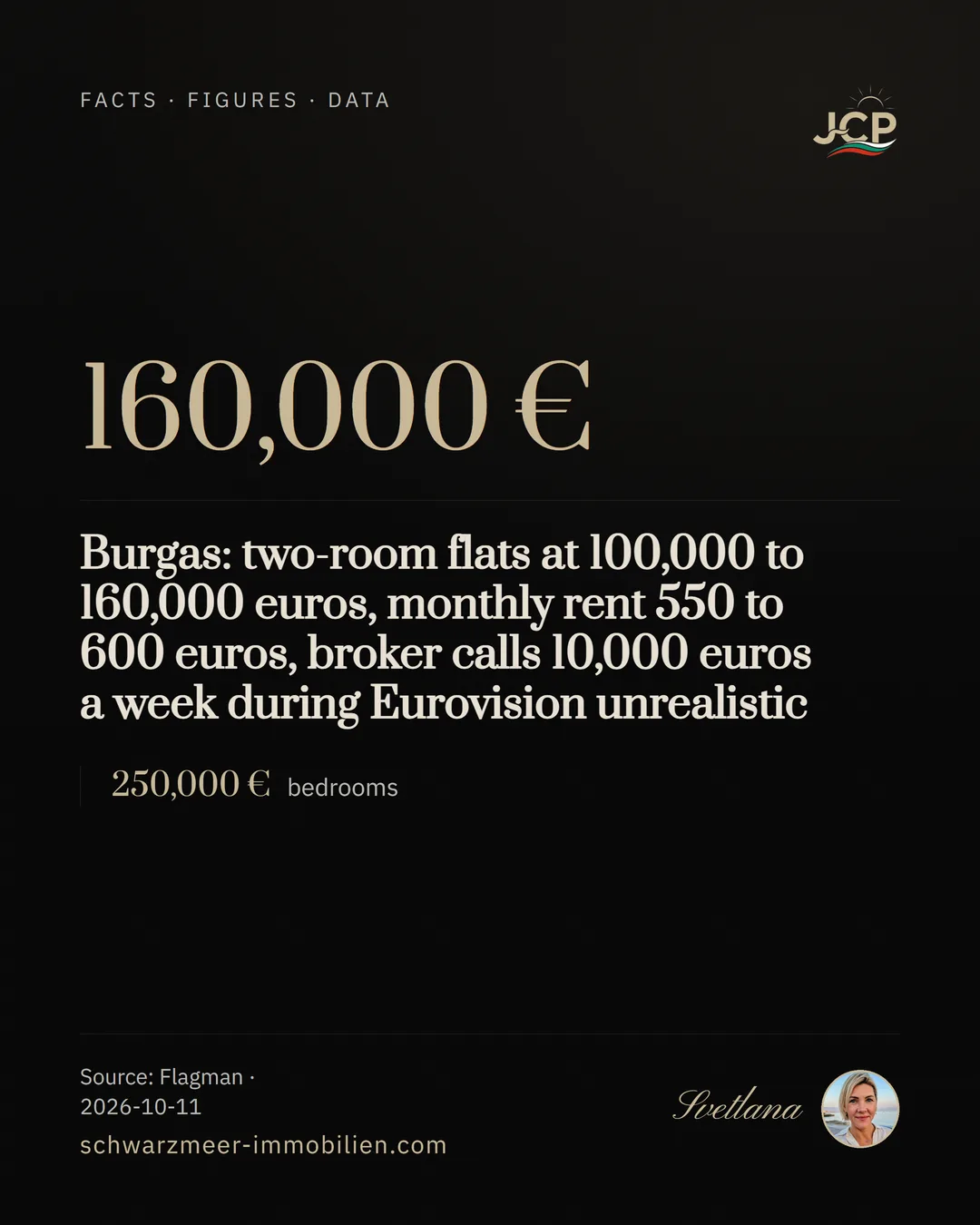
Burgas: two-room flats at 100,000 to 160,000 euros, monthly rent 550 to 600 euros, broker calls 10,000 euros a week during Eurovision unrealistic
According to a broker's account that Flagman reported on 11.10.2026, citing BNT, two-room flats in Burgas are offered at 100,000 to 160,000 euros, with monthly rents of 550 to 600 euros. A panel-block flat in the large housing complexes can reach 130,000 to 140,000 euros, two-room flats in Horizont and Madika stand at 120,000 to 130,000 euros, and three-room flats with two bedrooms at up to 250,000 euros. Some inflated asking prices are being cut step by step, while the broker sees no fall in rents yet. For Eurovision in May 2027 some owners expect about 10,000 euros for a week; the broker considers that unrealistic because guests can stay more cheaply outside the city.
Assessment: Arithmetically, a monthly rent of 550 to 600 euros on purchase prices of 100,000 to 160,000 euros gives a gross rental yield of 4.1 to 7.2 per cent (annual rent divided by purchase price, before running costs, vacancy and taxes). The price and rent ranges do not come from the same flat, so the figure is a frame, not a promise of return. Anyone planning a short-term let for Eurovision should calculate with the prices guests actually pay, not with wish figures.
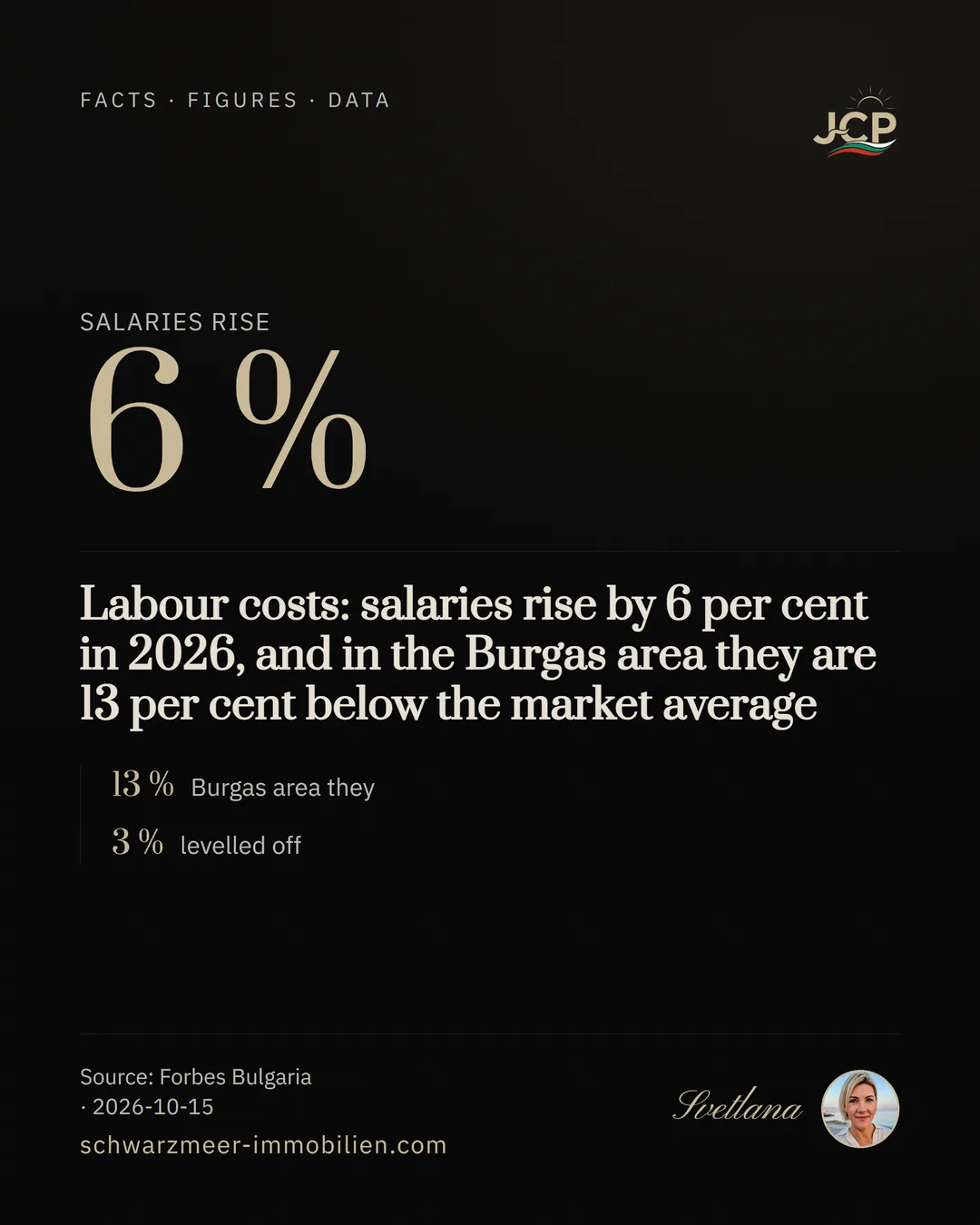
Labour costs: salaries rise by 6 per cent in 2026, and in the Burgas area they are 13 per cent below the market average
According to Marsh Bulgaria's annual TRS Bulgaria 2026 remuneration survey, salaries rose by an average of 6 per cent in 2026; employers expect 5 per cent for 2027, while increases in Western Europe have levelled off at around 3 per cent. Pay rose most in manufacturing, by 8.1 per cent, and in transport, by 7.8 per cent, and least in high technology, by 5.2 per cent, although salaries there remain around 24 per cent above the market level. Regionally, Sofia pays on average 5 per cent more than the market, while Central Bulgaria pays 12 per cent and the Burgas area 13 per cent less. Just under a third of companies, 32 per cent, increased their headcount in 2026, 54 per cent kept it unchanged, and the share that cut jobs almost doubled to 7 per cent.
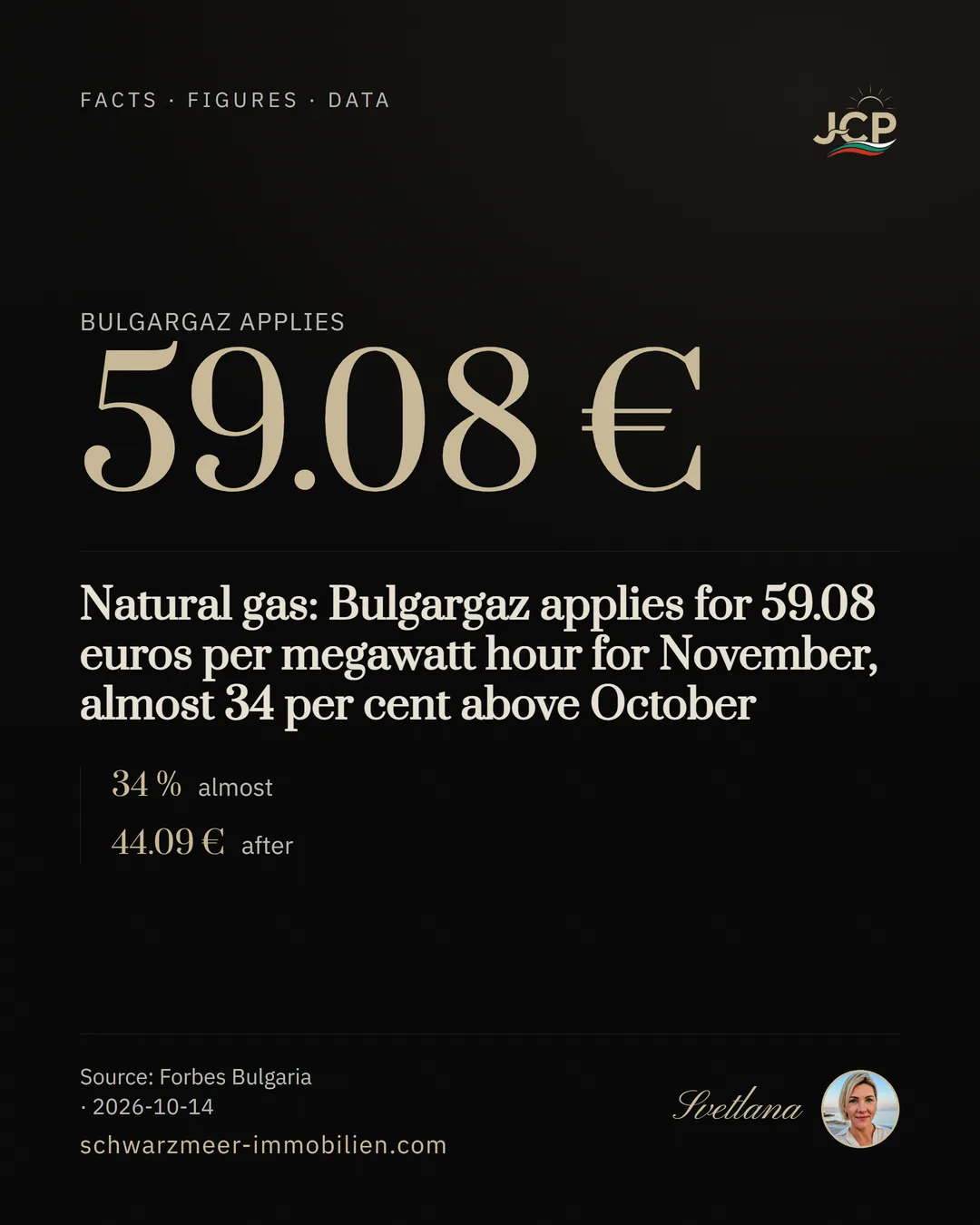
Natural gas: Bulgargaz applies for 59.08 euros per megawatt hour for November, almost 34 per cent above October
On 13 October Bulgargaz applied to the Energy and Water Regulatory Commission for a November price of 59.08 euros per megawatt hour, after 44.09 euros in October, an increase of almost 34 per cent. The application concerns the regulated price and does not automatically mean the same cost increase for every business; the commission has yet to decide. On the electricity market, the exchange price rose within two hours on 9 October from 148.35 to 379.67 euros per megawatt hour. According to the system operator, net electricity exports from the start of the year to 11 October reached 3.66 terawatt hours, around 70 per cent more than a year earlier, and battery storage delivered 1.82 terawatt hours, compared with 0.20 in the same period of 2025.
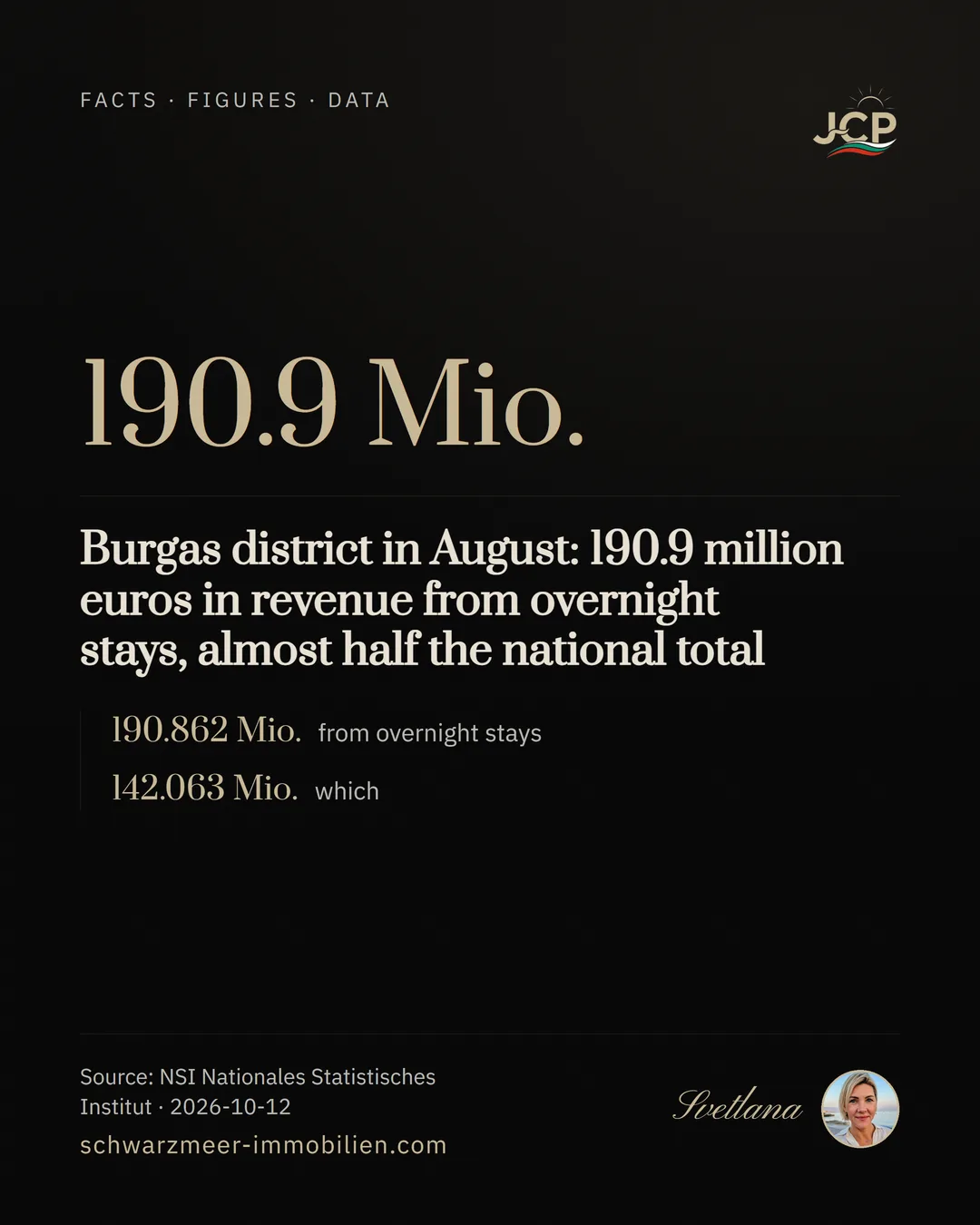
Burgas district in August: 190.9 million euros in revenue from overnight stays, almost half the national total
For August 2026 the National Statistical Institute counts 1,057 accommodation establishments in Burgas district with 150,752 bed places, 3,100,908 overnight stays and 643,592 arrivals. Revenue from overnight stays reached 190.862 million euros, of which 142.063 million came from non-residents, who booked 2,147,723 of the nights; that is 49.6 per cent of the national figure of 384.5 million euros. Nationwide, overnight stays fell by 2.0 per cent and arrivals by 0.8 per cent compared with August 2025, while revenue rose by 13.3 per cent. Bed occupancy stood at 65.9 per cent in Burgas district and at 56.5 per cent nationally; four- and five-star establishments reached 72.0 per cent across the country.
Assessment: Fewer guests but higher revenue: the pattern of June and July continues in August. Burgas district earns almost half of the national revenue from overnight stays and runs nearly ten points above the national occupancy rate. For owners who let, the category therefore matters most: anyone buying a flat as a holiday let should align fit-out and management with the upper segment, where occupancy is highest.
Budget 2027: main taxes unchanged, one-off contribution from banks, insurers, retail chains and telecoms
Cabinet head Rumen Radev presented the 2027 budget on 14 October 2026; on the same day the cabinet decides on sending the budget plan to the European Commission and the Eurogroup. According to the head of government, the main taxes on income, profit and value added remain unchanged. Additional revenue is to come from better collection, action against fraud and a one-off contribution from banks, insurers, retail chains and telecommunications companies. Measures against fraud in property transactions are also to be tightened. Public-sector salaries rise by 5 per cent, teachers' pay by 7.5 per cent and pensions by 8 per cent; an increase in the minimum wage is planned, but the government names no figure.
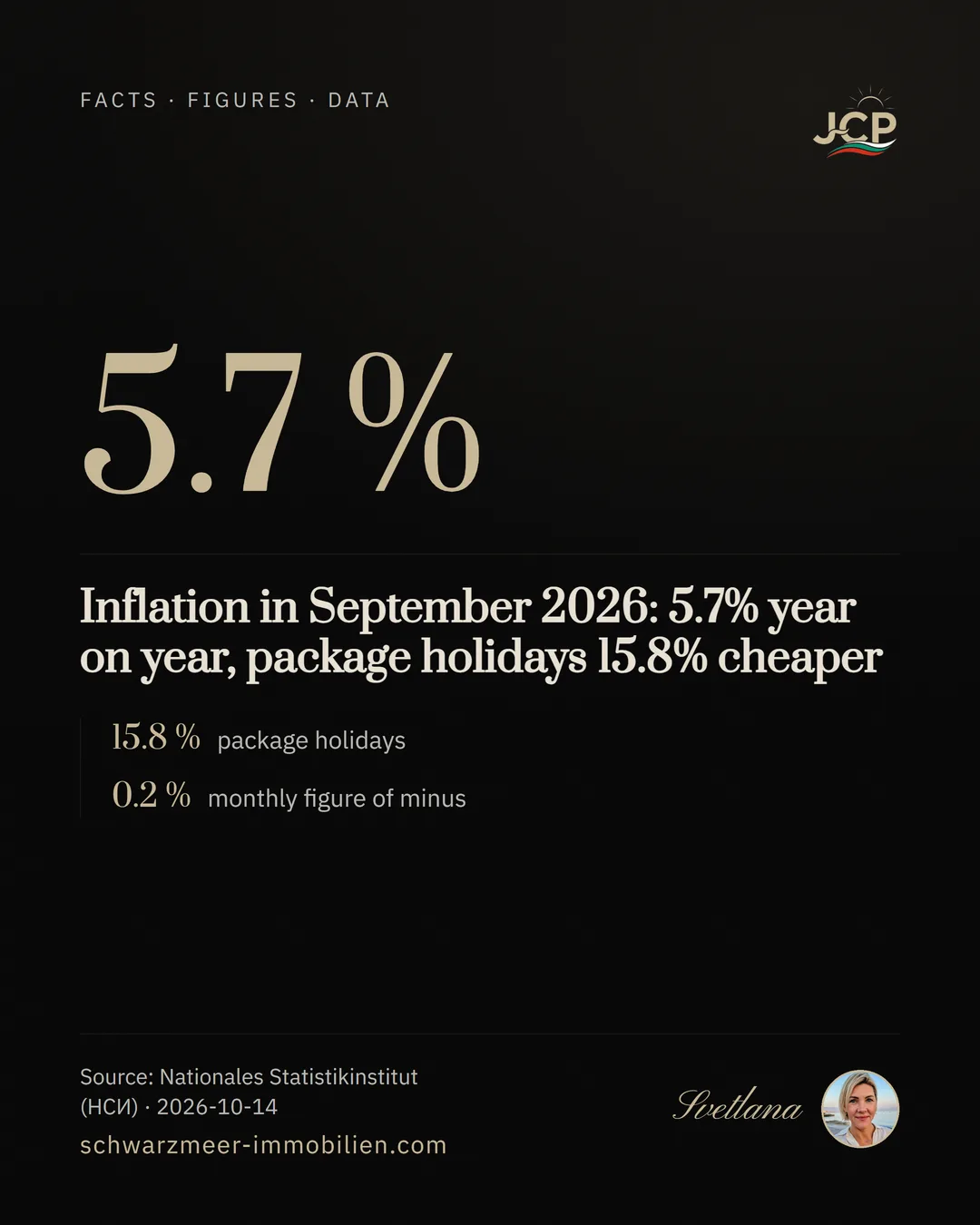
Inflation in September 2026: 5.7% year on year, package holidays 15.8% cheaper
The statistics institute NSI reports annual inflation of 5.7% for September 2026, with a monthly figure of minus 0.2%. Prices have risen by 4.2% since December 2025; the average for the twelve months from October 2025 to September 2026 is 5.1%. Month on month, transport became 3.7% dearer and education 3.2%, the group housing, water, electricity, gas and other fuels 0.4%. Recreation, sport and culture became 10.2% cheaper, package holidays and tourist trips 15.8%. Over three years inflation adds up to 12.9%, over five years to 42.4%.
Bulgarian National Bank approves the merger of Tokuda Bank into Bulgarian-American Credit Bank
The Governing Council of the Bulgarian National Bank (BNB) has approved the merger of Tokuda Bank AD into Bulgarian-American Credit Bank AD (BACB), BTA reports on 9 October 2026. BACB becomes the legal successor and Tokuda Bank ceases to exist without liquidation. In April 2024 BACB had agreed with the Japanese company Tokushukai Inc. to acquire 99.94% of the shares. The competition authority approved in July 2024; in early December 2025 the BNB, on instruction from the European Central Bank, consented to a qualifying holding of more than 50%.
Assessment: Anyone holding an account at Tokuda Bank should have the bank confirm the transfer date and the future account details before a payment for the notary appointment falls due. The report gives neither a cut-off date nor terms. I therefore do not schedule transfers for a completion in the transition period.
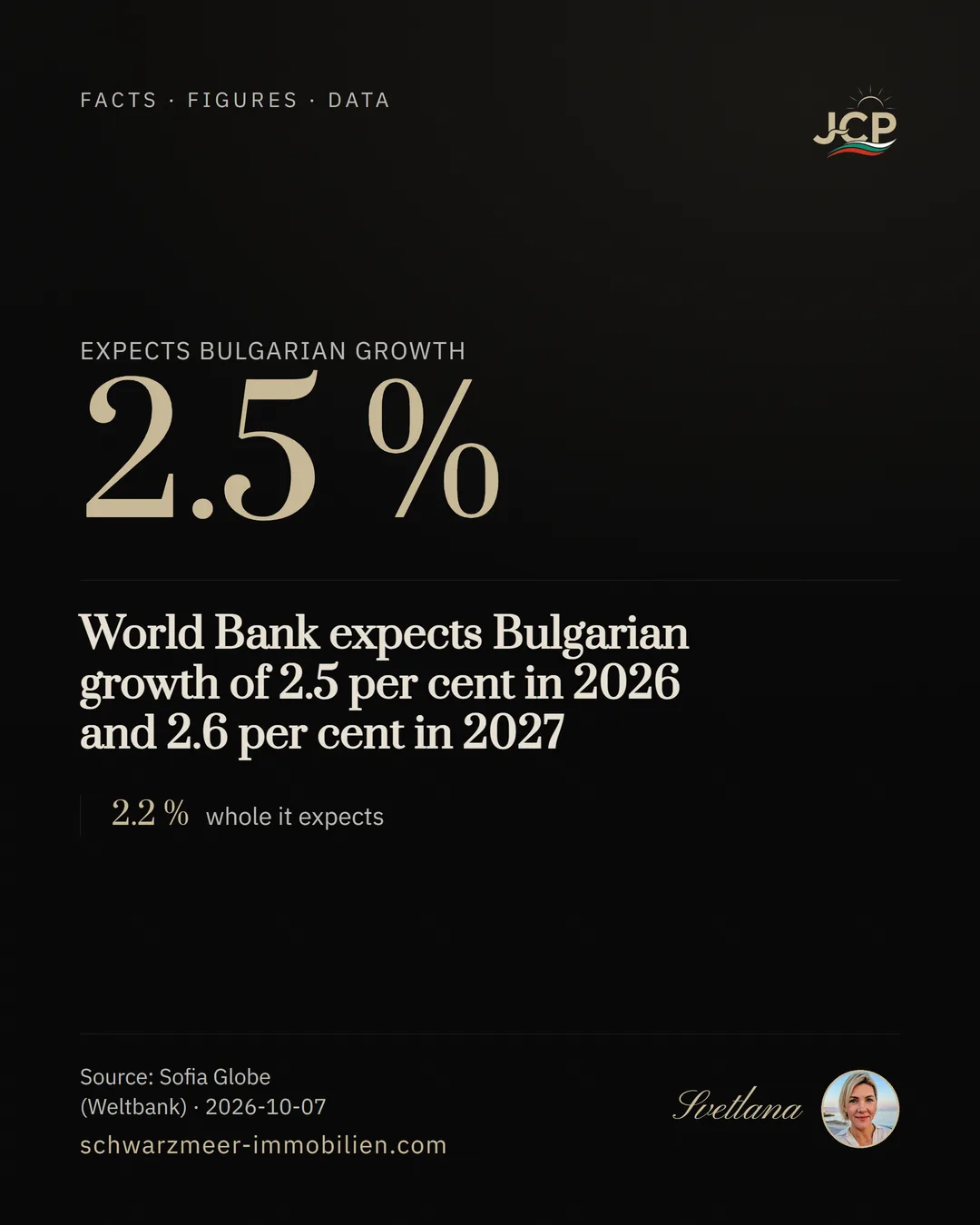
World Bank expects Bulgarian growth of 2.5 per cent in 2026 and 2.6 per cent in 2027
In its Europe and Central Asia Economic Update of 6 October 2026, the World Bank forecasts economic growth in Bulgaria of 2.5% in 2026 and 2.6% in 2027. In June it had assumed 2.6% for 2026 and 2.9% for 2027, so the new figures are 0.1 and 0.3 points lower. For the region as a whole it expects 2.2% after 2.6% the year before. The report cites higher energy prices, uncertainty and weaker growth among trading partners. The Sofia Globe reported on 7 October 2026.
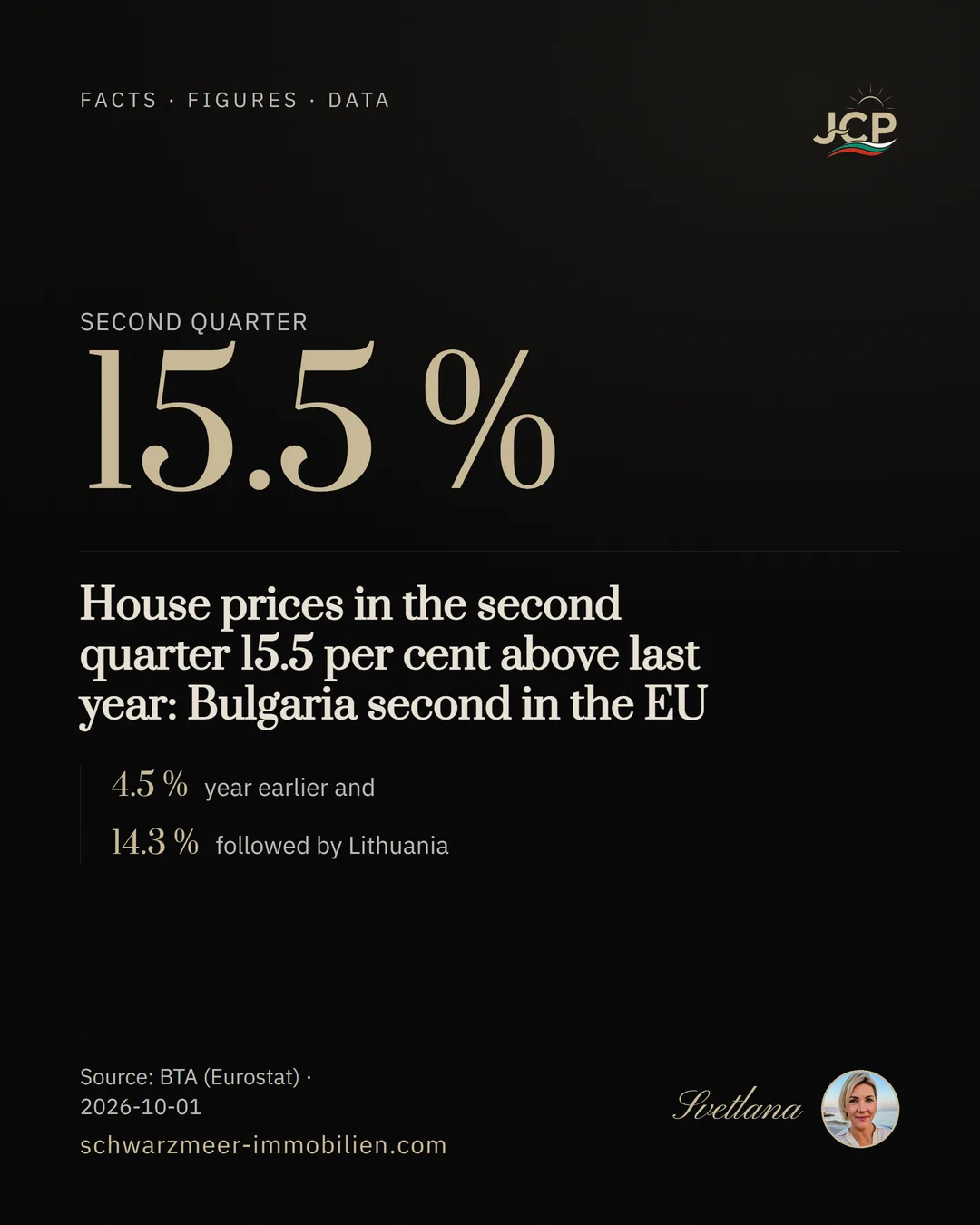
House prices in the second quarter 15.5 per cent above last year: Bulgaria second in the EU
According to Eurostat data, house prices in Bulgaria rose 15.5% in the second quarter of 2026 compared with the same quarter a year earlier and 4.5% on the first quarter. Only Portugal, at 16.5%, records a higher annual increase, followed by Lithuania at 14.3%; in the first quarter the Bulgarian increase had stood at 14.8%. The EU average is 4.7% year on year, the euro area 4.0%. Rents in the EU rose 3.0% year on year. BTA reported the figures on 1 October 2026.
Construction output in August 4.2 per cent above last year, building construction up 7.4 per cent
The National Statistical Institute (NSI) reports that construction output in August 2026 rose 4.2% year on year and 0.8% on July (seasonally adjusted, preliminary). Building construction stands 7.4% above last year but 0.4% below the previous month; civil engineering grows 4.2% year on year and 0.5% month on month, specialised construction activities 0.8% and 2.4%. In July, building construction had still been 9.5% above the previous year. The index base is 2021 = 100.
Assessment: Building construction keeps growing but is losing pace: 7.4% in August after 9.5% in July. For buyers of new-build property on the coast this means contractors remain busy, so the completion date and any price-escalation clauses belong in writing in the preliminary contract. I fix the Act 16 acceptance as the reference date.
Fiscal Council estimates over €1 billion from a temporary levy on bank windfall profits
Fiscal Council chair Simeon Djankov puts the yield of a temporary levy on bank windfall profits at more than €1 billion in his analysis “Benefits of Taxing Banking Windfall Profits in the European Union”, without raising VAT, income tax or social contributions. Profits above a pre-set historical profitability benchmark would be taxed, with a clearly fixed end date and no general increase in the corporate tax rate for banks. Twelve EU states have introduced such surcharges; the Czech Republic levies 60% on defined windfall profits for 2023 to 2025. The report names no tax rate, term or draft law for Bulgaria.
Assessment: This is an analysis by an advisory body, not a draft law; the report mentions no draft law. For buyers who need financing it is open whether banks would price such a levy into loan terms. Anyone planning a mortgage should therefore collect several offers and have the fixed-rate period and fees confirmed in writing.
Finance Ministry weighs a tax on empty dwellings, assessed values to double by 2029
According to Lyudmila Petkova of the Finance Ministry's leadership, the ministry is preparing a new line on property taxation: assessed tax values, barely changed for about two decades, will rise in stages from 2027 to 2029 and are to double within three years. In addition, a one-off 33% tax on excess profits of banks and other large sectors is planned for the 2027 tax year. Under discussion, with no decision yet, is a separate tax on uninhabited dwellings; the aim is to push owners to let or sell, while the legal definition of "uninhabited" remains open.
Retail trade volume in August 5.9% above the previous year, EU average 1.2%
According to Eurostat data published on 6 October 2026, the volume of retail trade in Bulgaria in August was 5.9% above the same month a year earlier, against 1.2% in the EU as a whole and 0.8% in the euro area. Only Sweden at 7.7% and Cyprus at 7.5% reported higher growth, with Estonia next at 6.0%; declines were recorded in Malta (minus 2.4%), Spain (minus 0.6), Italy (minus 0.5) and Germany (minus 0.4). For Bulgaria the series for the year reads January 4.2, February 7.3, March 12.4, April 7.4, May 7.9, June 7.1 and July 5.6%.
Assessment: Private consumption is carrying the Bulgarian economy, and that supports the rental market for retail space in Burgas and the coastal towns. For investors in commercial property the series since January is a solid signal, even if the pace has slowed since March. Anyone letting residential property sees in tenants' purchasing power the basis for stable rents.
Fuel prices easing: diesel at 1.83 euros, petrol at 1.61 euros per litre
According to the Association of Bulgarian Fuel Traders, Producers, Importers and Transporters, diesel cost around 1.83 euros per litre on 6 October 2026 and petrol 1.61 euros; petrol fell by another cent within two weeks. The association's Dimitar Hadzhidimitrov attributes the calmer market to the normalisation of supply routes: nearly 80% of the earlier cargo volumes through the Strait of Hormuz are moving again. For LPG the reduced excise duty is having an effect, but higher production costs in winter push upwards; a possible release of European oil reserves of around 100 million barrels could lower prices further, while from 2027 new EU rules could add 13 to 14 cents to fuel prices.
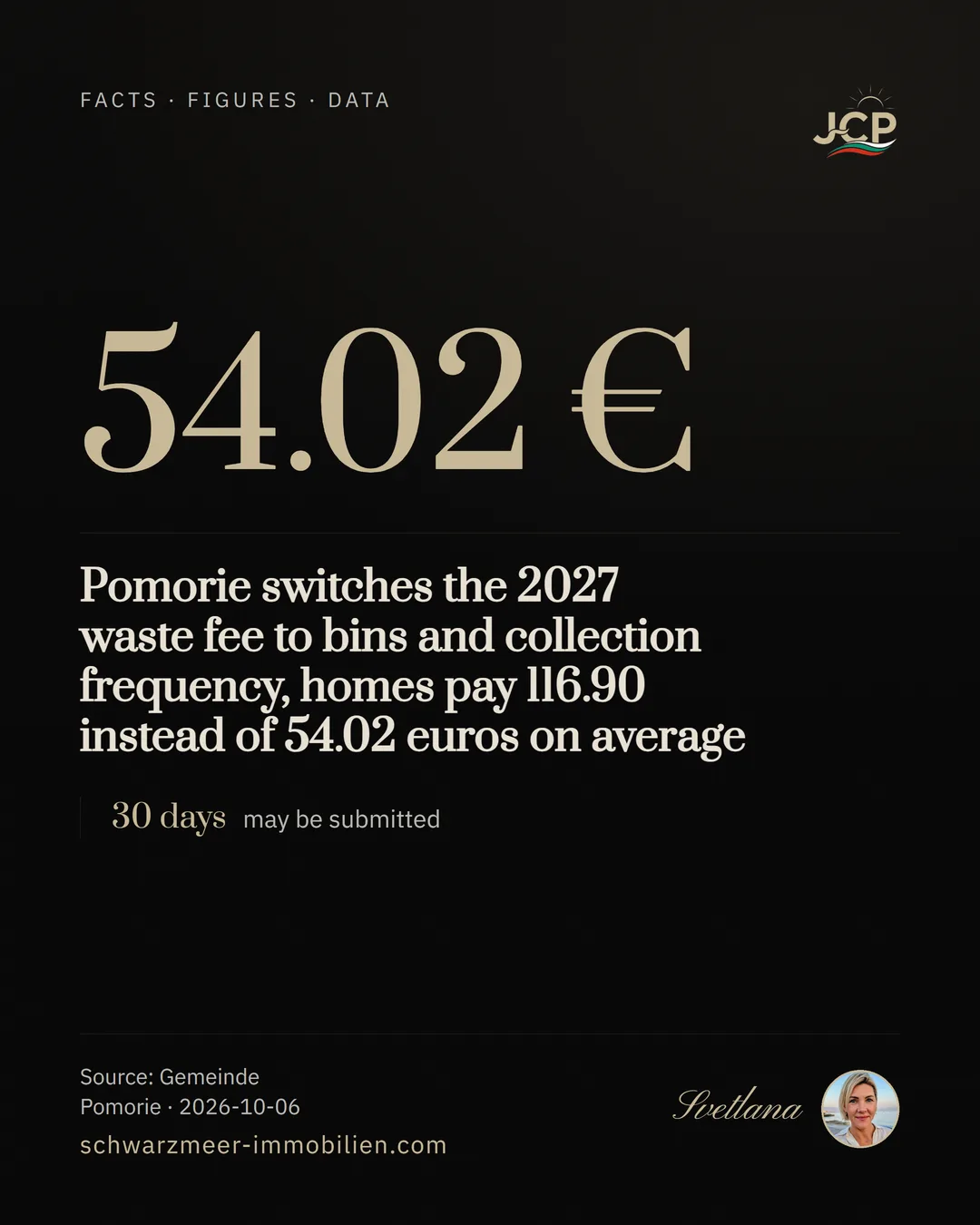
Pomorie switches the 2027 waste fee to bins and collection frequency, homes pay 116.90 instead of 54.02 euros on average
On 6 October 2026 the Municipality of Pomorie published the draft amendment of Ordinance No. 11 on local fees; comments may be submitted for 30 days under Article 26(3) and (4) of the Normative Acts Act, in person at counter 1 of the administrative service centre at 5 Solna Street or to mayor@pomorie.bg. From 2027 the tax value may no longer serve as the basis of the waste fee under Article 67(8) of the Local Taxes and Fees Act; Pomorie opts for the number and volume of bins and the collection frequency for collection, fixed-volume bags in the Svoboda district, and for street cleaning the floor area with coefficients of 1.0 for residential and 2.0 for non-residential space. Under the municipality's model calculation the average fee for a residential property in the town of Pomorie rises from 54.02 euros in 2026 to 116.90 euros, in Aheloy from 41.02 to 79.32 euros, while commercial properties in Pomorie fall from 370.93 to 251.78 euros; total revenue grows from 2,749,976.96 to 3,532,400 euros. Declarations on the number of bins and exemption applications for 2027 must be filed by 31 January 2027; multi-family buildings are assessed at 80 litres per unit from the 1,100-litre container, single-family houses at one 240-litre bin.
Property sales in the third quarter: Nessebar and Sunny Beach down 37.1%, Burgas down 14.3%
According to the Registry Agency, 1,857 property sales were recorded in Nessebar and Sunny Beach in the third quarter of 2026, down from 2,951 a year earlier, a fall of 37.1%. Sales in Burgas dropped 14.3% to 2,047 (2,389 a year ago), Tsarevo lost 25.1% and Pomorie only 3.5%; Varna fell 26.3% (2,853 after 3,859). Nationwide, 45,312 sales were registered, 22.1% fewer than the 58,184 of the third quarter of 2025 and the lowest quarterly figure since at least 2005. Mountain resorts fell even harder: Razlog and Bansko minus 30.4%, Smolyan and Pamporovo minus 30.7%.
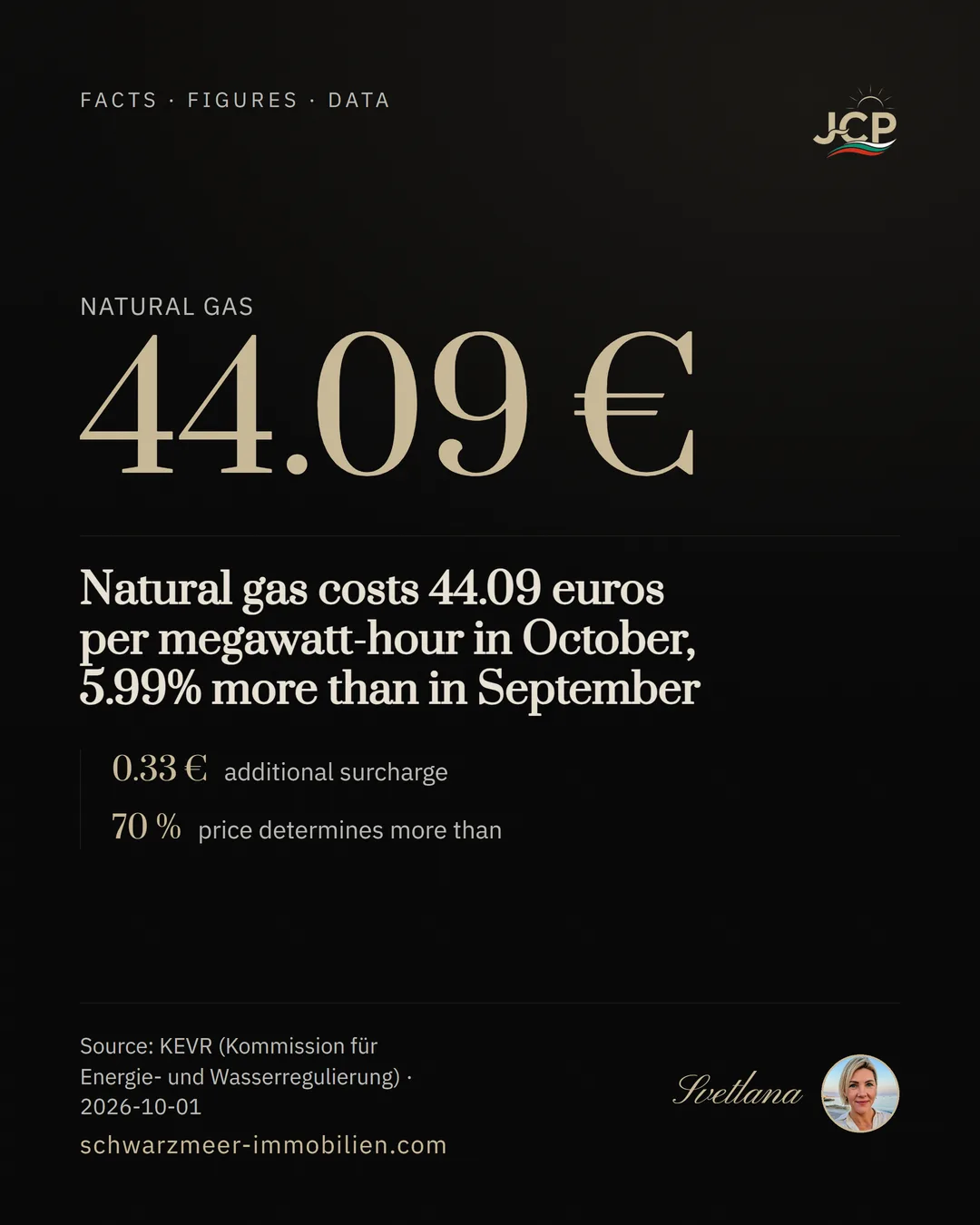
Natural gas costs 44.09 euros per megawatt-hour in October, 5.99% more than in September
On 1 October 2026 the energy regulator KEVR set the natural gas price for October at 44.09 euros per megawatt-hour, 5.99% above the September price; the figure excludes network and transmission charges, excise duty and VAT. Bulgargaz supplies end suppliers and district heating companies at this price; the mix comprises the long-term contract with Azerbaijan, liquefied natural gas from tenders and the minimum withdrawal from the Chiren storage facility. The commission rejected an additional surcharge of 0.33 euros per megawatt-hour because the gas price determines more than 70% of the final price of heat.
Assessment: For owners on the coast the gas price matters mainly through electricity and heating costs in winter, since heating there is mostly electric. Anyone using or letting a flat year-round should calculate the service charges for the heating season now; the increase has run at around five to six percent for the third month in a row. I do not see this as an obstacle to buying, but as an argument for well-insulated buildings with their own heat pump.
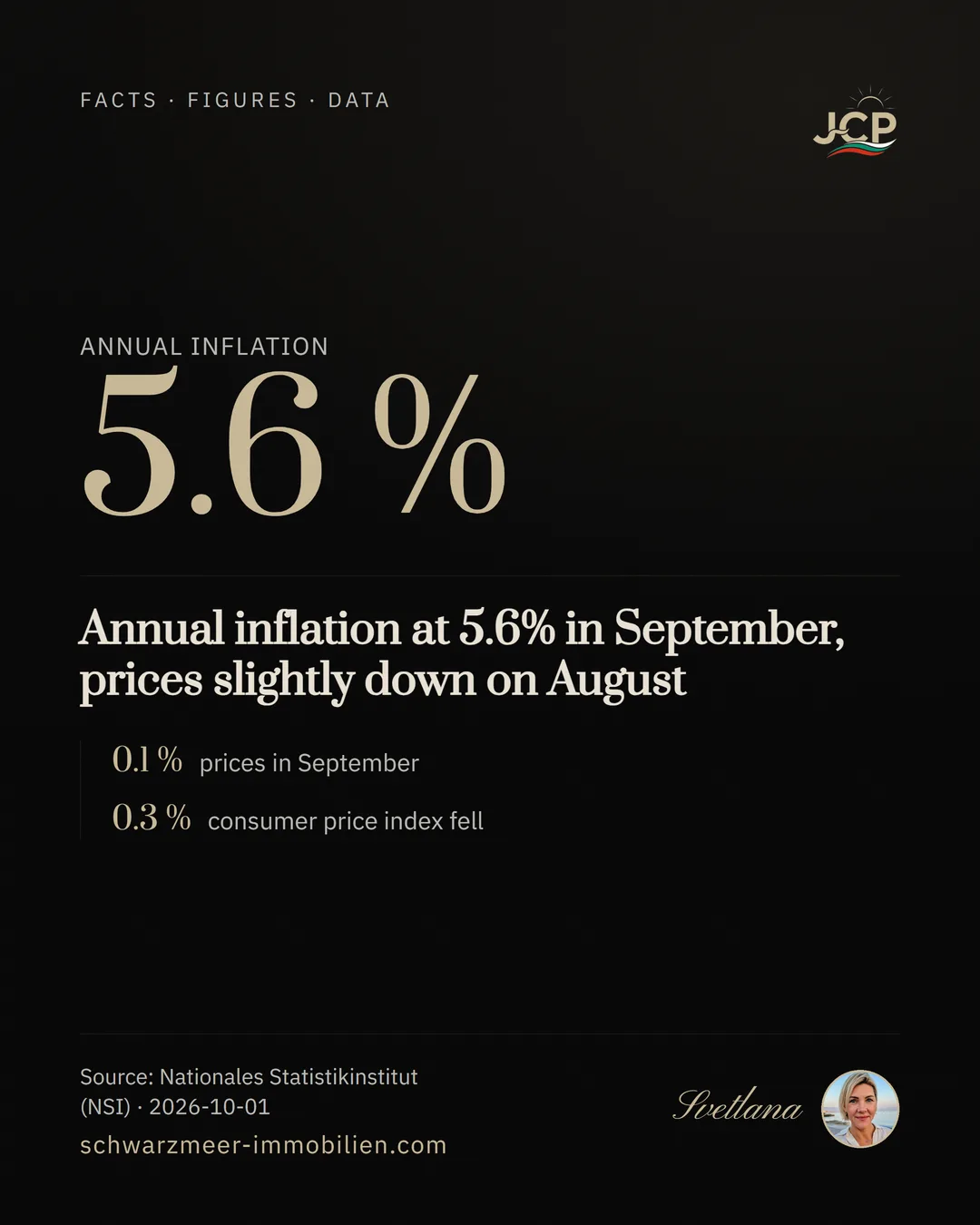
Annual inflation at 5.6% in September, prices slightly down on August
According to the flash estimate of the National Statistical Institute (NSI) of 1 October 2026, the harmonised index of consumer prices in September was 0.1% below the August figure and 5.6% above September 2025; the national consumer price index fell 0.3% on August and also rose 5.6% year on year. Month on month, restaurants and hotels fell most at minus 4.3%, followed by recreation and culture at minus 3.3%; education rose 3.2% and transport 1.7%. The estimate is based on about 90% of the planned price observations, with final figures due on 14 October.
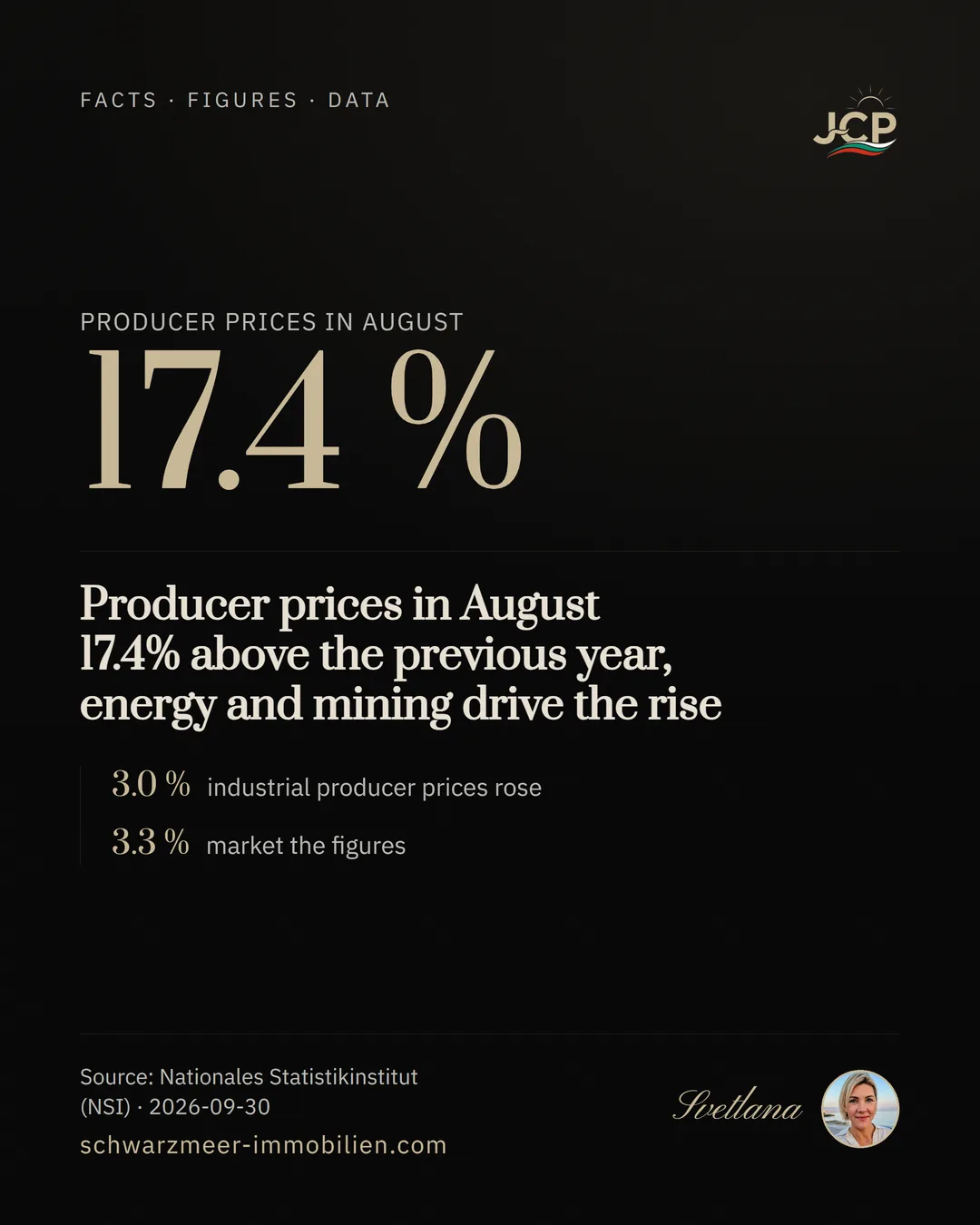
Producer prices in August 17.4% above the previous year, energy and mining drive the rise
According to NSI data of 30 September 2026, the total index of industrial producer prices rose 3.0% in August compared with July and 17.4% compared with August 2025; on the domestic market the figures were 3.3% and 16.8%, on the non-domestic market 2.6% and 18.4%. Month on month, mining and quarrying rose 10.2%, electricity, gas and heat supply 5.3% and manufacturing 1.5%. Year on year, mining stands 97.3% above the previous year, energy 13.0% and manufacturing 10.4%; within manufacturing, basic metals rose 29.7% and chemical products 10.6%.
NSI: Construction business climate drops to multi-year low of 9.3% in September
Bulgaria's National Statistical Institute reports that the construction business climate indicator fell by 4.7 points in September 2026, to 9.3% from 14.0% in August. The overall economy indicator dropped 1.3 points to 15.3%. NSI attributes the decline to construction entrepreneurs' worsening assessment of order books, with economic uncertainty, labour shortages and material prices cited as the main obstacles.
Assessment: For buyers of new-build projects on the coast, the drop is a signal to scrutinise a developer's order book and completion timeline more closely before signing, since a weaker sector climate raises the risk of delays. For sellers of existing properties, bargaining power shifts slightly toward buyers for as long as the sector stays at this level.
OBB data: Bulgarian buyers finance property conservatively despite rising prices
The average mortgage at United Bulgarian Bank (OBB) runs 25 years, with a debt-service-to-income ratio of 36.4% and a loan-to-value ratio of 68.5%, well below the ceilings the Bulgarian National Bank allows of 30 years, 50% DSTI and 85% LTV, Standart reported on 30 September 2026. The average new loan amount stands at around €150,000, up 25% year-on-year. According to OBB management, buyers consciously weigh their desired home against their family's financial security.
Assessment: The figure that matters for buyers is the loan-to-value ratio: 68.5% against a permitted 85% means a large share of buyers enter the market with meaningful equity rather than financing to the limit. That supports prices structurally, since it limits forced sales in a downturn. For your own purchase, the comparison is worth making: anyone needing well above 68.5% external financing is buying on a tighter calculation than the average Bulgarian buyer.
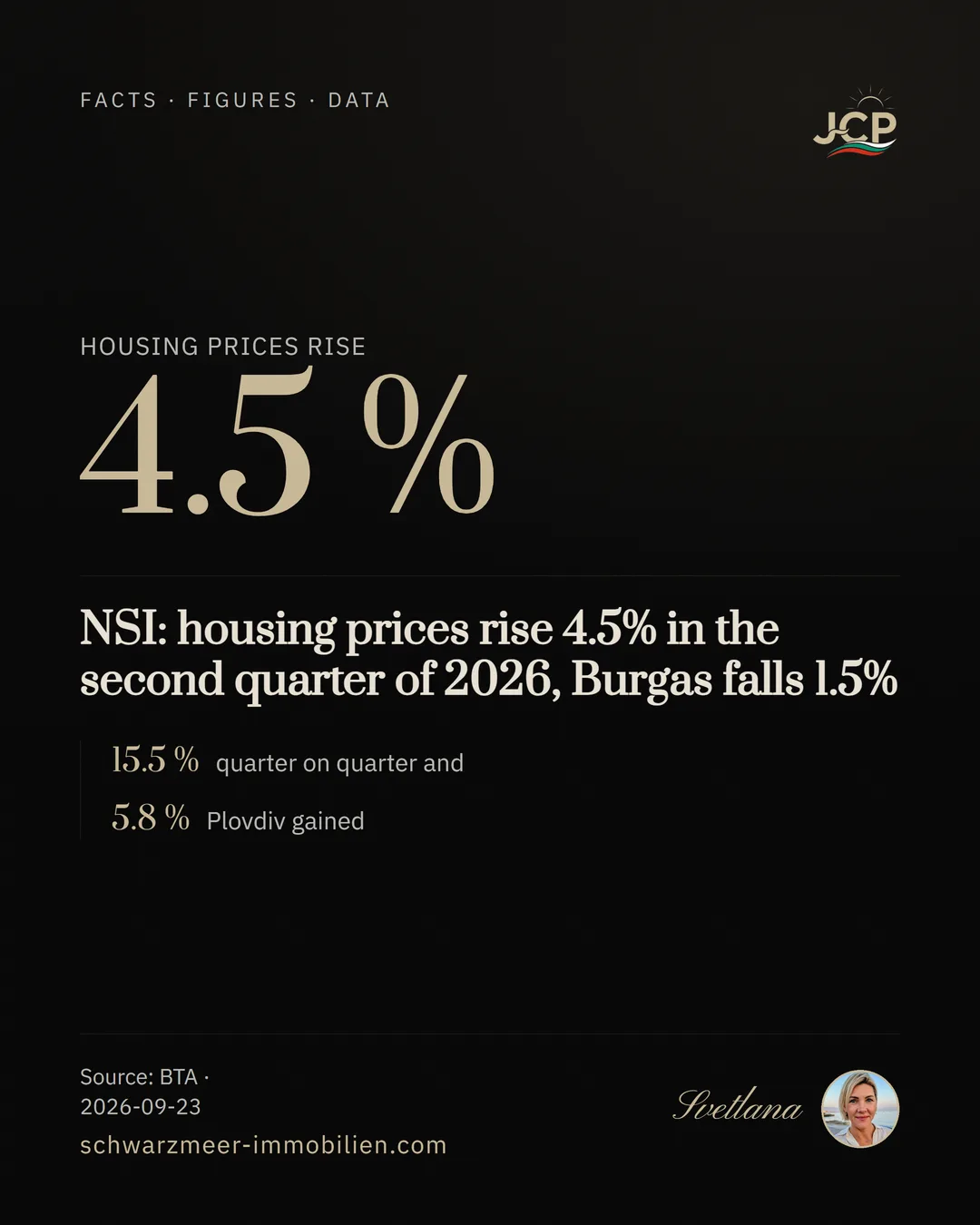
NSI: housing prices rise 4.5% in the second quarter of 2026, Burgas falls 1.5%
The National Statistical Institute reports housing prices up 4.5% quarter on quarter and 15.5% year on year for the second quarter of 2026. Regionally the picture is mixed: Plovdiv gained 5.8%, Stara Zagora 2.9%, Varna 2.8% and Sofia 2.4%, while Burgas was the only one of the five large cities to fall, by 1.5%. In the first quarter of 2026 annual growth had stood at 14.8%, quarterly growth at 6.2%.
Assessment: The 1.5% decline in Burgas stands out against the national rise and deserves a sober reading: after several strong quarters, a single city can move sideways or dip briefly without reversing the medium-term trend. For buyers this means checking location and condition selectively along the coast rather than relying on a national growth figure. Sellers should anchor pricing to local closings of recent months rather than the national average.
Finance ministry plans minimum wage of 660 euro and contribution ceiling of 2,400 euro for 2027
The finance ministry's guidance for the 2027 budget procedure sets a projected minimum wage of 660 euro and a maximum social security contribution base of 2,400 euro. For 2028 it foresees a minimum wage of 680 euro and a base of 2,500 euro, for 2029, 710 euro and 2,600 euro. The basis is a new calculation mechanism with four equally weighted indicators: the consumer price index, median and average gross income, and gross value added per employee.
Deadline 30 September: a corrective tax return for 2025 can be filed only once
The National Revenue Agency reminds taxpayers that corrective returns for income earned in 2025 can be filed up to 30 September. The correction is possible once per return and covers both the annual return of individuals and the return under Article 92 of the Corporate Income Tax Act. Filing is electronic, through the pre-filled return service, using a personal access code or an electronic signature. Where the agency finds discrepancies against its own records, for instance on fees or proceeds from online sales, it sends a notice by e-mail.
New car registrations up 9.8 per cent from January to August, 35,573 vehicles
In Bulgaria 35,573 new passenger cars were registered from January to August 2026, 9.8 per cent more than in the same period a year earlier, according to the European manufacturers' association ACEA. Across the European Union the increase over the same period was 5.3 per cent. Petrol accounted for 26,239 vehicles, diesel for 3,135, battery-electric for 2,939, full hybrids for 2,328 and plug-in hybrids for 883. Union-wide, battery-electric cars now hold a 21.7 per cent share, against a good eight per cent in Bulgaria.
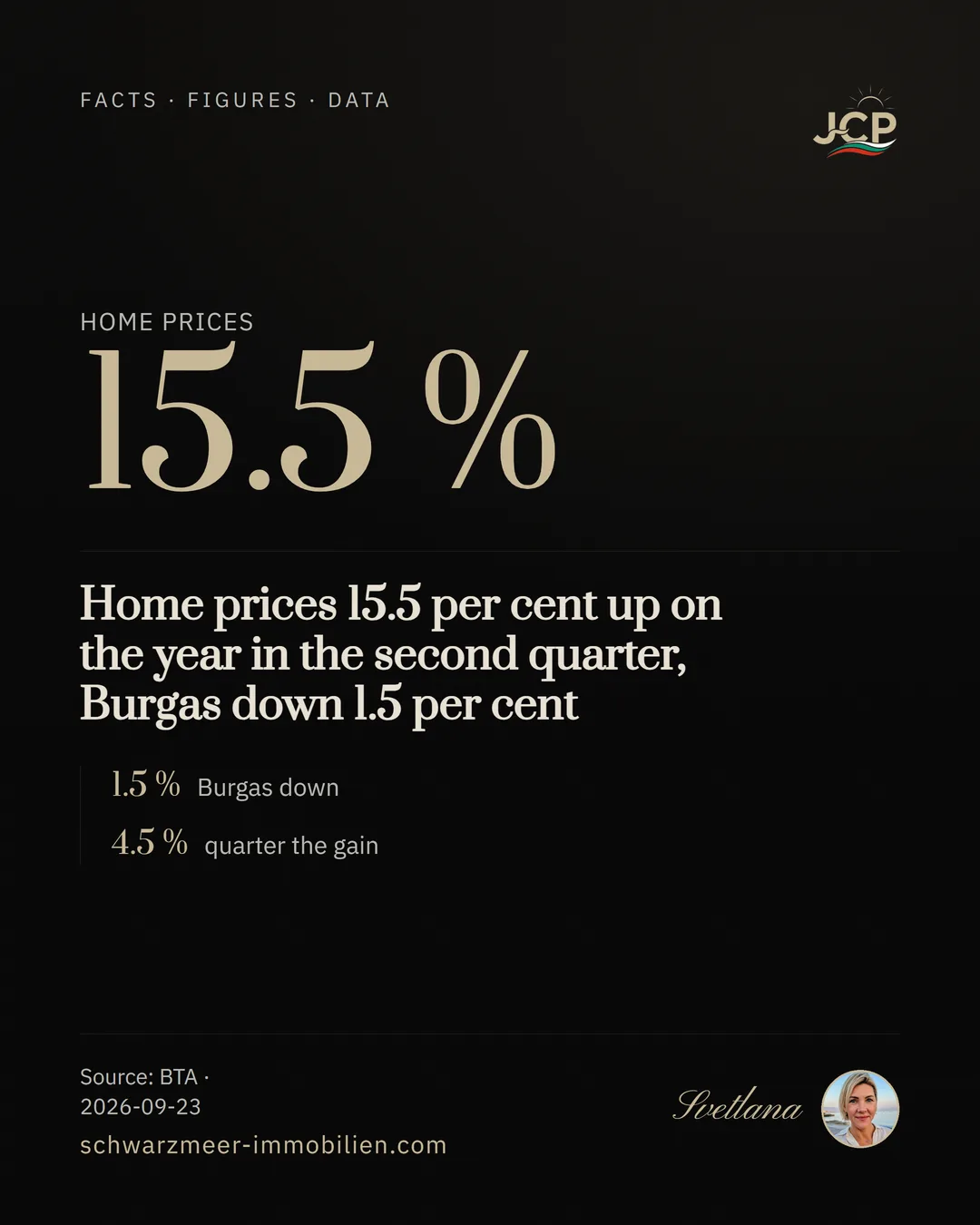
Home prices 15.5 per cent up on the year in the second quarter, Burgas down 1.5 per cent
Home prices in the second quarter of 2026 stood 15.5 per cent above the same quarter a year earlier, according to the National Statistical Institute. Against the first quarter the gain is 4.5 per cent. It is spread unevenly: Plovdiv leads on 5.8 per cent, followed by Stara Zagora on 2.9, Varna on 2.8 and Sofia on 2.4, while Burgas gave up 1.5 per cent. The annual reading in the first quarter had been 14.8 per cent.
Assessment: The Burgas decline is a quarterly figure, not a change of direction. The coast breathes with the season, and the second quarter covers the months before high summer, when few deeds are signed on the southern shore. For buyers that means a calmer negotiating position than in Plovdiv or Sofia. Sellers should look at the annual figure rather than the quarter, and landlords at summer occupancy in any case.