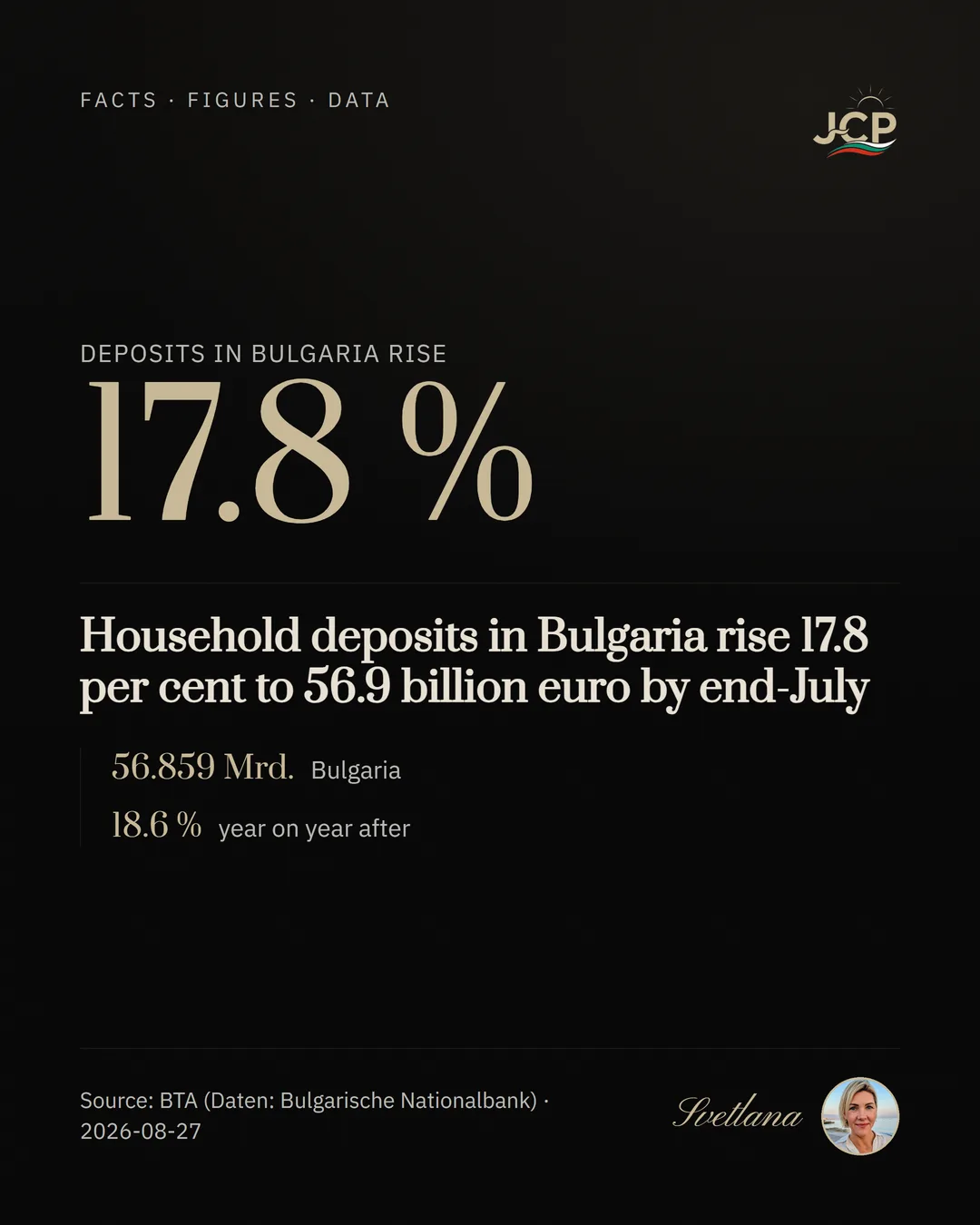
Household deposits in Bulgaria rise 17.8 per cent to 56.9 billion euro by end-July
Private household deposits in Bulgaria stood at around 56.859 billion euro at the end of July 2026, up 17.8 per cent year on year after 18.6 per cent in June. Deposits of non-financial companies rose 10.8 per cent to 27.207 billion euro. The data come from the statistics of the Bulgarian National Bank. The high level of savings shows how much capital in private hands is waiting for investment opportunities.
Assessment: Growing savings are a quiet reservoir for the property market – part of this capital seeks its way into real assets when real interest rates are low. For the southern coast this means a solid domestic demand base alongside foreign buyers. I read the high level of deposits as a sign of available equity that supports the market without overheating it.
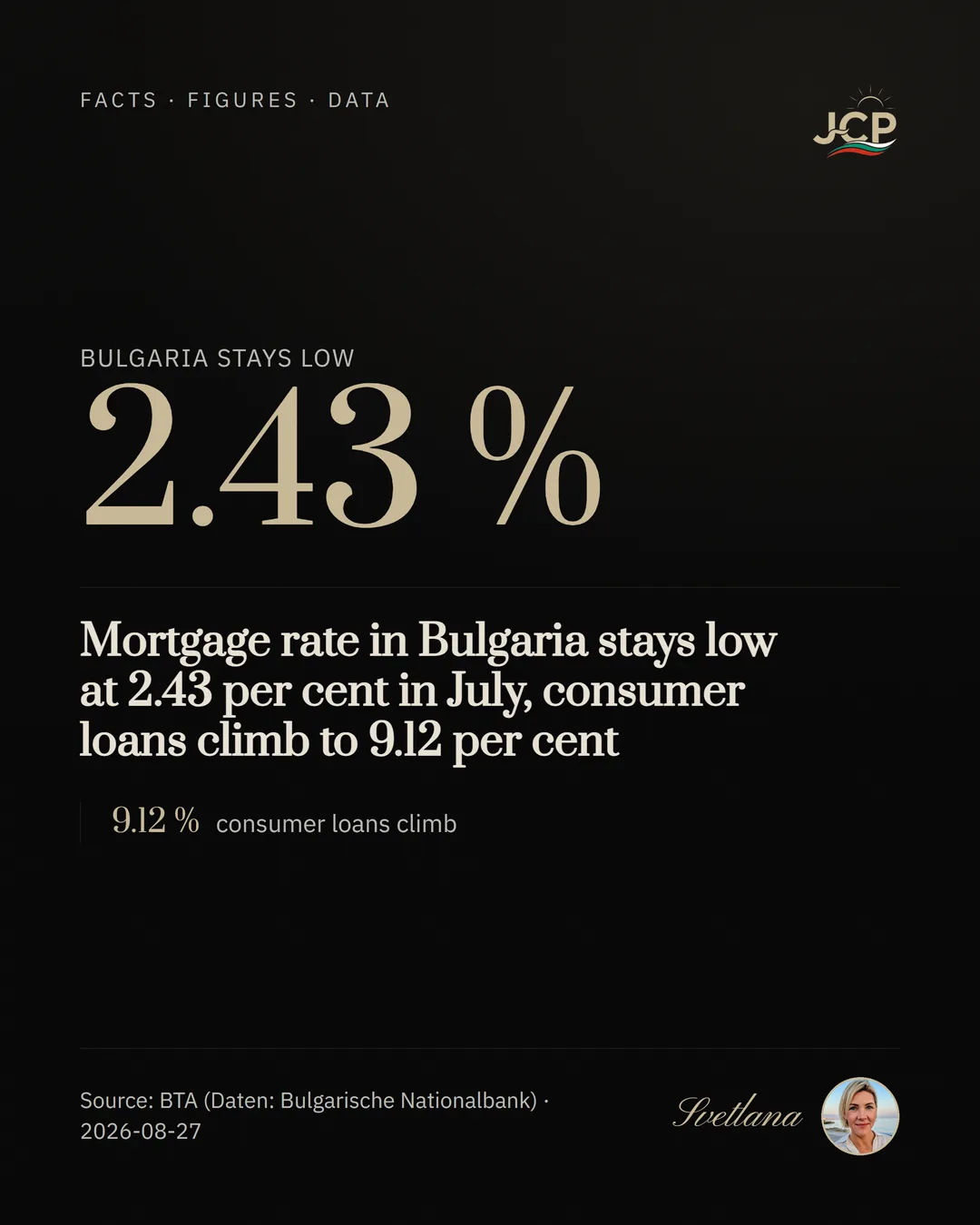
Mortgage rate in Bulgaria stays low at 2.43 per cent in July, consumer loans climb to 9.12 per cent
The average interest rate on home loans in Bulgaria was 2.43 per cent in July 2026, only 0.02 percentage points higher than in June. Consumer loans became notably more expensive: their average rate rose by 0.36 percentage points to 9.12 per cent. The figures come from the interest-rate statistics of the Bulgarian National Bank. While financing consumption becomes markedly dearer, property loans remain at a low level.
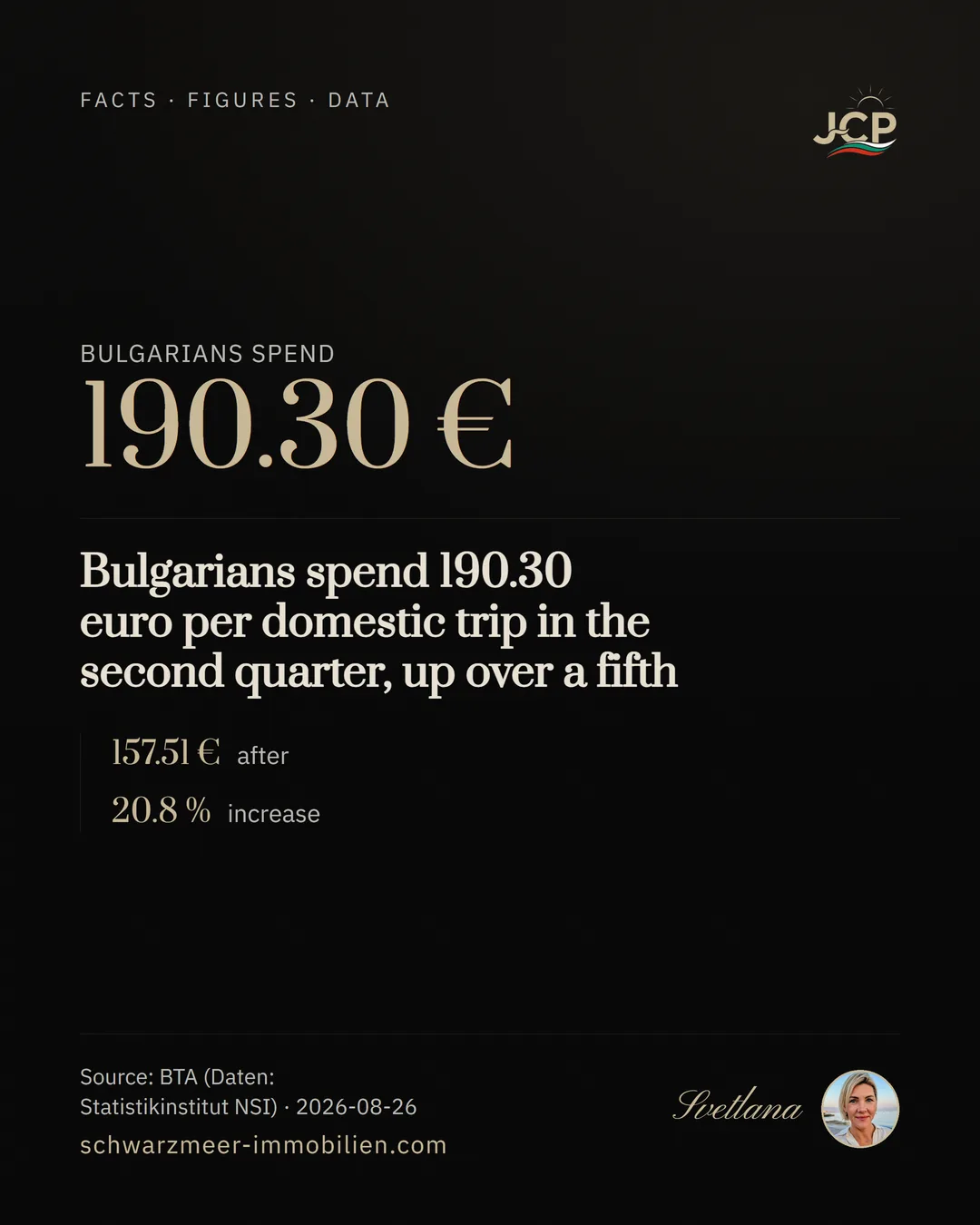
Bulgarians spend 190.30 euro per domestic trip in the second quarter, up over a fifth
The average spending of Bulgarian travellers on a private domestic trip rose to 190.30 euro per person in the second quarter of 2026, after 157.51 euro in the first quarter, an increase of 20.8 per cent. Accommodation costs alone climbed by a good 35 per cent. Around 1.3 million Bulgarians travelled in the period, more than two thirds of them within the country only. The data come from the statistics institute.
Assessment: When residents spend more on travel at home, it strengthens the domestic season and occupancy beyond foreign guests. For landlords on the southern coast, growing internal demand is a second pillar alongside international tourism. I see this as a reason to gear properties to the Bulgarian guest as well, not only to the summer flight arrival.
Banks expect steady demand for home loans in the third quarter
According to the National Bank lending survey, Bulgarian banks expect unchanged demand for home loans in the third quarter of 2026. In the second quarter demand had still been rising, supported by improved consumer confidence. Lending standards for mortgages were tightened slightly of late and are expected to stay stable in the third quarter. This points to a calm, orderly credit market.
Assessment: Steady credit demand with slightly stricter standards is exactly the mix that avoids overheated swings. For buyers with sound creditworthiness, financing conditions remain predictable, and for the market as a whole the risk of a credit-driven bubble falls. I take this as a sign of discipline that serves everyone involved in the long run.
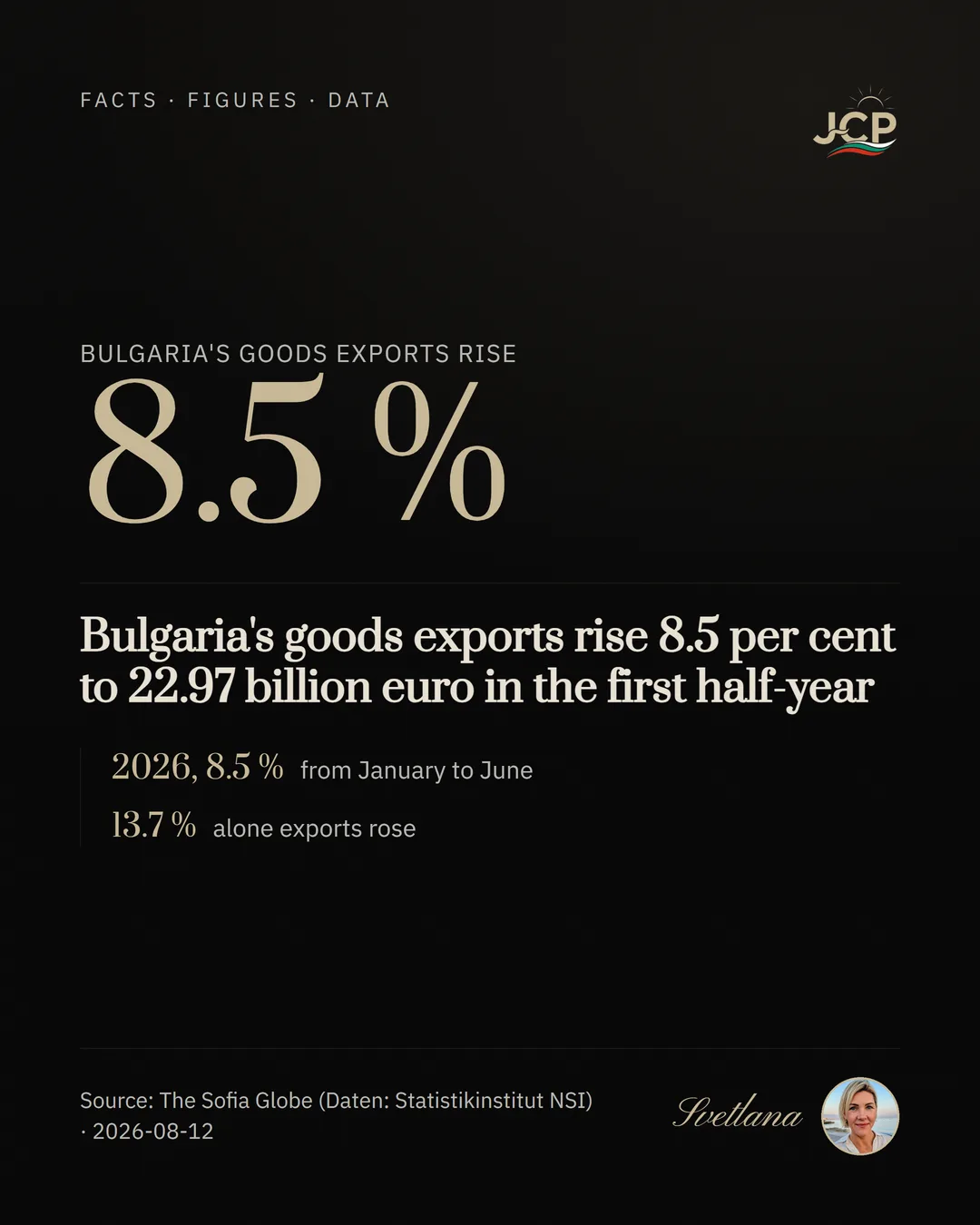
Bulgaria's goods exports rise 8.5 per cent to 22.97 billion euro in the first half-year
Bulgaria's goods exports reached around 22.97 billion euro from January to June 2026, 8.5 per cent above the same period a year earlier. In June alone exports rose by 13.7 per cent to about 4.16 billion euro. The figures come from the statistics institute and show robust foreign-trade momentum. They underline the economy's integration into European supply chains.
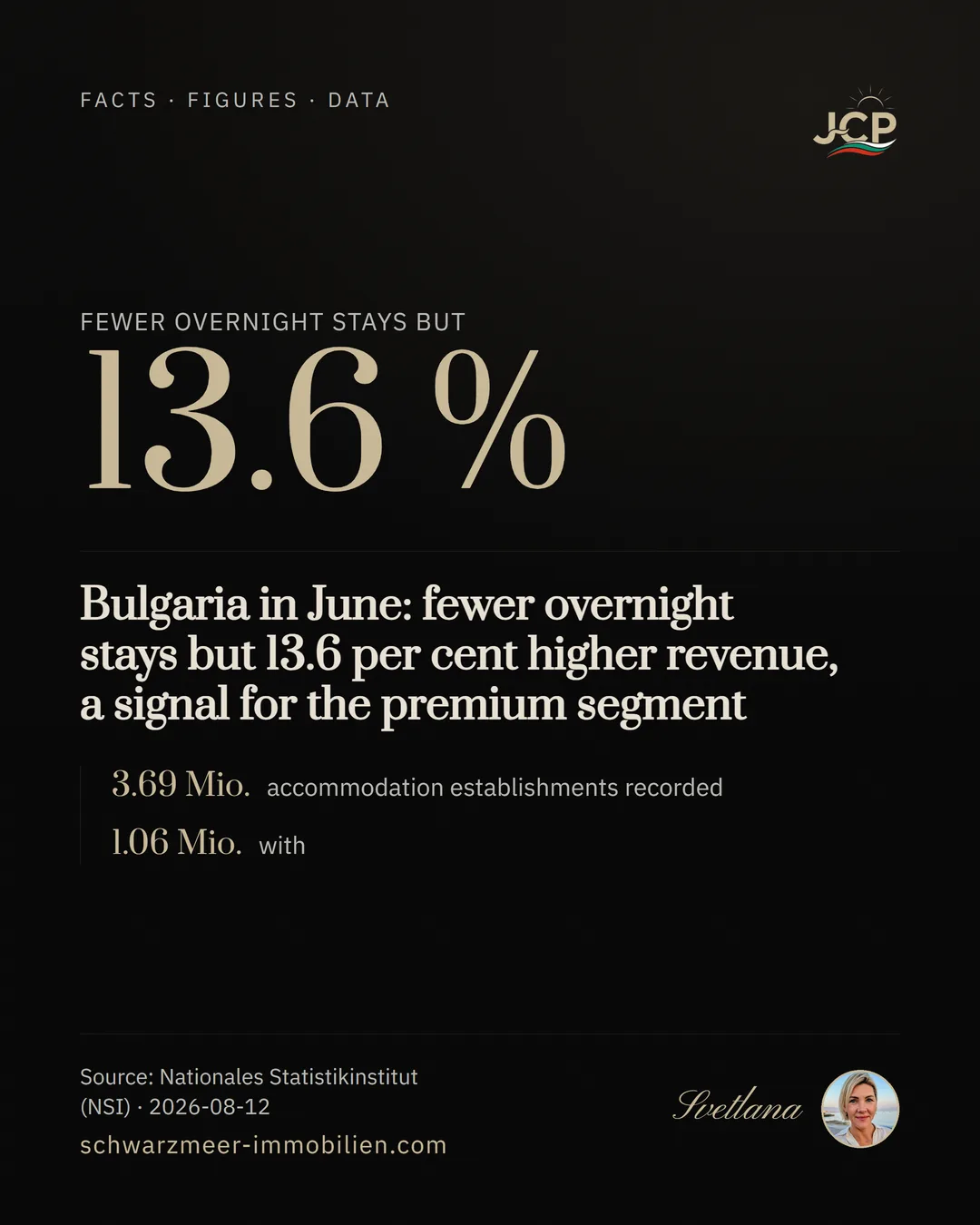
Bulgaria in June: fewer overnight stays but 13.6 per cent higher revenue, a signal for the premium segment
Bulgaria's accommodation establishments recorded around 3.69 million overnight stays in June 2026, a 3.6 per cent fall on the previous year, with 1.06 million arrivals (down 3.1 per cent). At the same time, revenue from overnight stays rose 13.6 per cent to 198.0 million euro. Fewer but markedly higher-spending guests point to higher prices and a growing premium segment. For holiday letting on the southern coast this is a relevant trend.
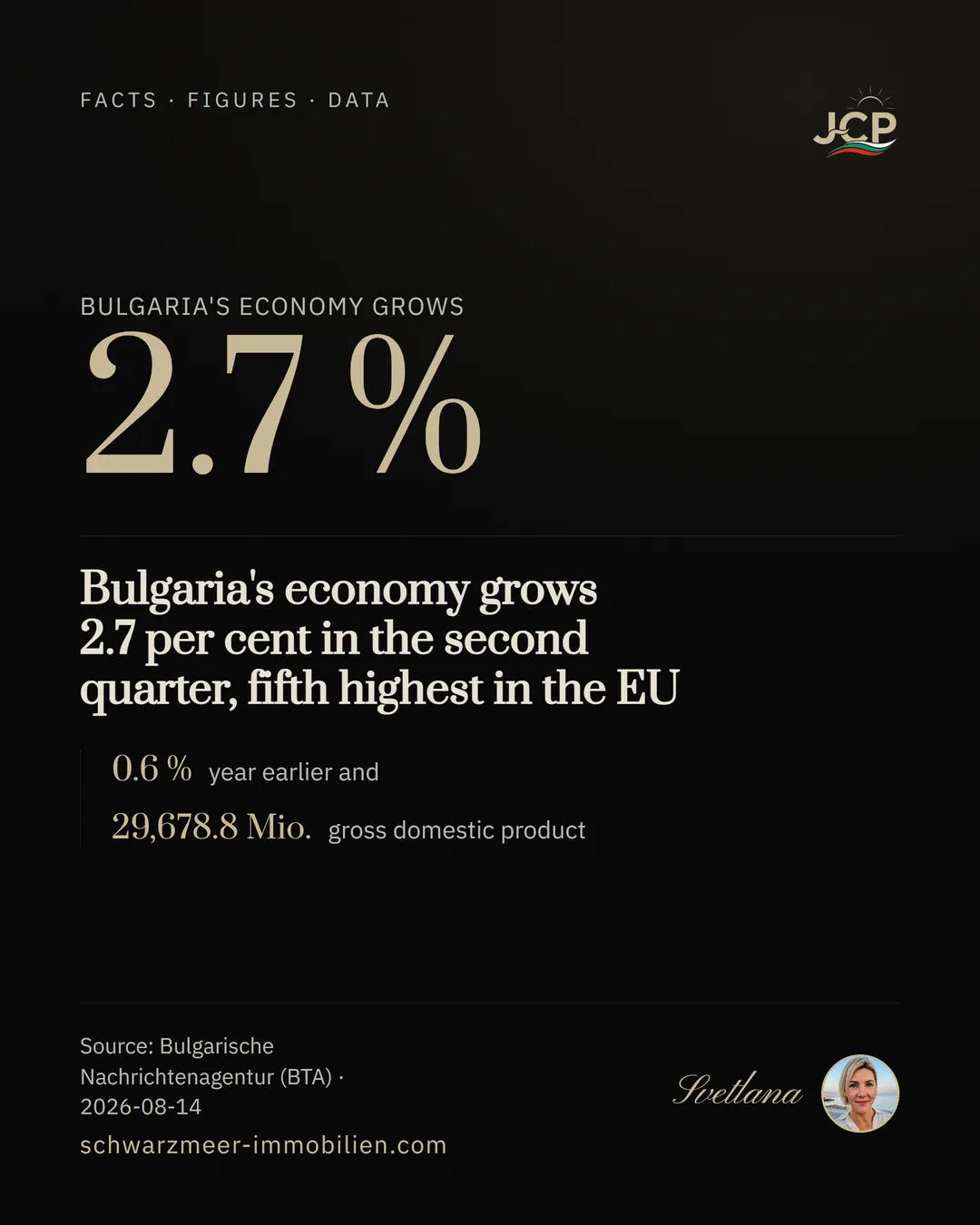
Bulgaria's economy grows 2.7 per cent in the second quarter, among the fastest in the EU
Gross domestic product rose 2.7 per cent year on year and 0.6 per cent quarter on quarter in the second quarter of 2026. That puts Bulgaria fifth in the EU growth ranking, level with Spain and well above the EU average of 1.2 per cent and the euro area at 1.0 per cent. Growth was carried by private consumption at plus 7.6 per cent and fixed investment at plus 8 per cent; exports slipped 2.8 per cent. Nominal GDP reached around 29.68 billion euro (statistics institute flash estimate).
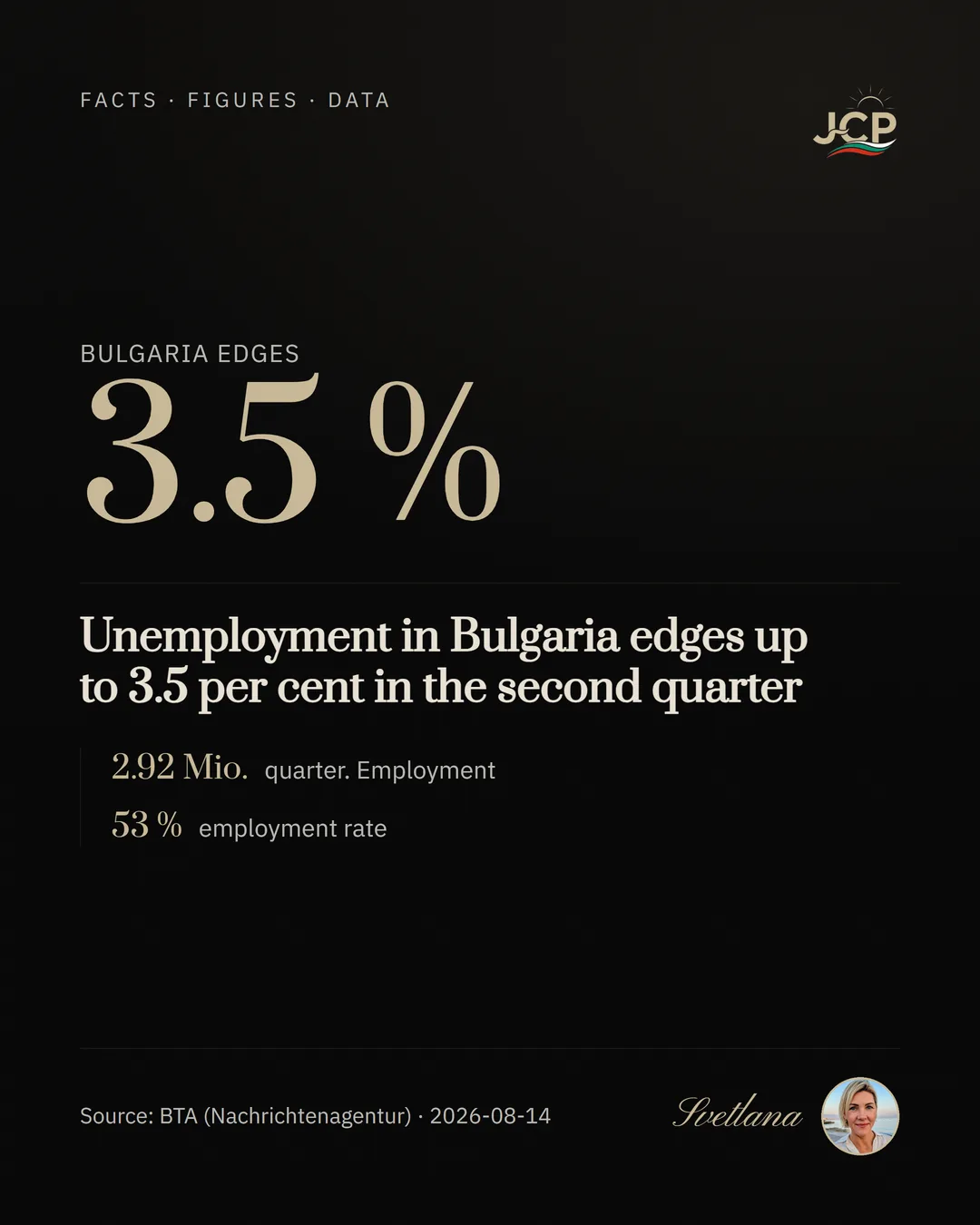
Unemployment in Bulgaria edges up to 3.5 per cent in the second quarter
In the second quarter of 2026 Bulgaria had 107,100 people out of work, a rate of 3.5 per cent after 3.2 per cent in the first quarter. Employment stood at 2.92 million, with an employment rate of 53 per cent for those aged 15 and over. Youth unemployment among 15- to 29-year-olds was 8.1 per cent. Despite the slight rise the labour market remains very tight by European standards; the data come from the statistics institute.
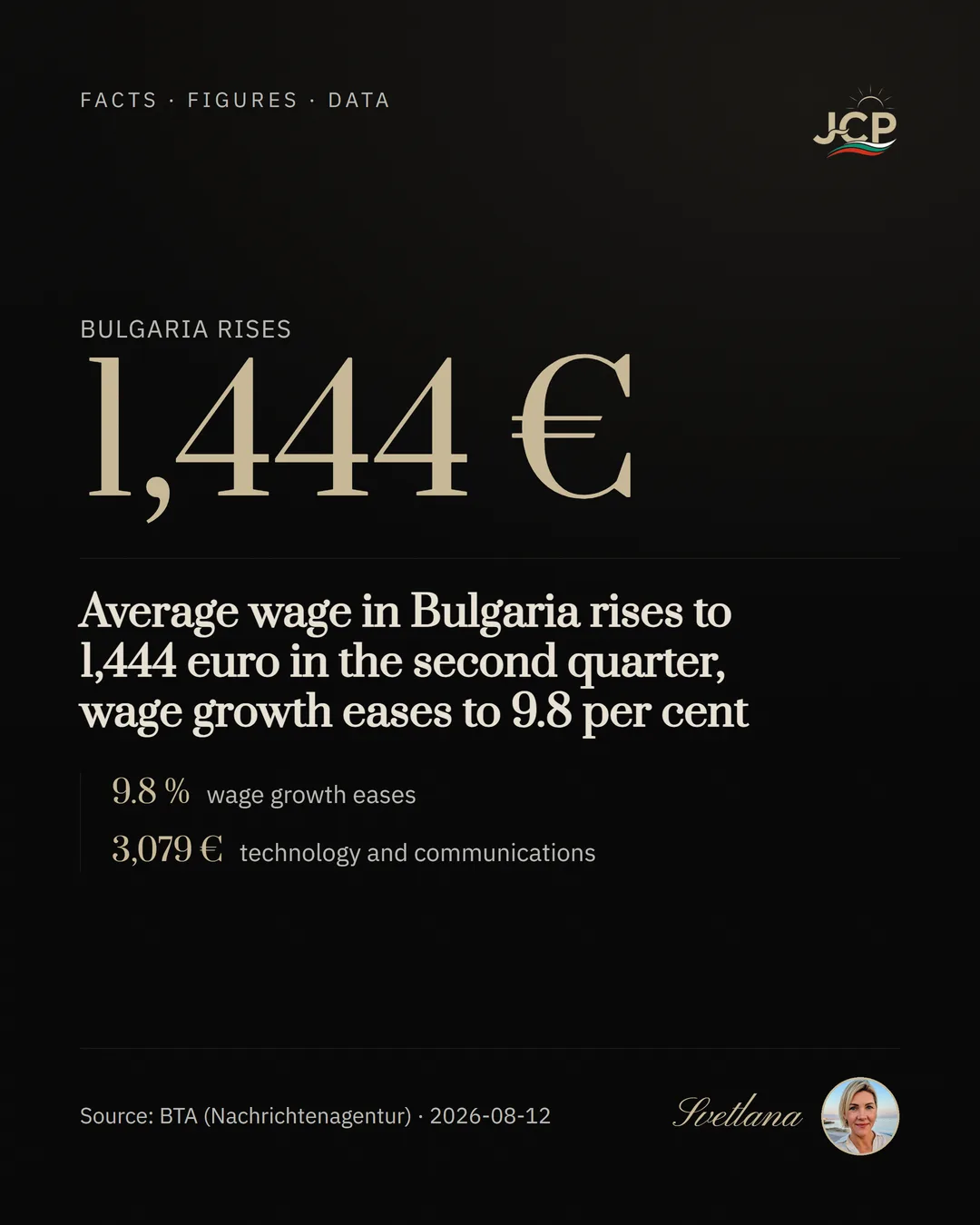
Average wage in Bulgaria rises to 1,444 euro in the second quarter, wage growth eases to 9.8 per cent
The average gross monthly wage reached 1,444 euro in the second quarter of 2026, up 2.6 per cent on the previous quarter and 9.8 per cent year on year. Pay is highest in information technology and communications at 3,079 euro and in finance and insurance at 2,140 euro, and lowest in hospitality and catering at 918 euro. The private sector grew faster at 11.5 per cent than the public sector at 4.8 per cent. The figures come from the statistics institute.
Assessment: Rising wages lift local ability to pay rent and thus the basis for rental yields. The cooling pace is rather good news, because it eases price pressure ahead of the euro changeover. For landlords I read this as sustainable, not overheated demand; for owner-occupiers as a sign of a healthy local labour market.