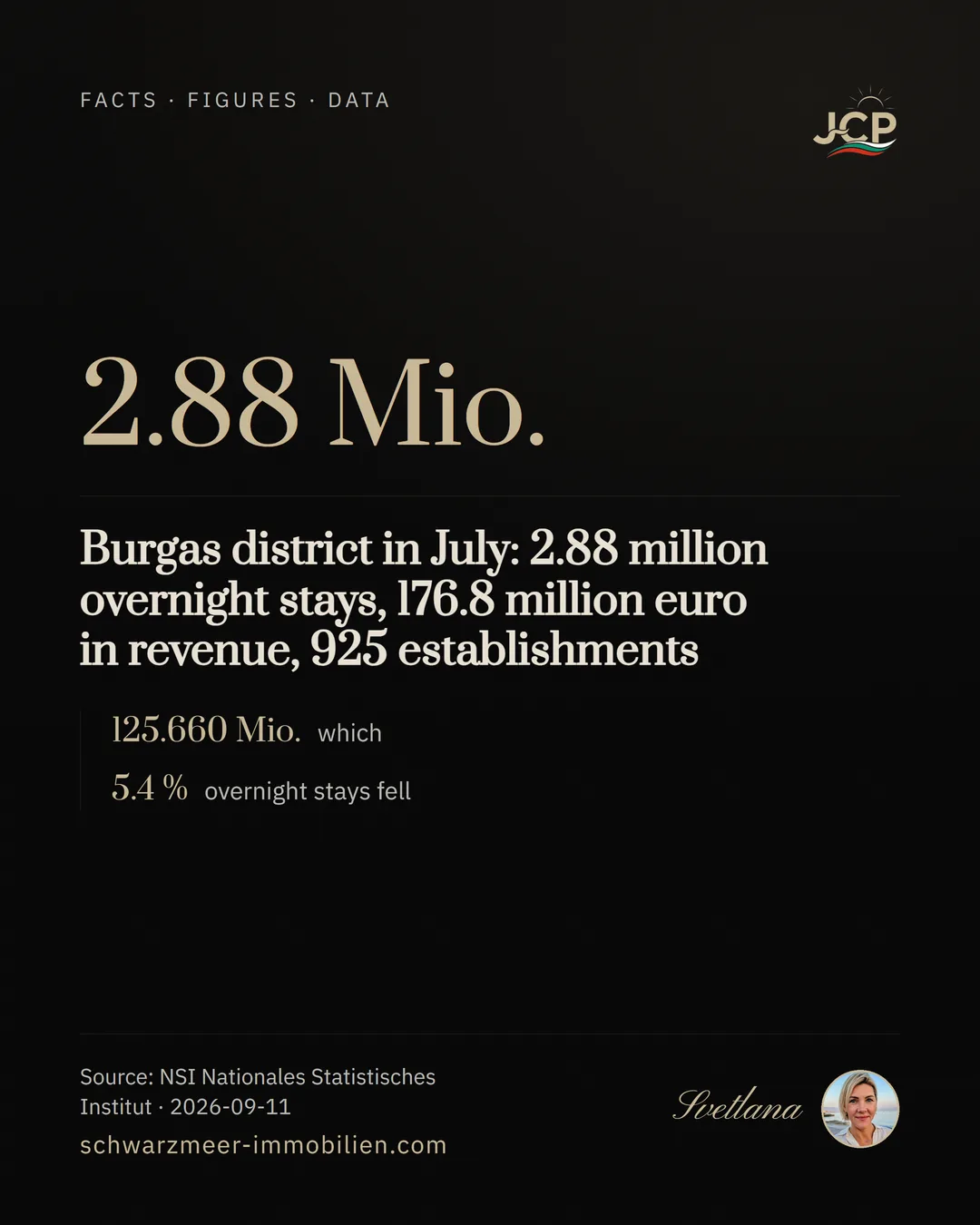
Burgas district in July: 2.88 million overnight stays, 176.8 million euro in revenue, 925 establishments
For July 2026 the National Statistical Institute counts 925 accommodation establishments in Burgas district with 140,360 bed places, 2,876,601 overnight stays and 575,361 arrivals. Revenue reached 176.761 million euro, of which 125.660 million came from non-residents, who booked 1,937,585 of the nights. Nationwide, overnight stays fell by 5.4 per cent to 5.769 million and arrivals by 3.1 per cent to 1.456 million, while revenue rose by 11.4 per cent to 346.4 million euro. Bed occupancy dropped by 2.5 percentage points to 53.3 per cent and splits sharply by category: 67.7 per cent in four- and five-star properties, 45.1 per cent at three stars, 32.3 per cent at one and two stars.
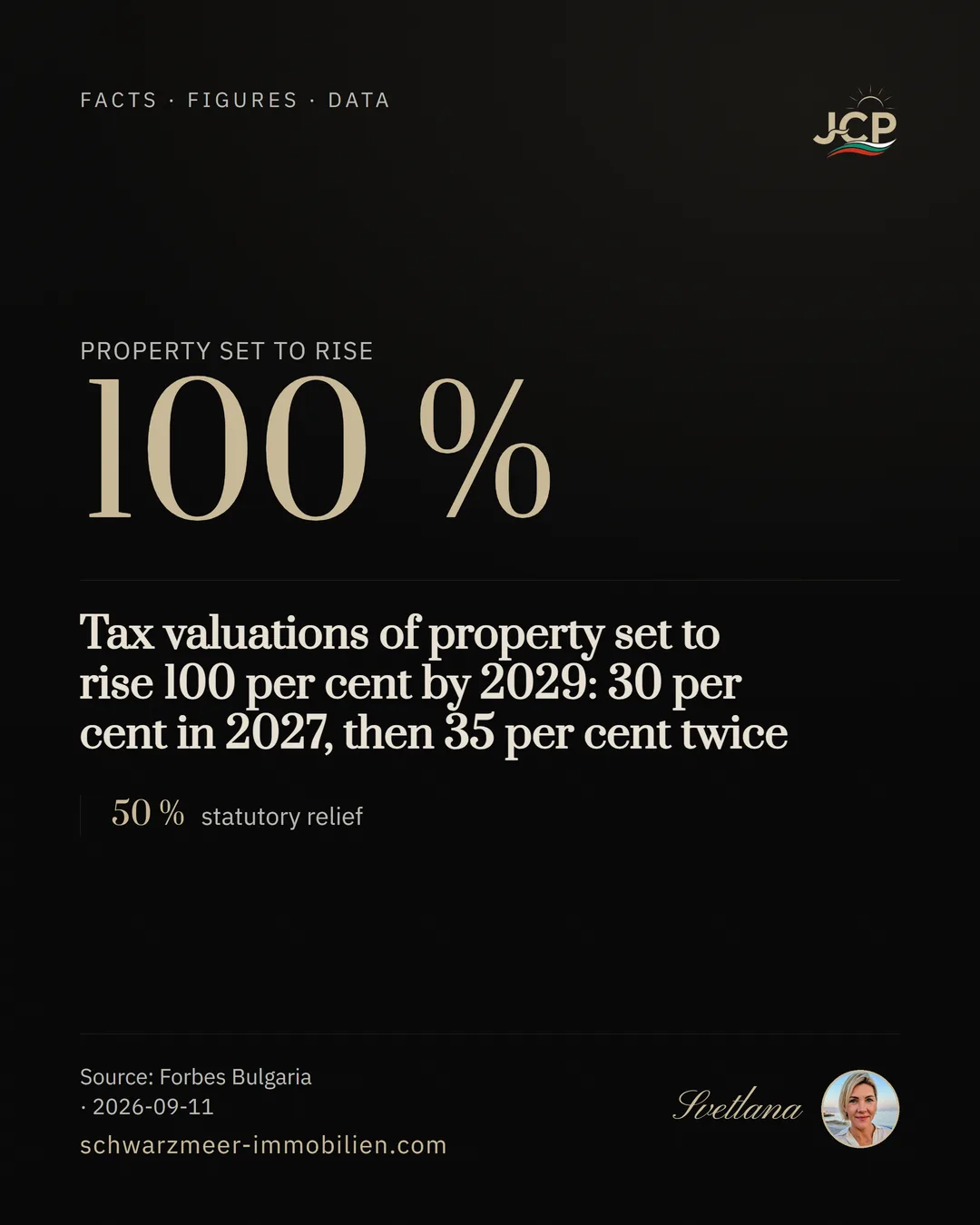
Tax valuations of property set to rise 100 per cent by 2029: 30 per cent in 2027, then 35 per cent twice
Forbes Bulgaria reports on plans to double the tax valuations of Bulgarian property by the end of 2029: 30 per cent in 2027, then 35 per cent in each of the following two years. The valuation base has not been updated since 2007. The rate itself is set by each municipality within a band of 0.1 to 4.5 per mille of the tax value, and a statutory relief of 50 per cent applies to a main residence. The draft budget for 2027, which sets the frame, is expected at the end of October. No adjustment mechanism and no impact assessment have been published so far, and it remains open whether municipalities will lower their rates in return.
Target of 800,000 Polish visitors a year by 2029, industry forum at Sunny Beach on 15 September
The state tourism administration and the Polish Chamber of Tourism are holding an industry forum in Bulgaria for the first time on 15 September 2026, at Sunny Beach. The administration names a target of 800,000 Polish visitors a year by 2029; Bulgaria currently ranks fifth on the Polish market. In organised travel the Bulgarian share rose in 2026 from 5.5 to 6.9 per cent, and in dynamic packaging to 7.5 per cent. The programme covers B2B meetings between Bulgarian hotels and Polish operators for the 2027 season. Co-organisers are the association of incoming agencies, the Melia Sunny Beach hotel and Fraport.
Assessment: Poland is the market with the clearest upward trend for the northern part of our area, and Fraport is not at the table by chance: more seats out of Polish cities feed straight into occupancy in Sunny Beach, Sveti Vlas and Nessebar. For landlords this means planning the shoulder season with Polish operators instead of relying on July and August alone. Anyone holding a property for letting should check whether its fit-out matches what tour operators require.
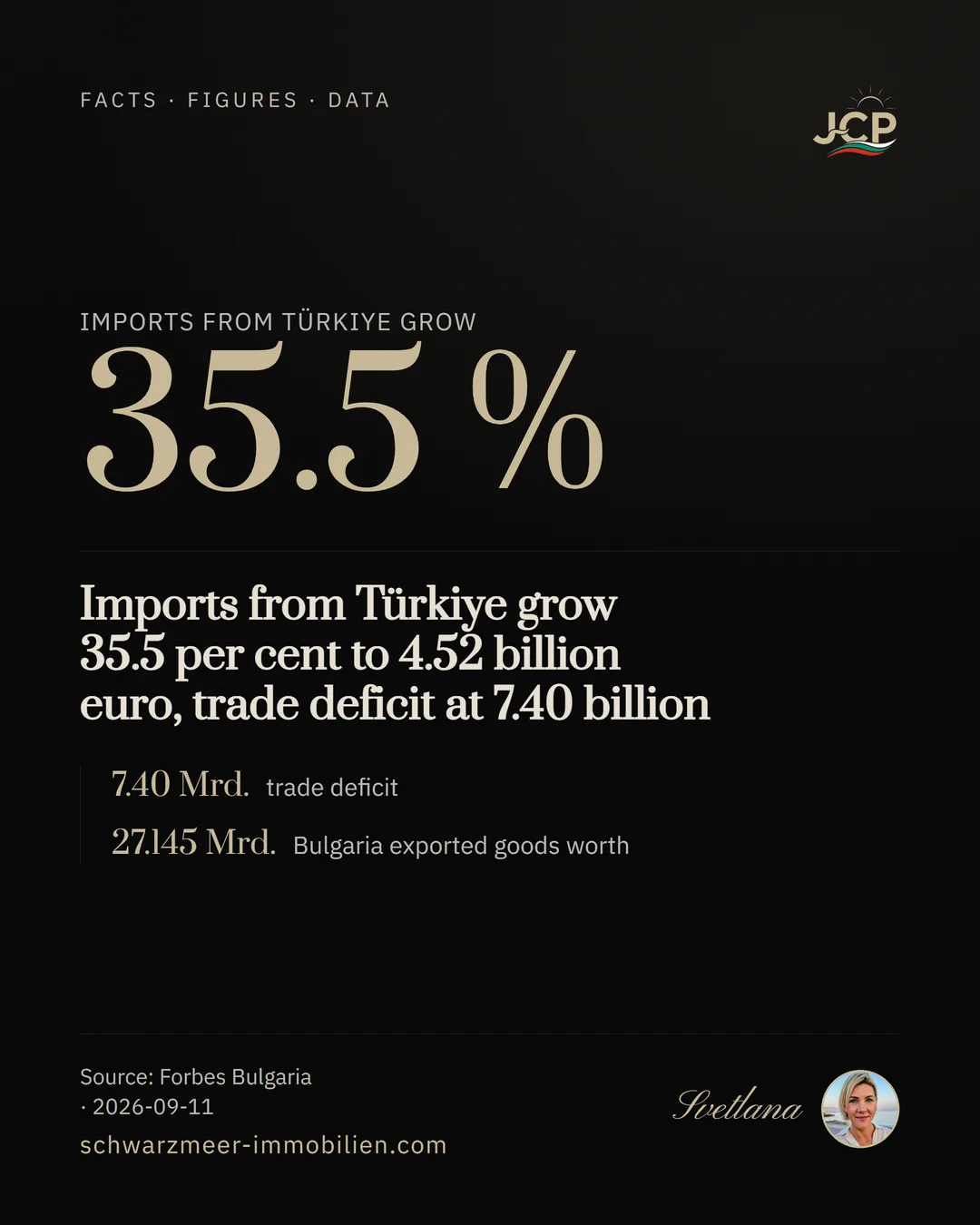
Imports from Türkiye grow 35.5 per cent to 4.52 billion euro, trade deficit at 7.40 billion
From January to July 2026 Bulgaria exported goods worth 27.145 billion euro, up 8.5 per cent, and imported goods worth 34.540 billion euro, up 13.7 per cent; the deficit reached 7.395 billion euro. Outside the EU the gap is widest at 6.411 billion euro. Imports from Türkiye grew by 35.5 per cent to 4.516 billion euro and those from China by 49 per cent to 2.950 billion euro. In July alone exports of 4.063 billion euro faced imports of 5.090 billion euro, a monthly deficit of 1.027 billion euro.
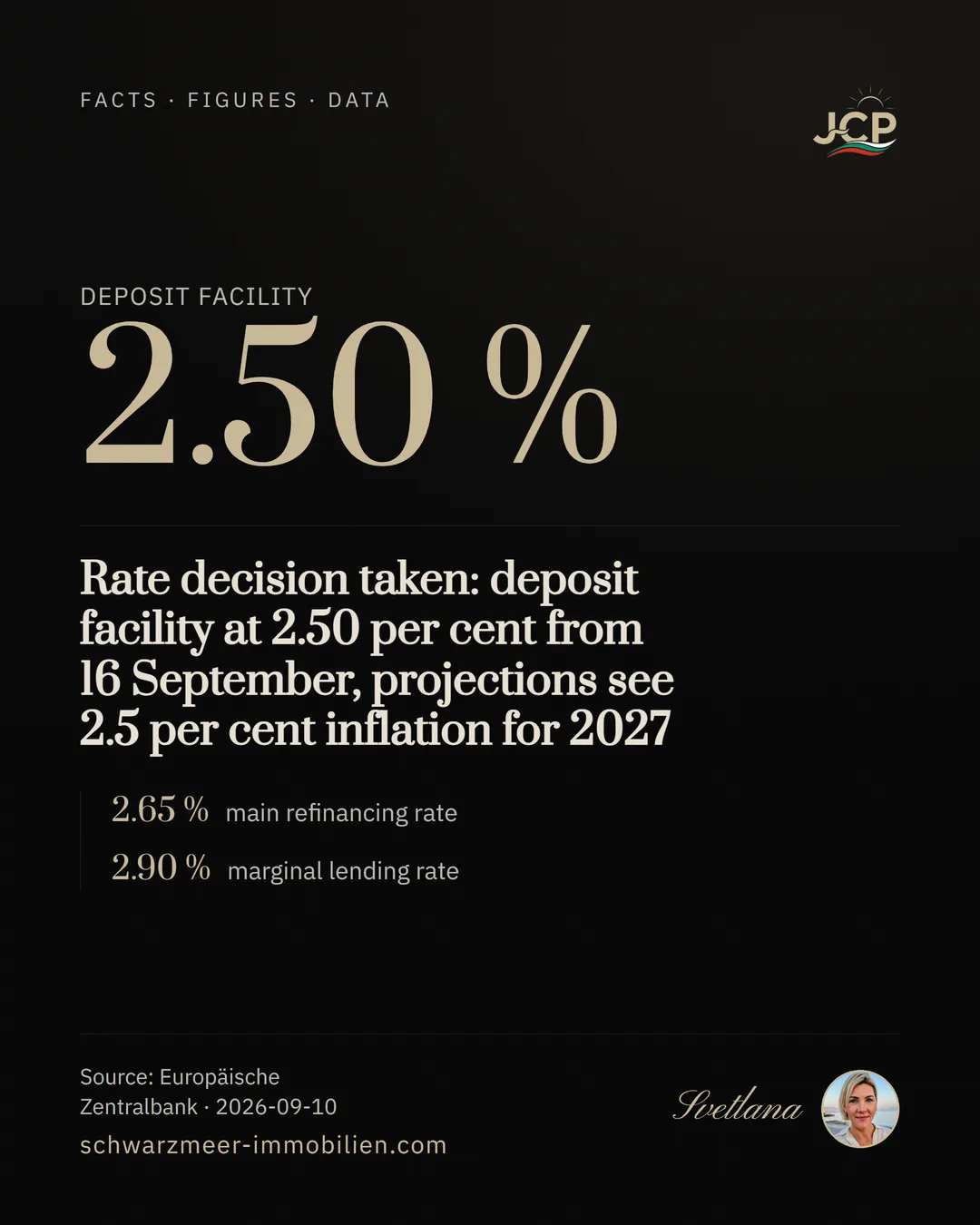
Rate decision taken: deposit facility at 2.50 per cent from 16 September, projections see 2.5 per cent inflation for 2027
The Governing Council of the European Central Bank raised all three key rates by 25 basis points on 10 September, effective from 16 September 2026. The deposit facility rate now stands at 2.50 per cent, the main refinancing rate at 2.65 per cent and the marginal lending rate at 2.90 per cent. The new projections put headline inflation at 3.0 per cent for 2026, 2.5 per cent for 2027 and 2.1 per cent for 2028, and the rate excluding energy and food at 2.5, 2.6 and 2.3 per cent. Growth is projected at 0.9 per cent in 2026, 1.4 per cent in 2027 and 1.5 per cent in 2028, revised upwards for the first two years. The further course remains expressly data-dependent.
Construction output in July: building work 9.5 per cent above last year, down 0.4 per cent on the month
The National Statistical Institute released the construction output indices for July 2026 on 10 September. Seasonally adjusted, building work came in 0.4 per cent below June and civil engineering 0.5 per cent below. Against July 2025, adjusted for working days, building work stands 9.5 per cent higher and civil engineering 5.0 per cent. For the coastal strip the reading is straightforward: the year-on-year picture remains clearly positive while the month-to-month pace is levelling off.
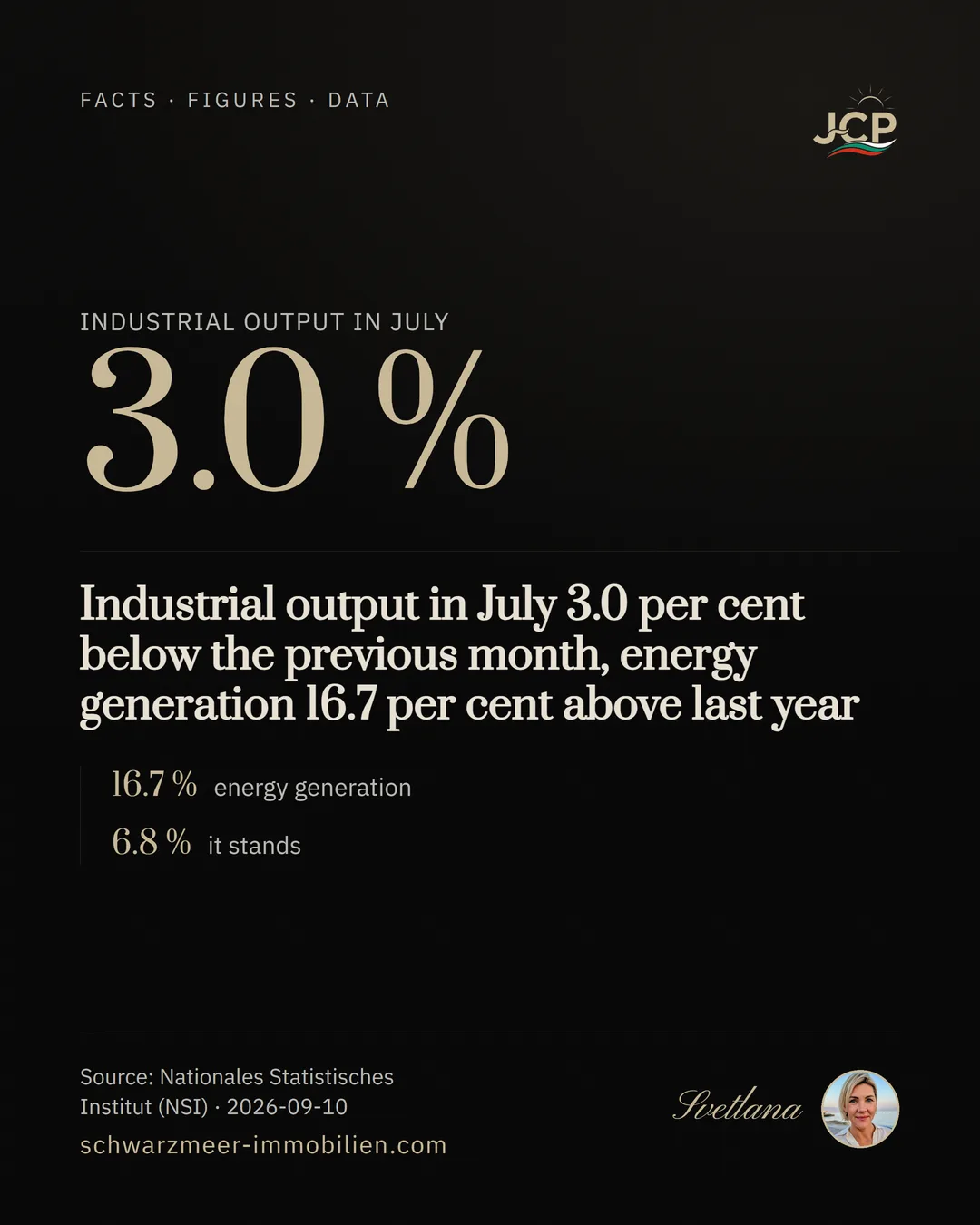
Industrial output in July 3.0 per cent below the previous month, energy generation 16.7 per cent above last year
The industrial production index fell 3.0 per cent in July 2026 against June, the National Statistical Institute reported on 10 September. Year on year, adjusted for working days, it stands 6.8 per cent lower. Mining, down 36.1 per cent, and manufacturing, down 7.3 per cent, carry the decline, while generation and distribution of energy rose 16.7 per cent. Within manufacturing, vehicle production fell 27.3 per cent and electronics 18.4 per cent, the sharpest monthly drops.
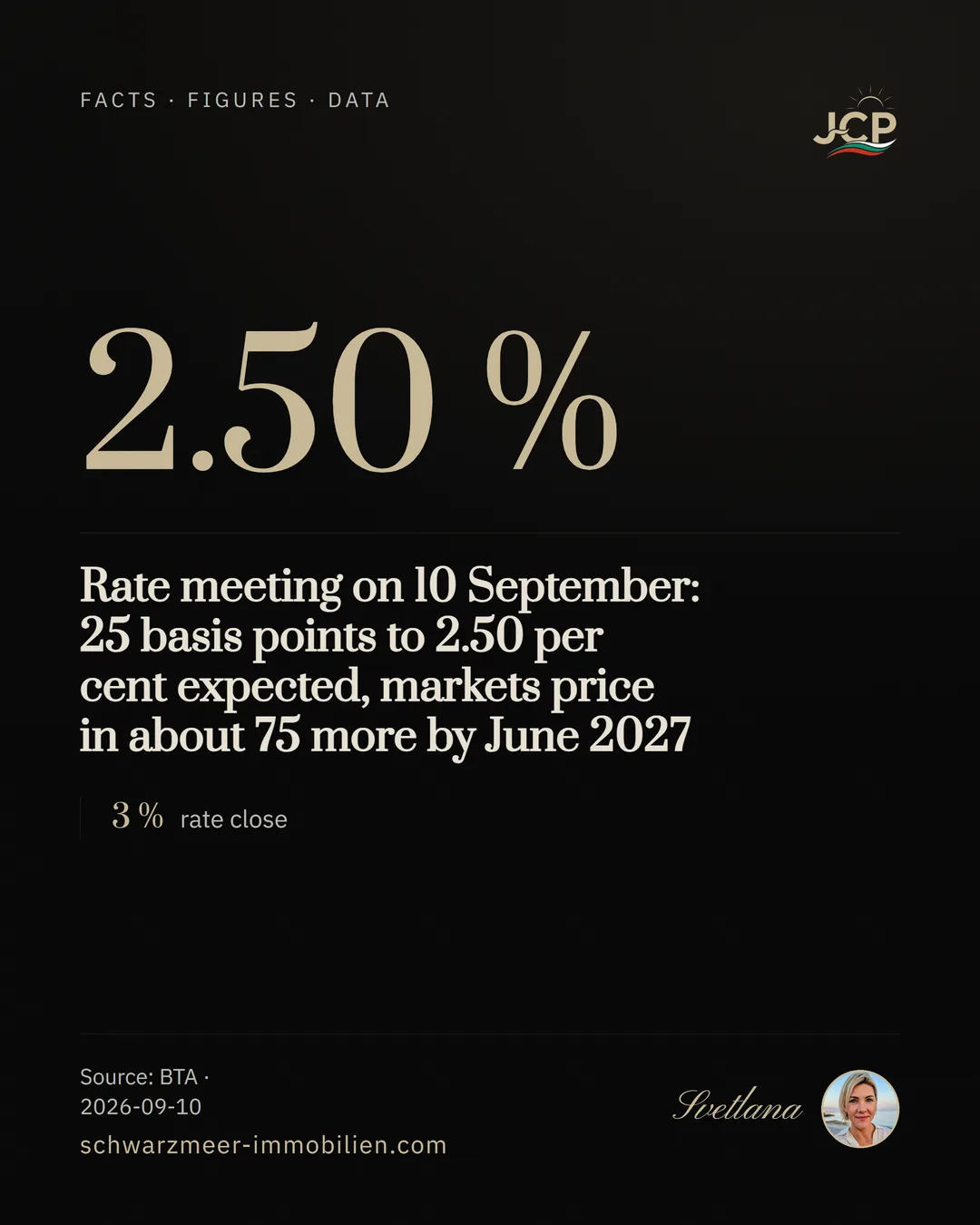
Rate meeting on 10 September: 25 basis points to 2.50 per cent expected, markets price in about 75 more by June 2027
A 25 basis point rise in the deposit rate from 2.25 to 2.50 per cent is treated as all but certain for the European Central Bank meeting on 10 September. That step is already in the price. Beyond it, markets are pricing in some 75 further basis points by June 2027, which would take the rate close to 3 per cent. Bulgaria sits directly inside this rate framework since joining the euro area, so the same direction applies to mortgage pricing here.
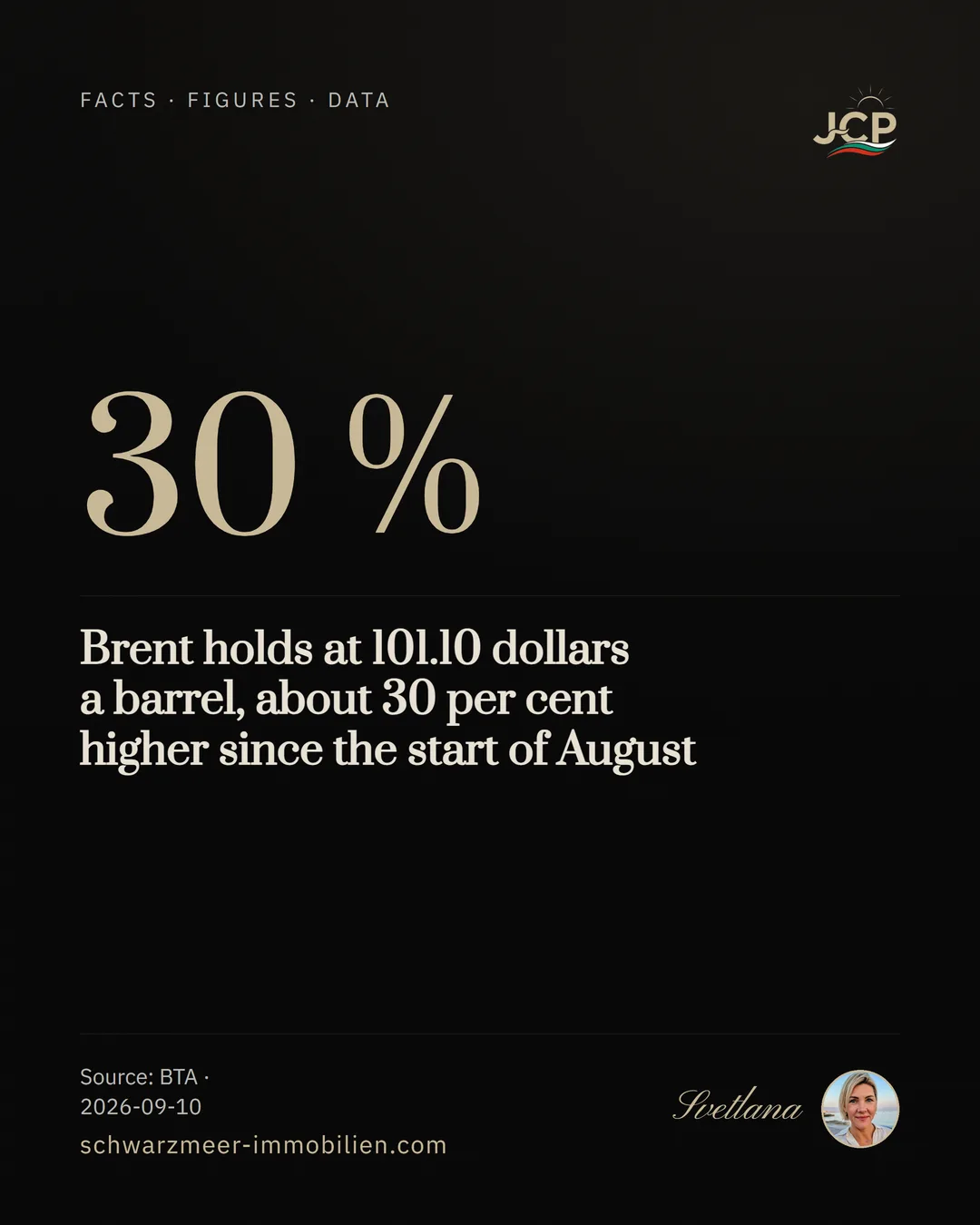
Brent holds at 101.10 dollars a barrel, about 30 per cent higher since the start of August
Brent traded at 101.10 dollars a barrel at 05:56 on 10 September, 0.1 per cent below the previous close. West Texas Intermediate stood at 96.24 dollars, up 0.2 per cent. Brent has been above the 100 dollar mark since 3 September, and the gain since the start of August adds up to roughly 30 per cent. Crude is the upstream stage of pump and heating costs and feeds through with a lag of several weeks.
Cabinet sets aside 170 million euros for electricity compensation, running to 30 June 2027
On 9 September the Bulgarian cabinet approved a budget of 170 million euros in compensation for energy-intensive electricity users. The scheme runs from 1 July 2026 to 30 June 2027, covers up to 50 per cent of the cost of electricity consumed, and applies only where the underlying price is at least 50 euros per megawatt hour. Half of the aid must be reinvested in emission-reduction measures. The legal basis is Decree No 237 and the 2022 EU state aid guidelines for climate and energy; funding comes from the Electricity System Security Fund.
Assessment: This is no direct relief for private owners, but it is a signal for Burgas as a location: the region industrial employers keep a predictable electricity cost base until mid-2027. Where employment holds, demand for year-round lettings holds too, and that is what carries the yield outside the season. The risk I see is that the 50 euro per megawatt hour floor leaves the scheme idle in calm market phases.
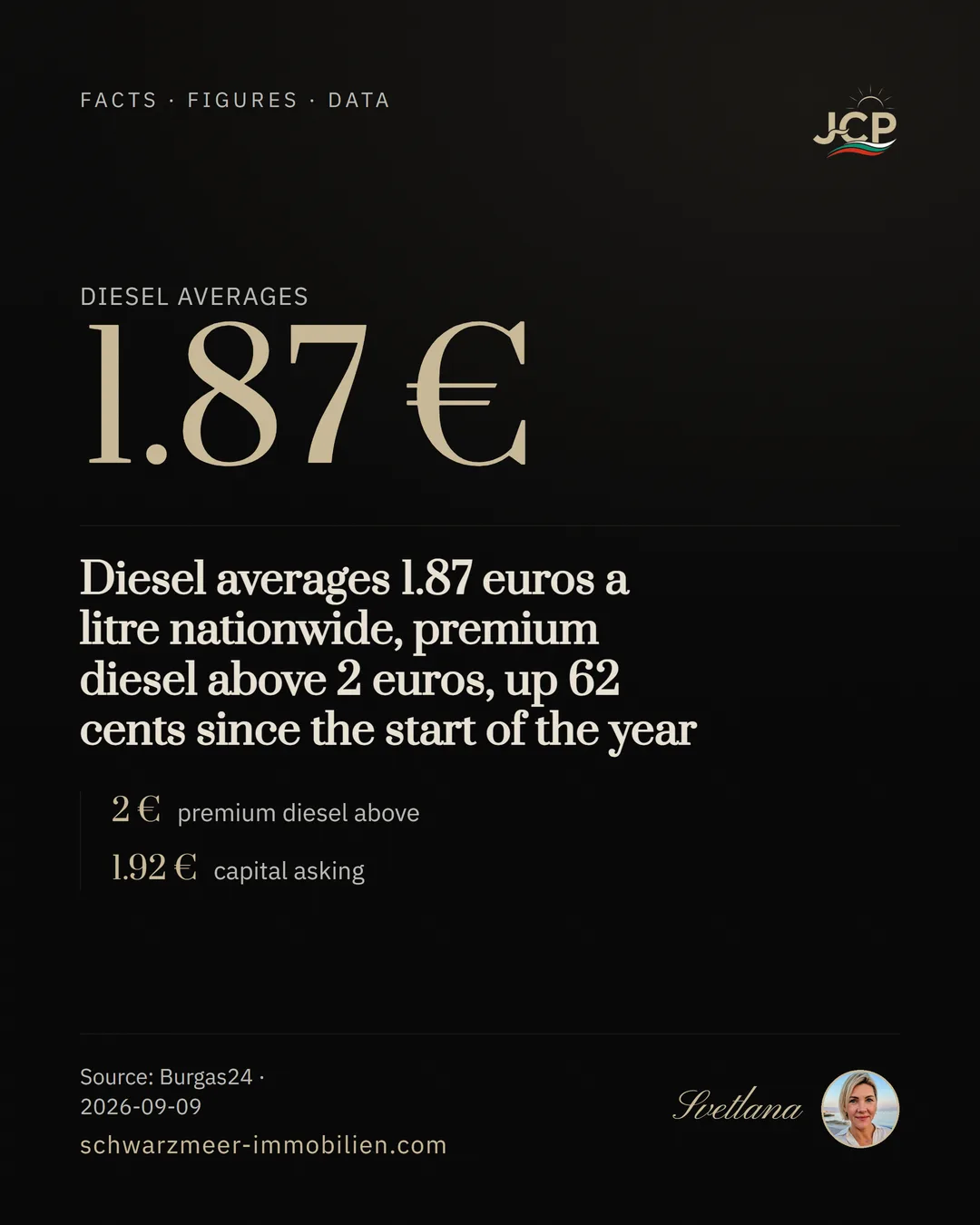
Diesel averages 1.87 euros a litre nationwide, premium diesel above 2 euros, up 62 cents since the start of the year
The national average for diesel stood at 1.87 euros a litre on 9 September, one cent above the previous day, with individual filling stations in the capital asking 1.92 euros. Petrol was unchanged at 1.61 euros on average and autogas at 0.67 euros a litre. Premium diesel averages 2.08 euros and reaches 2.14 euros at some stations, while premium petrol at 1.83 euros sits below ordinary diesel. For comparison, on 9 January petrol averaged 1.23 euros and diesel 1.25 euros, so the rise since then is 38 and 62 cents respectively. The figures come from the Fuelo price platform.
Fiscal data for July: central government revenue of 3,850.52 million euros, social security funds pay out more than they take in
On 9 September the National Statistical Institute published the monthly fiscal data for July 2026. In the central government sub-sector, revenue of 3,850.52 million euros stands against expenditure of 3,513.57 million euros. The social security funds sub-sector collected 1,736.46 million euros and spent 1,759.92 million euros, so here spending exceeds income. The series follows European accounting methodology and forms the numerical basis for the autumn negotiations on contribution bases, tax rates and fees.
Assessment: For owners the telling line in this release is the social security one. A sub-sector that pays out more than it collects in July puts pressure on contribution bases and rates, and that reaches everyone who runs a company here or declares rental income. I follow the series month by month because it runs weeks ahead of the draft budget.
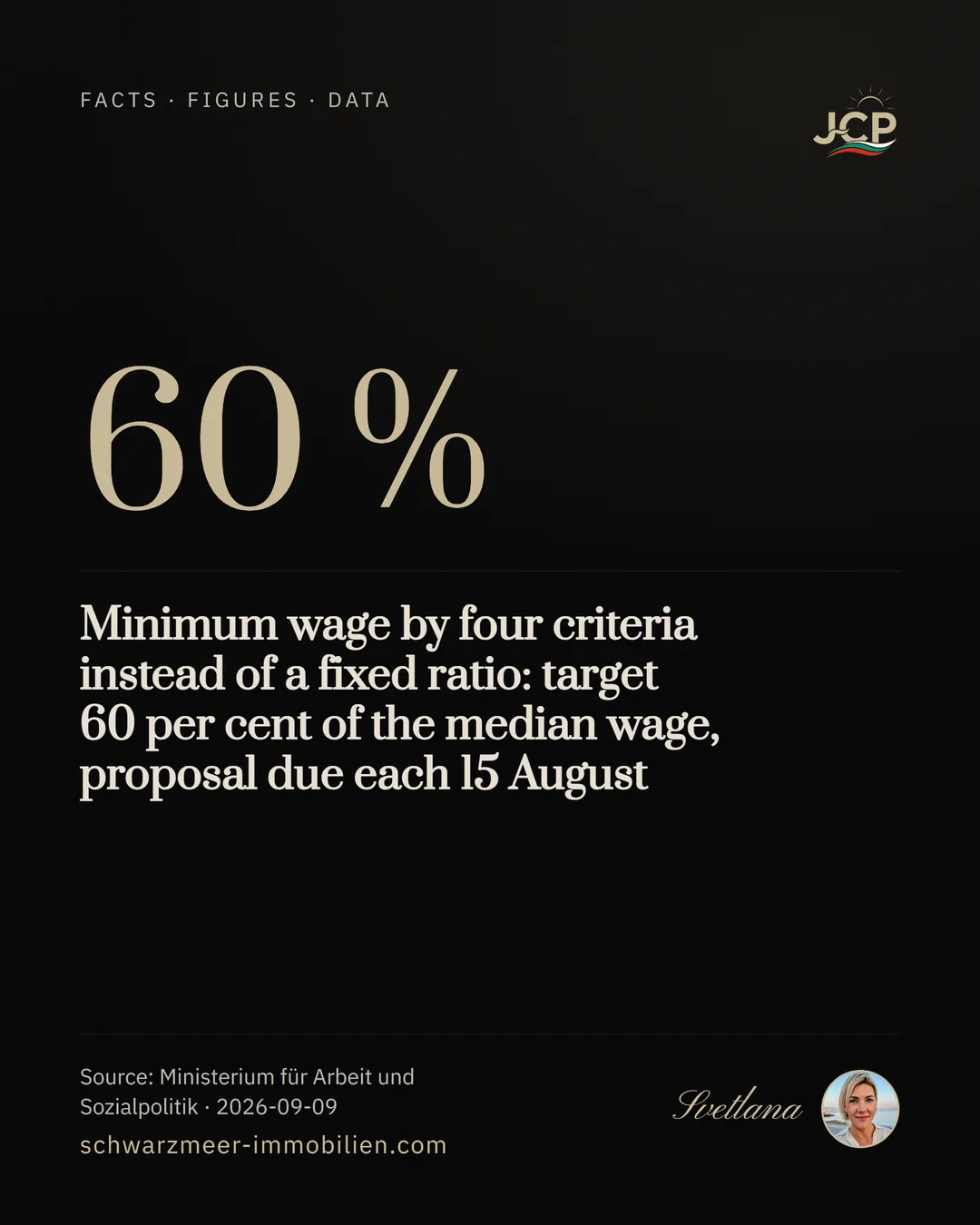
Minimum wage by four criteria instead of a fixed ratio: target 60 per cent of the median wage, proposal due each 15 August
On 9 September the cabinet approved amendments to the Labour Code that will set the minimum wage by four criteria: its purchasing power, the cost of living, the general level and growth rate of wages, and labour productivity. The proposal for the following year must be tabled by 15 August each year, after negotiations with the nationally representative organisations of employees and employers. Adequacy is reviewed every three years; the target is a minimum wage that reaches both 60 per cent of the median wage and the level of the cost of living. The National Statistical Institute is to develop the methodology for calculating the cost of living.
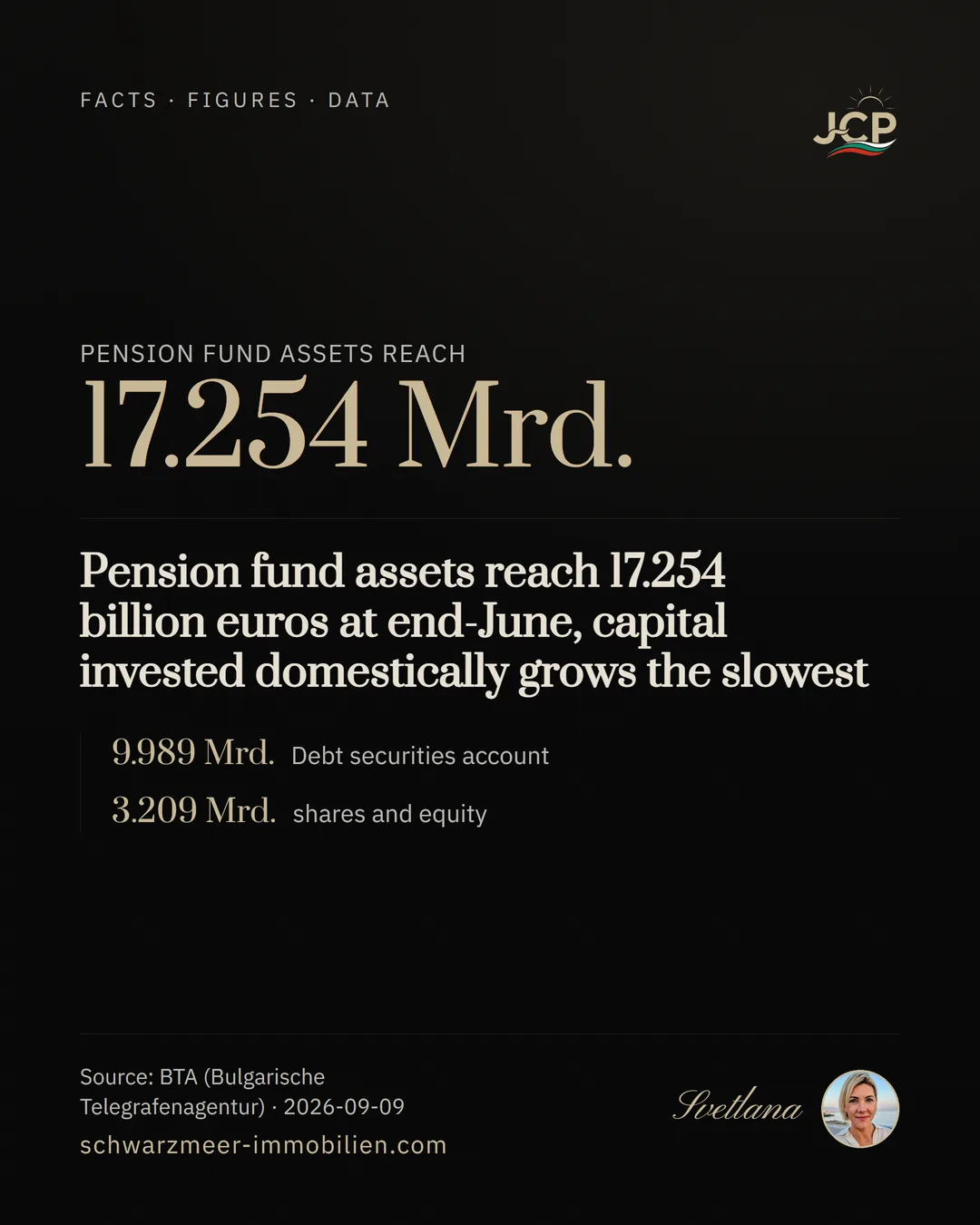
Pension fund assets reach 17.254 billion euros at end-June, capital invested domestically grows the slowest
The National Bank puts the assets of Bulgaria's pension funds at 17.254 billion euros as at 30 June 2026, 16.8 per cent more than a year earlier. Debt securities account for 9.989 billion euros, shares and equity for 3.209 billion with growth of 37.8 per cent, and investment and money market funds for 2.931 billion with growth of 52.8 per cent. Domestic holdings amount to 5.168 billion euros, up 9.2 per cent, holdings elsewhere in the euro area to 6.336 billion, up 21.1 per cent, and holdings outside it to 3.481 billion, up 27.6 per cent. Pension entitlements of 17.176 billion euros make up 99.5 per cent of liabilities.
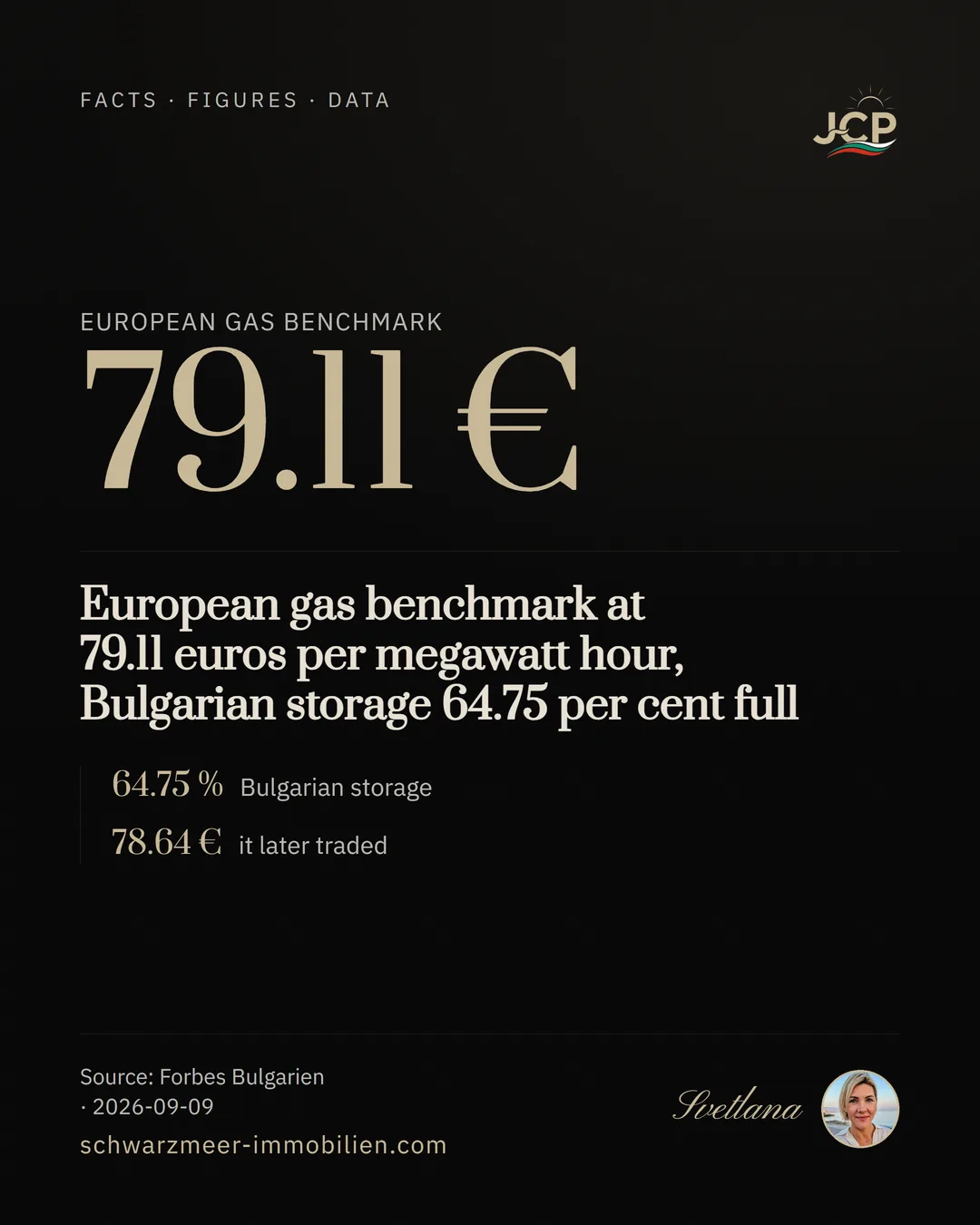
European gas benchmark at 79.11 euros per megawatt hour, Bulgarian storage 64.75 per cent full
The benchmark price for natural gas at the Dutch TTF hub reached 79.11 euros per megawatt hour on 9 September, its highest level since the end of 2022; it later traded at 78.64 euros, 1.22 per cent above the previous session. The price has close to doubled since the start of July. European Union storage stood at 66.9 per cent on 7 September, Bulgarian storage at 64.75 per cent, German at around 54 and Dutch at around 50 per cent. For comparison, in 2022 the price peaked above 300 euros per megawatt hour.
Assessment: On the southern coast natural gas is rarely the heating source; the exchange price works through the electricity price and the running costs of the plant in the complex. Anyone taking over a flat with a gas connection or gas-fired central supply should look at the bills for the past two winters before signing. With a heat pump or split air conditioning it is the electricity tariff that decides, and there it pays to check the meter readings and the connected load.
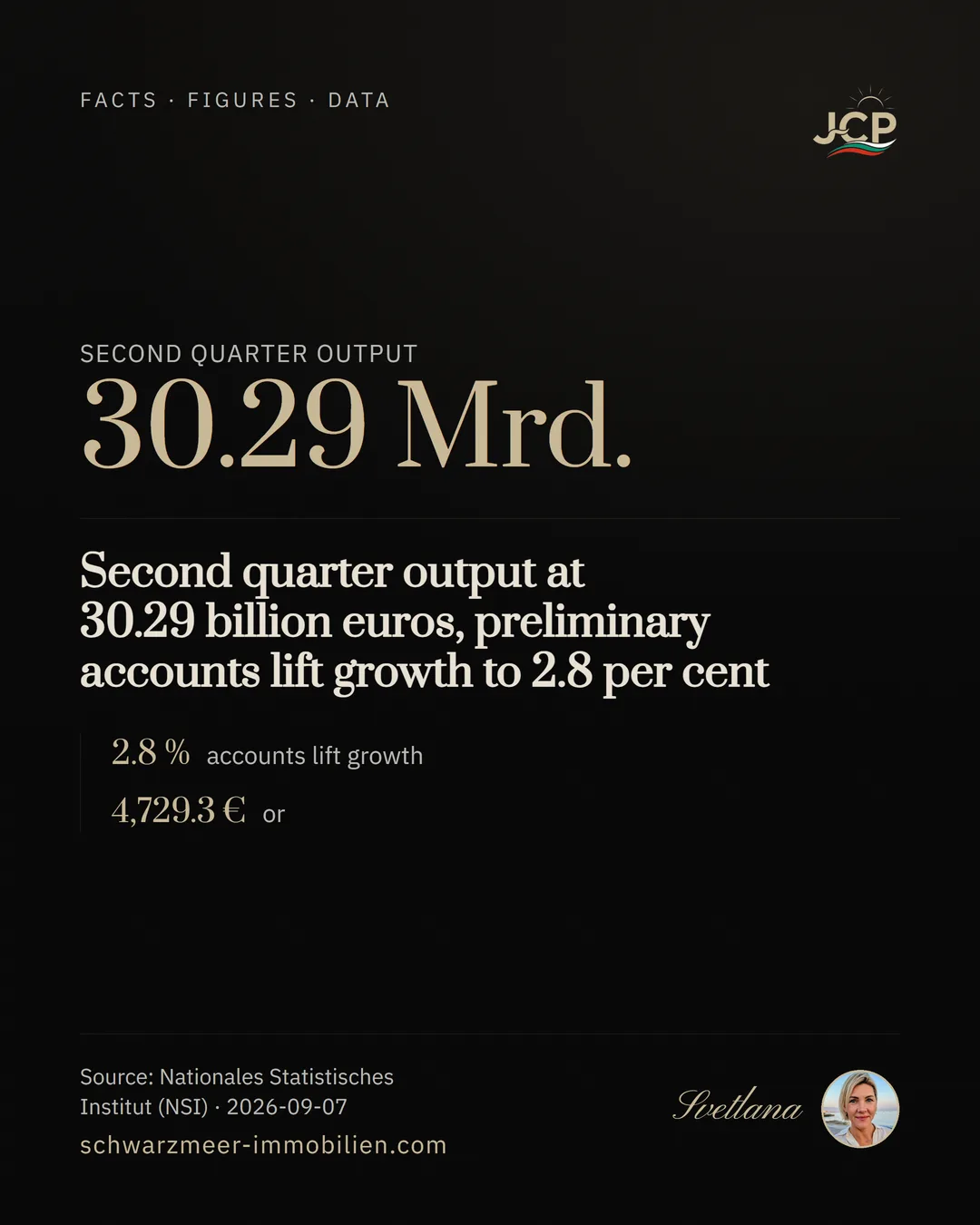
Second quarter output at 30.29 billion euros, preliminary accounts lift growth to 2.8 per cent
On 7 September the National Statistical Institute published preliminary national accounts for the second quarter of 2026. Output reached 30,292.5 million euros at current prices, or 4,729.3 euros per head of population. That is 2.8 per cent above the same quarter of 2025 and 0.7 per cent above the previous quarter after seasonal adjustment; the flash estimate in mid-August had shown 2.7 per cent. Final consumption accounts for 79.0 per cent and gross fixed capital formation for 23.0 per cent, while the external balance stays negative at minus 3.5 per cent (exports 51.8, imports 55.3 per cent of output).
Assessment: For owners on the coast the telling figure is not the growth rate but the 23.0 per cent investment share: as long as close to a quarter of output goes into plant and buildings, cost pressure on new build and refurbishment stays high. The negative trade balance points the same way, because building materials and fittings are largely imported. Sellers sit more comfortably in this setting; anyone planning to build or refurbish should ask for quotations with a short validity and read the price adjustment clauses before signing.
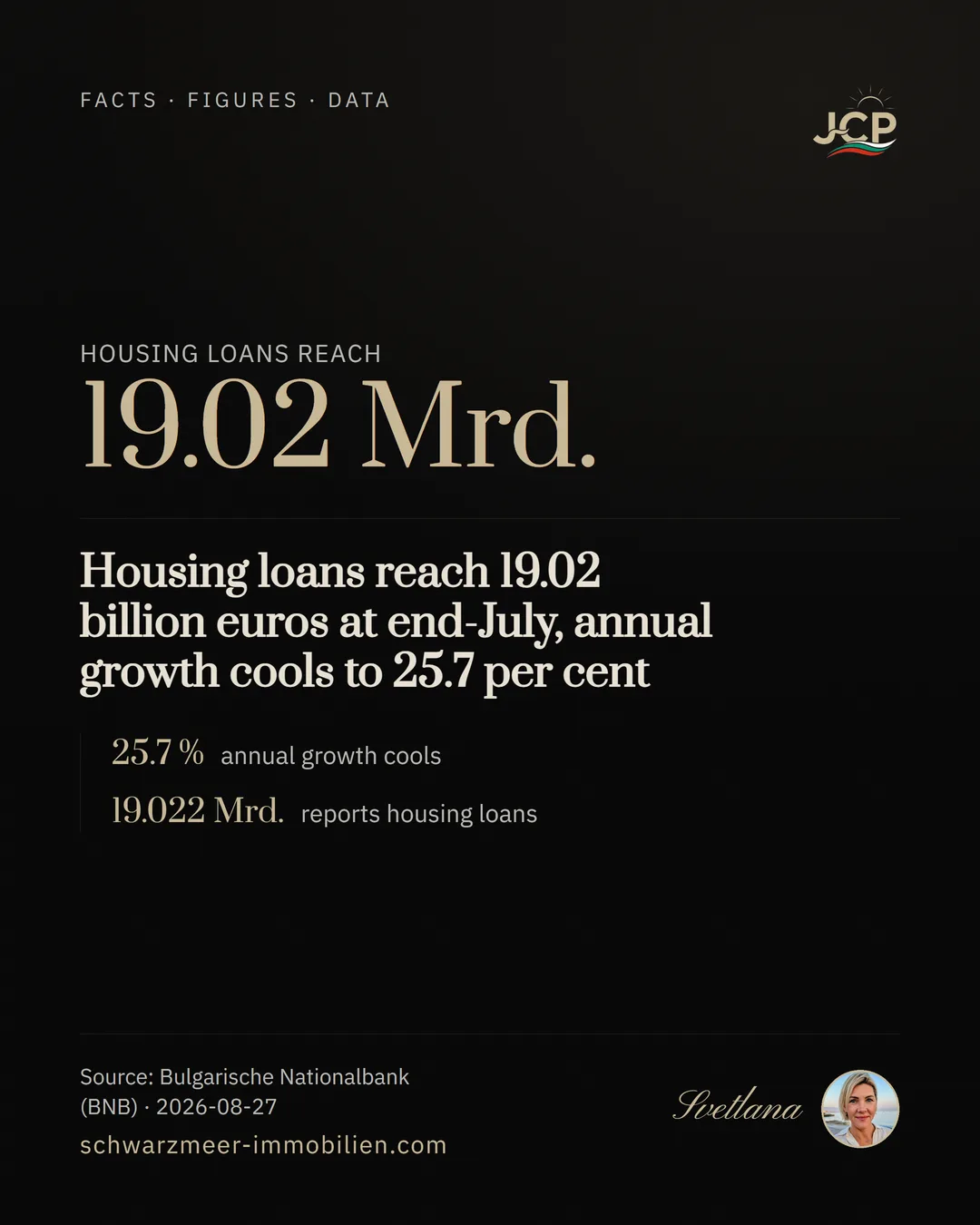
Housing loans reach 19.02 billion euros at end-July, annual growth cools to 25.7 per cent
The central bank reports housing loans of 19.022 billion euros at end-July 2026, 25.7 per cent above the same month a year earlier; in June the annual increase still stood at 26.4 per cent. Total lending to households reached 32.129 billion euros, up 20.8 per cent, consumer loans 12.089 billion (up 15.4 per cent) and loans to non-financial corporations 29.150 billion (up 13.0 per cent). Deposits of the non-government sector add up to 86.305 billion euros, of which 56.859 billion are held by households. The statistics were released on 27 August 2026.
Trade association expects diesel above 1.90 euros per litre, petrol and diesel up 6 to 7 cents recently
The association of fuel traders, producers, importers and transporters expects diesel to rise above 1.90 euros per litre next week. Its representative Dimitar Hadzhidimitrov puts the increase of recent weeks at roughly 6 to 7 cents for both petrol and diesel. He cites tight refining capacity, low stocks and plants running below full utilisation. On top of that comes the lag in purchasing: about three months pass between buying the crude and taking delivery, which is why traders do not build stocks at elevated prices. For comparison, on 1 August diesel averaged 1.76 euros per litre across the country.
Assessment: Fuel is no minor item on the southern coast, because almost every trip to the property, the bank and the notary runs by road. For landlords the price bites twice: in their own journeys and in the travel costs of tradespeople, which experience shows are passed on in service contracts. So I budget the winter running costs with a mark-up and insist that new contracts state the travel flat rate in figures.
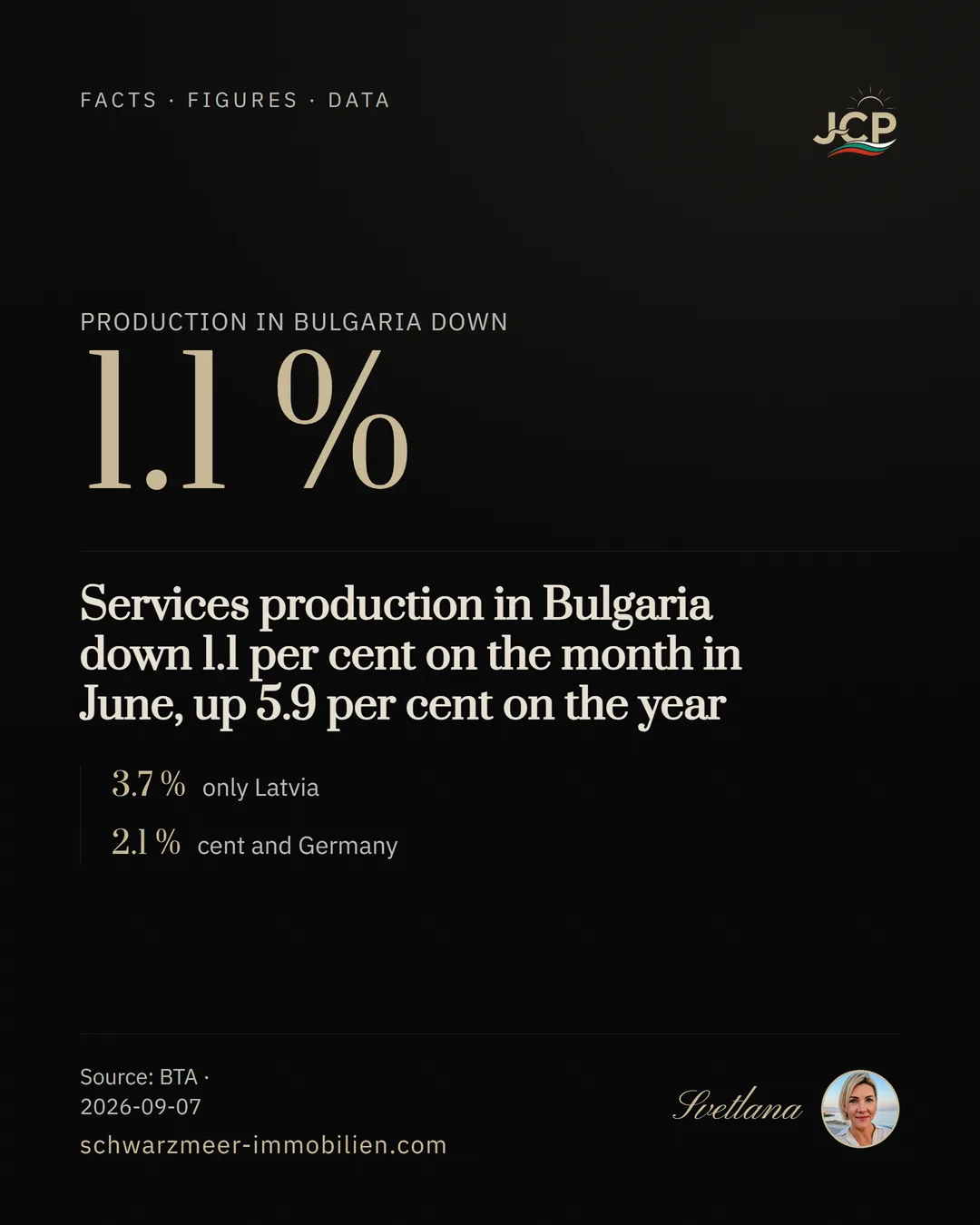
Services production in Bulgaria down 1.1 per cent on the month in June, up 5.9 per cent on the year
According to Eurostat figures published on 7 September, services production in Bulgaria fell by 1.1 per cent in June 2026 against May. That is the third largest monthly decline in the European Union; only Latvia at 3.7 per cent and Germany at 2.1 per cent saw sharper drops. Year on year Bulgaria remains well above the Union average, at 5.9 per cent against 1.5 per cent. Across the Union the index fell by 0.2 per cent on the month in June, and by 0.3 per cent in the euro area. The strongest monthly gains were reported by Luxembourg at 7.8 per cent and Portugal at 3.1 per cent.
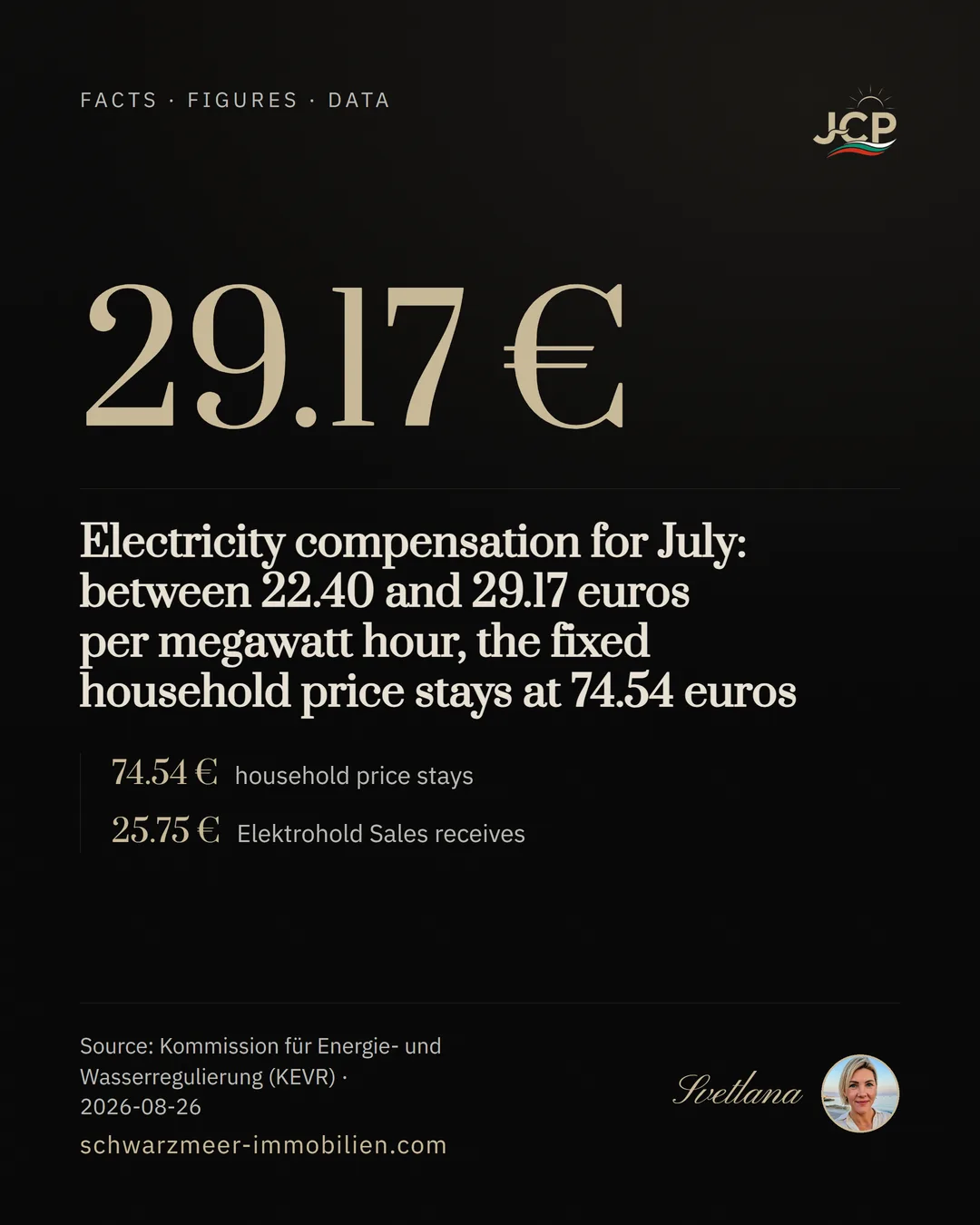
Electricity compensation for July: between 22.40 and 29.17 euros per megawatt hour, the fixed household price stays at 74.54 euros
On 26 August the Energy and Water Regulatory Commission set the compensation amounts for July 2026 that cover part of household electricity costs. Elektrohold Sales receives 25.75 euros per megawatt hour excluding VAT, EVN Bulgaria Electricity Supply 22.40 euros, Energo-Pro Sales 25.18 euros and ESP Zlatni Pyasatsi 29.17 euros. What is compensated is the gap between the fixed household price of 74.54 euros per megawatt hour and the higher procurement prices of that month. The funds come from the Electricity System Security Fund; the legal basis lies in the amendments to the Energy Act.
Assessment: The figure an owner should keep in mind is not the compensation but the fixed price of 74.54 euros per megawatt hour. It shows where the bill would stand without support, and it explains why the service charge forecast for a holiday property should not simply be rolled forward from the last annual statement. For a buyer that means heating load and insulation belong in the viewing, not in the first winter bill.
Social insurance to July: 4,806.2 million euros of revenue, 8,596.9 million euros of spending, average pension 560.13 euros
The National Social Security Institute reports revenue of the consolidated state social insurance budget of 4,806.2 million euros for the period to July 2026, 56.4 per cent of the annual plan and 439.4 million euros or 10.1 per cent more than a year earlier. Spending stood at 8,596.9 million euros, 56.3 per cent of plan and 744.1 million euros or 9.5 per cent above the same period of 2025. Of that, 7,655.0 million euros went on pensions, an increase of 694.7 million euros or 10 per cent. The number of pensioners rose by 11,784 to 2,069,181, and the average monthly pension by 7.9 per cent from 519.07 to 560.13 euros. Cash benefits and allowances absorbed 883.9 million euros.
Regulator adopts incentives for water utility mergers: costs may be spread over up to three years, plan changes within 60 days
On 21 August the Energy and Water Regulatory Commission adopted the final ordinance on regulatory incentives for mergers of water and sewerage operators. Economically justified costs directly connected with a merger are recognised and may be spread over up to three years. Business plans involving a merger receive priority review, and amendments to already approved plans are processed within 60 days. Also recognised are investments in integrating systems, in connecting pipelines, in modernising facilities and in shared information systems. The basis is the amendment to the Water Act in force since 8 June 2026 and a commitment under the national recovery and resilience plan; the stated aim is socially bearable prices.
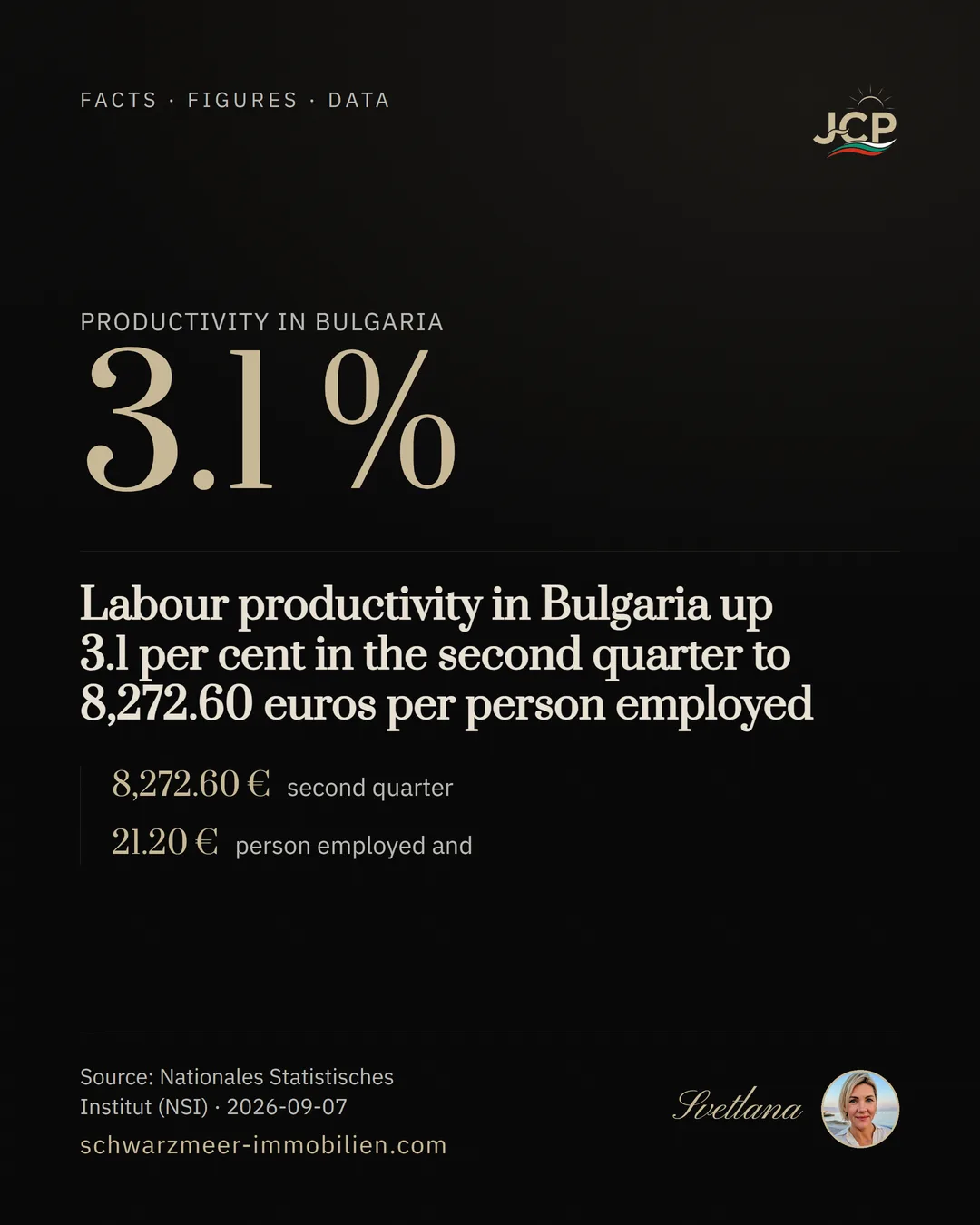
Labour productivity in Bulgaria up 3.1 per cent in the second quarter to 8,272.60 euros per person employed
The statistics institute reports gross domestic product of 8,272.60 euros per person employed and 21.20 euros per hour worked for the second quarter of 2026. In real terms output per person employed stands 3.1 per cent above the same quarter of 2025, while gross value added rose by only 0.3 per cent per person employed and 0.5 per cent per hour worked. A total of 3,661,800 people worked 1,428.3 million hours. By sector, industry leads with 7,898.20 euros of value added per person employed, ahead of services with 7,298.40 euros and agriculture with 1,305.80 euros; the employment share of services grew while industry and agriculture lost ground.
Assessment: For landlords and developers on the coast this is the wage side of the arithmetic. With value added per hour worked up by only 0.5 per cent in real terms, the pay steps announced for 2027 are not carried by productivity. So I keep budgeting rising rates for management, cleaning and maintenance, and I advise putting a price clause into any service contract that runs beyond twelve months.
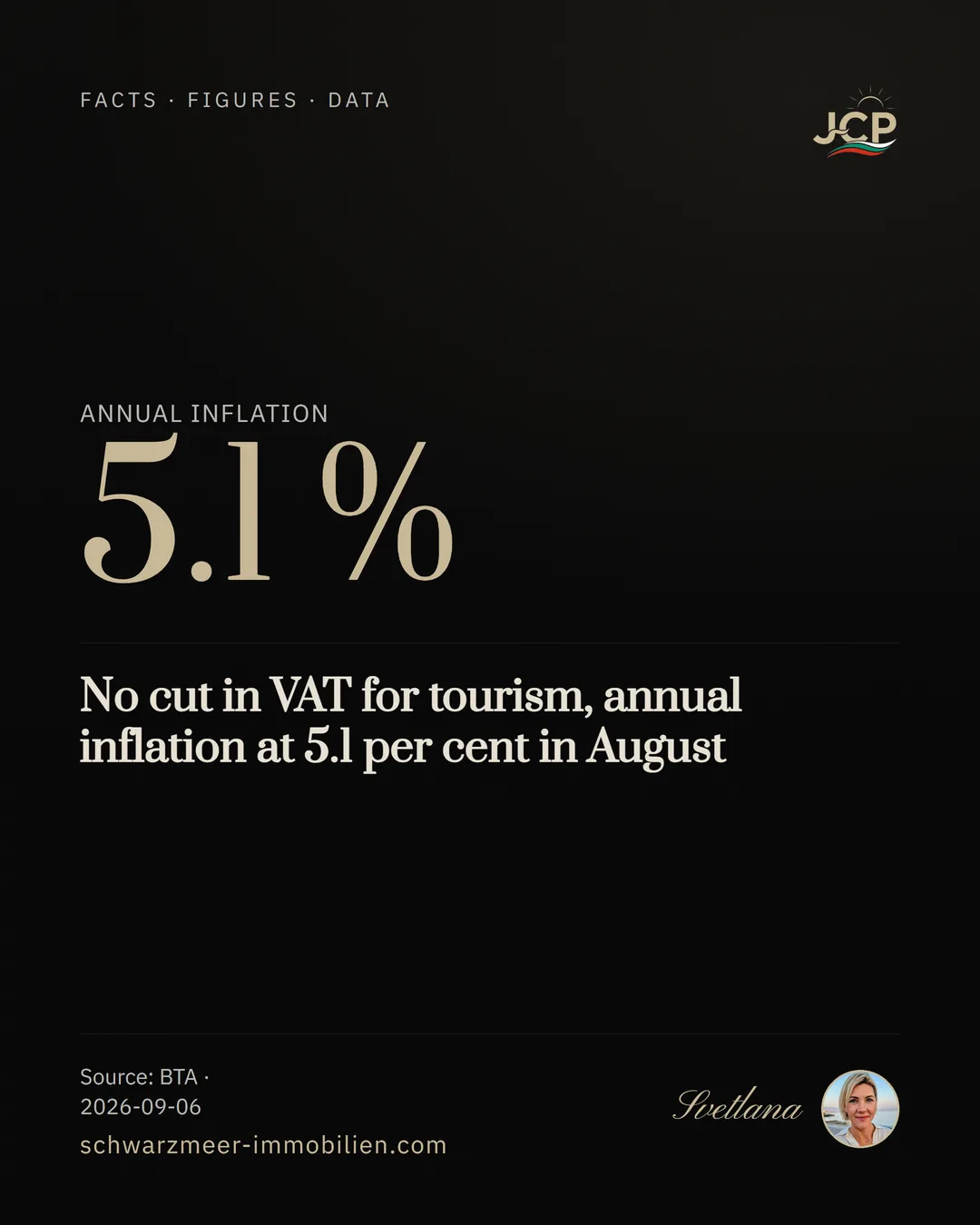
No cut in VAT for tourism, annual inflation at 5.1 per cent in August
Deputy Premier Atanas Pekanov said on 6 September that VAT for tourism will not be reduced. He argued that the sector had already received considerable concessions after the pandemic support and had incurred no additional costs that would justify higher prices. On his figures the services sector recorded the second largest price rise of all sectors in July and August; annual inflation stood at 5.1 per cent in August. Food prices, he said, have fallen since May following talks with the retail chains. For the coming season he called on restaurants to cut prices in nominal terms.
Assessment: For owners letting a flat on the coast this is news you can plan with: the reduced rate on accommodation stays where it is, and no further relief is to be expected for the 2027 season. Anyone doing the sums should read the expectation of nominally falling restaurant prices alongside it, because it shows where price pressure in coastal tourism is heading. I see in it an argument for properties with real quality rather than for premiums justified by location alone.
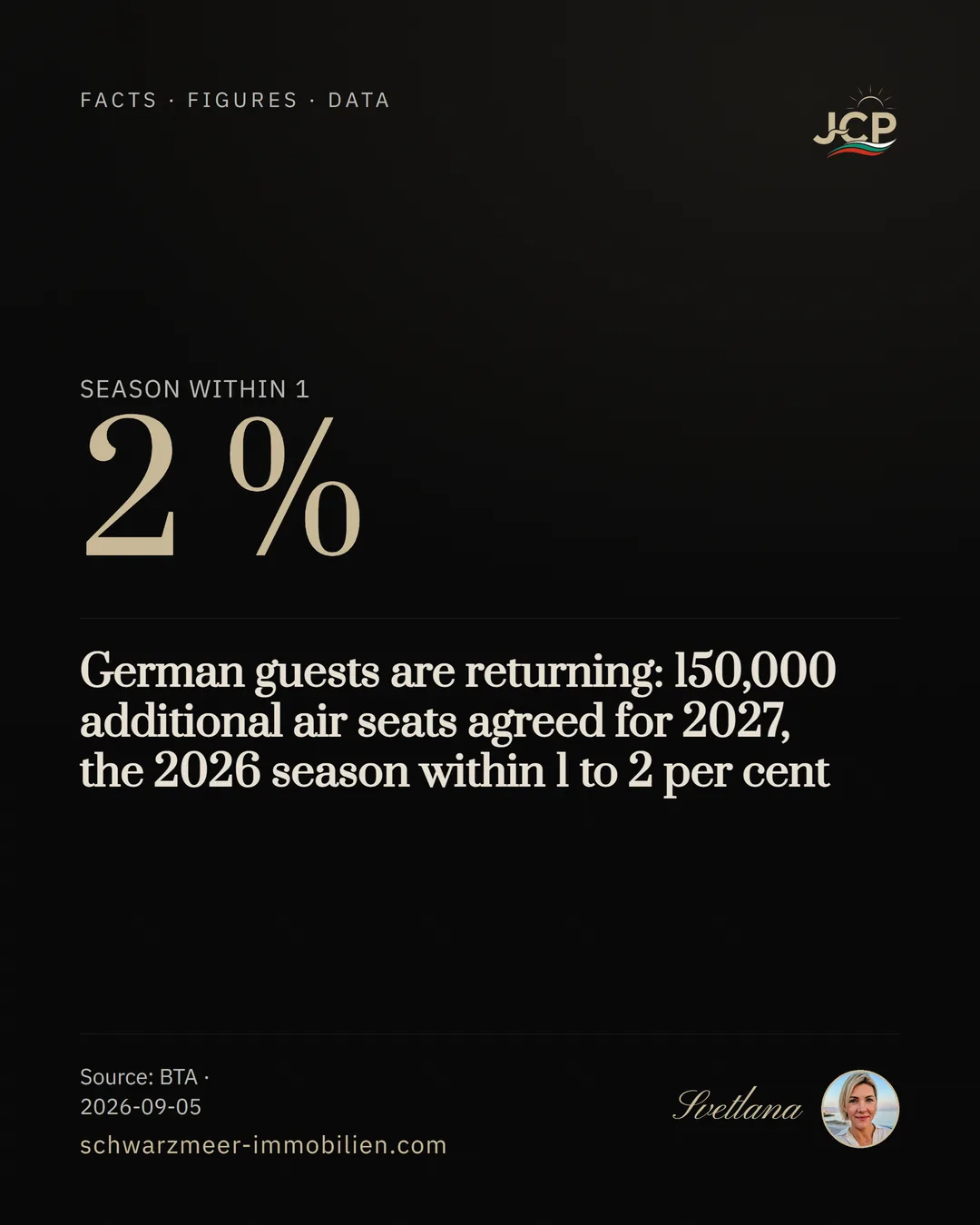
German guests are returning: 150,000 additional air seats agreed for 2027, the 2026 season within 1 to 2 per cent
The tourism ministry expects the 2026 summer season to end within one to two per cent of the previous year. May and June were weaker because around 200,000 air seats from the German market were missing; the shortfall was made up later in the season. For the coming season some 150,000 additional air seats have been agreed, from which the ministry considers 25 to 30 per cent more German guests than in 2026 achievable. German holidaymakers book charter flights with a minimum duration of seven days and arrive earlier, which lengthens the operating season of the hotels. On price levels along the Black Sea coast, results were good where mark ups stayed moderate. To tackle informal letting, the ministry wants short term rentals to be registered in the unified tourism information system and the properties linked to the booking platforms so that the tax is captured.
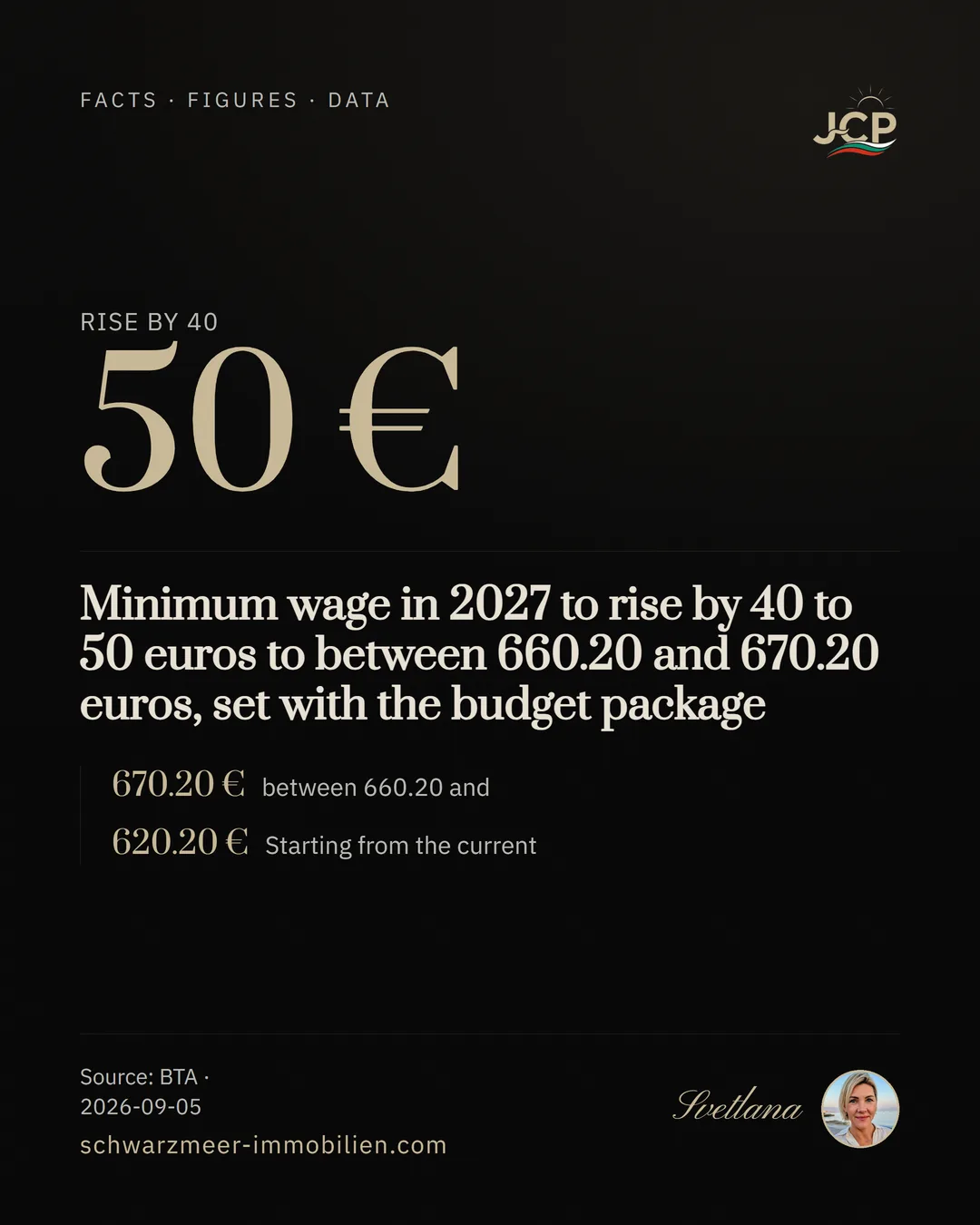
Minimum wage in 2027 to rise by 40 to 50 euros to between 660.20 and 670.20 euros, set with the budget package
The Labour and Social Policy Ministry regards a rise of 40 to 50 euros in the monthly minimum wage as the most realistic scenario for 2027. Starting from the current 620.20 euros that would give between 660.20 and 670.20 euros. The exact amount will be set with the 2027 budget legislation package; a higher upper limit was agreed between the cabinet, the trade unions and the employers' associations and complies with the requirements of EU law. Every three years the minimum wage will in future be measured against the cost of living, purchasing power, the development of the average wage and labour productivity. A final decision has not yet been taken.
Vertical Gas Corridor grows to nine countries, Bulgarian section due for completion on 1 October 2026
North Macedonia and Serbia have joined the Vertical Gas Corridor; the memorandum of understanding was signed in Thessaloniki on 4 September 2026 at the tenth Energy Forum for South East Europe. The project now covers nine countries: Bulgaria, Greece, Romania, Hungary, Slovakia, Ukraine, Moldova, North Macedonia and Serbia. Transmission operator Bulgartransgaz expects the facilities on Bulgarian territory to be completed on 1 October 2026. The operators involved intend to make joint use of existing infrastructure, identify additional capacity needs and improve cross-border transmission at regulatory, technical and commercial level.
Assessment: If you heat electrically on the southern coast, gas reaches you only through the electricity price, and that is where the lever sits. More supply routes mean more competition for the same customer; whether that shows up in the monthly price decision will only become clear over the winter. For properties with their own gas connection it is worth checking the contract now rather than looking for it in December.
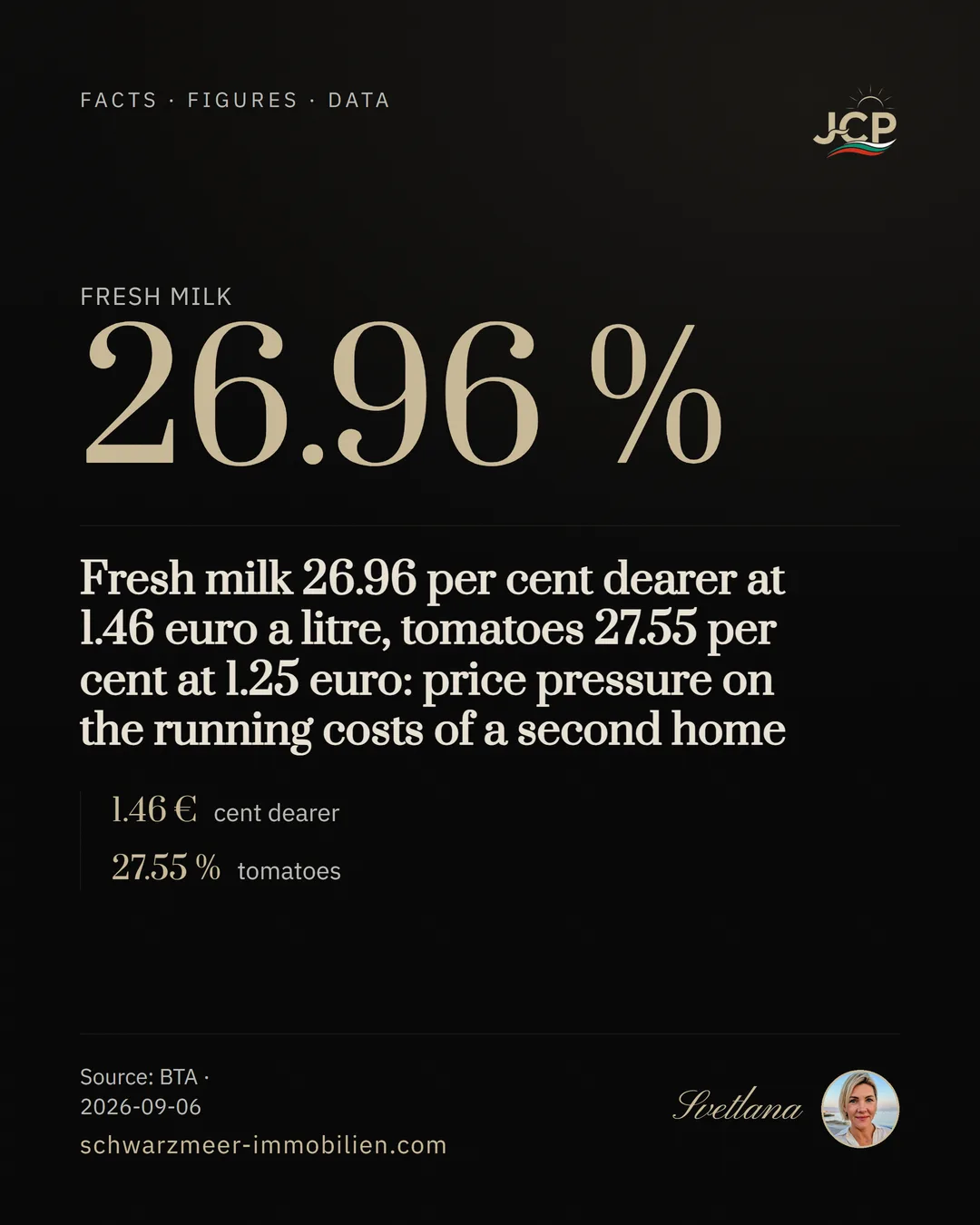
Fresh milk 26.96 per cent dearer at 1.46 euro a litre, tomatoes 27.55 per cent at 1.25 euro: price pressure on the running costs of a second home
The weekly survey of 6 September shows marked increases among staple foods: fresh milk rises by 26.96 per cent to 1.46 euro a litre, type 500 flour by 7.69 per cent to 0.70 euro a kilogramme, butter by 6.12 per cent to 1.56 euro for a 125-gramme pack and sugar by 4.6 per cent to 0.91 euro a kilogramme. Among vegetables tomatoes gain 27.55 per cent to 1.25 euro and courgettes 11.69 per cent to 0.86 euro a kilogramme, while green peppers give way by 9.65 per cent to 1.03 euro and onions by 9.68 per cent to 0.56 euro. Among fruit lemons fall by 12.62 per cent to 1.80 euro, peaches by 5.65 per cent to 1.17 euro and apples by 0.88 per cent to 1.13 euro a kilogramme. Potatoes cost 0.58 euro a kilogramme, 5.93 per cent less than in the previous week.
Assessment: For a second property on the coast these are not marginal figures, because milk, flour and butter feed straight into the running costs of a let flat that serves breakfast. I read the weekly survey chiefly as a leading indicator: when staple foods climb in double digits, the price lists of service providers follow a few months later. Anyone calculating for the coming season does better to set ancillary costs generously than tightly.
CHECKLIST: waste charge in Nessebar municipality – exemption for year-round non-use only on a declaration by 31 October of the preceding year
Ordinance 11 of the Nessebar municipal council calculates the waste charge in two ways: by the type and number of containers together with the emptying frequency, or by the tax valuation of a residential property, respectively the higher value for commercial objects. Under article 26 paragraph 1 item 2 no charge is levied where the plot is undeveloped or is not used for the whole calendar year and a declaration to that effect has been filed. The declaration is submitted in writing to the municipality; the deadline is 31 October of the preceding year, for as long as the council does not change it by resolution. Checklist: ask which basis applies to your object; decide whether the flat will really stay unused all through the coming year; file the declaration before 31 October and have receipt acknowledged; do not apply for the exemption if you let the flat in season, because the condition is then absent.
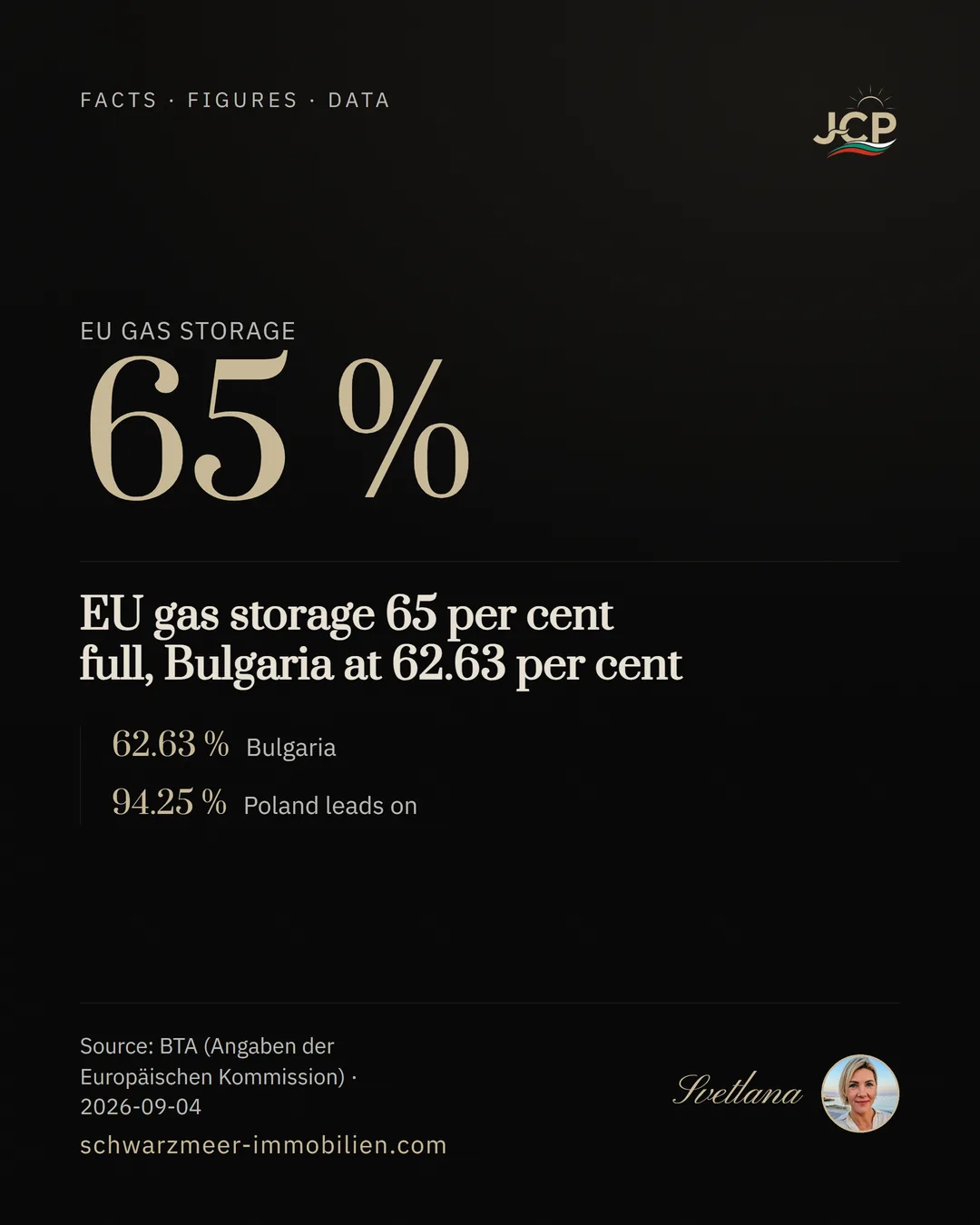
EU gas storage 65 per cent full, Bulgaria at 62.63 per cent
EU gas storage facilities were 65 per cent full on 4 September 2026, and the Bulgarian ones 62.63 per cent. Poland leads on 94.25 per cent, ahead of Portugal on 93.08 and Italy on 83.25; at the other end sit Latvia on 45.47, the Netherlands on 48.21 and Slovakia on 50.75 per cent. The European storage regulation names 90 per cent as the target and permits a shortfall of five percentage points. The European Commission regards 80 per cent as sufficient for the coming winter.