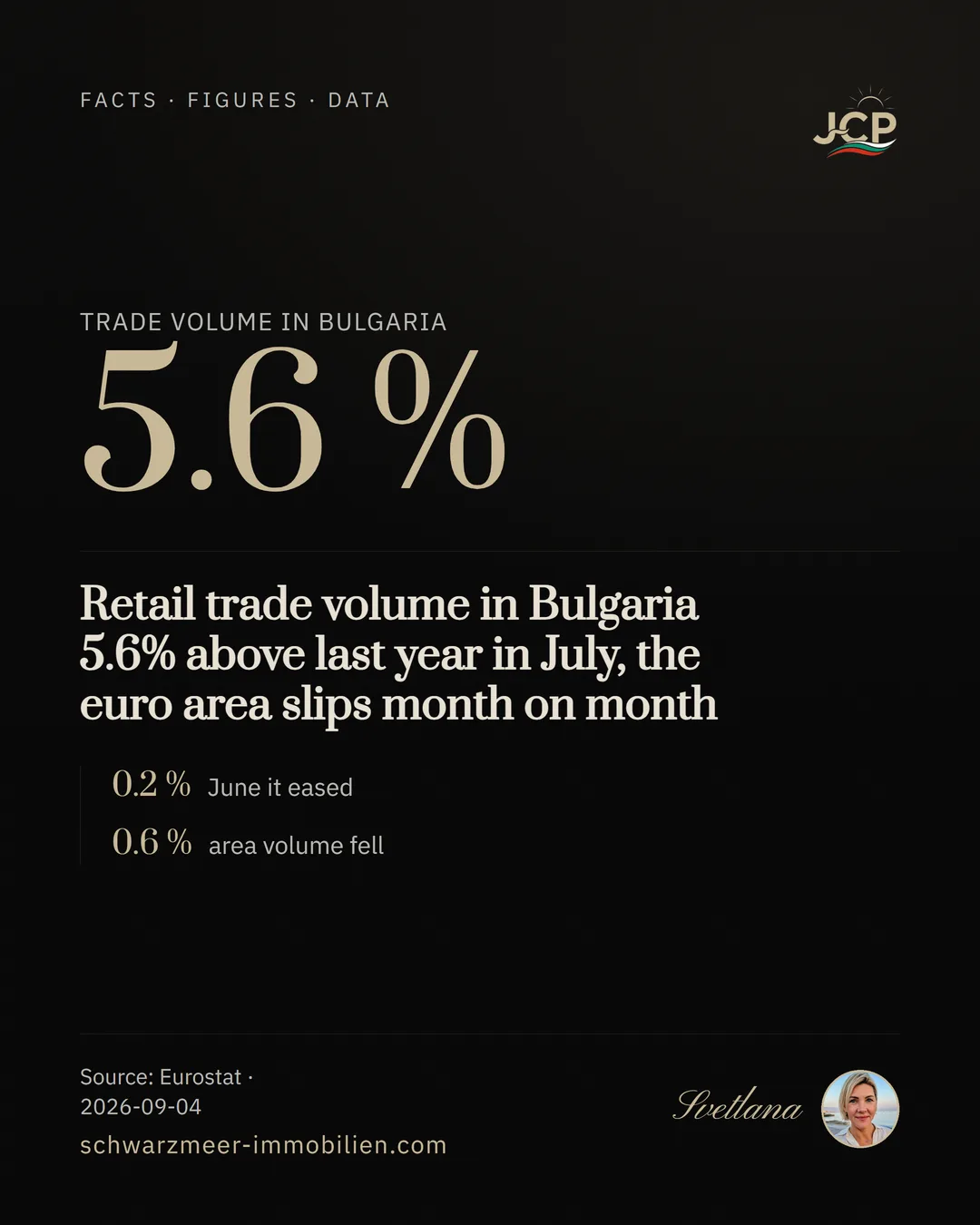
Retail trade volume in Bulgaria 5.6% above last year in July, the euro area slips month on month
On 4 September 2026 Eurostat put Bulgaria's seasonally adjusted retail trade volume for July at 5.6 per cent above July 2025. Against June it eased by 0.2 per cent. The seasonally adjusted index stands at 128.8 points and the calendar adjusted index at 134.6 points, with 2021 as the base year. Across the euro area volume fell by 0.6 per cent on the month and across the European Union by 0.4 per cent. Bulgaria grows year on year while the single currency area contracts month on month.
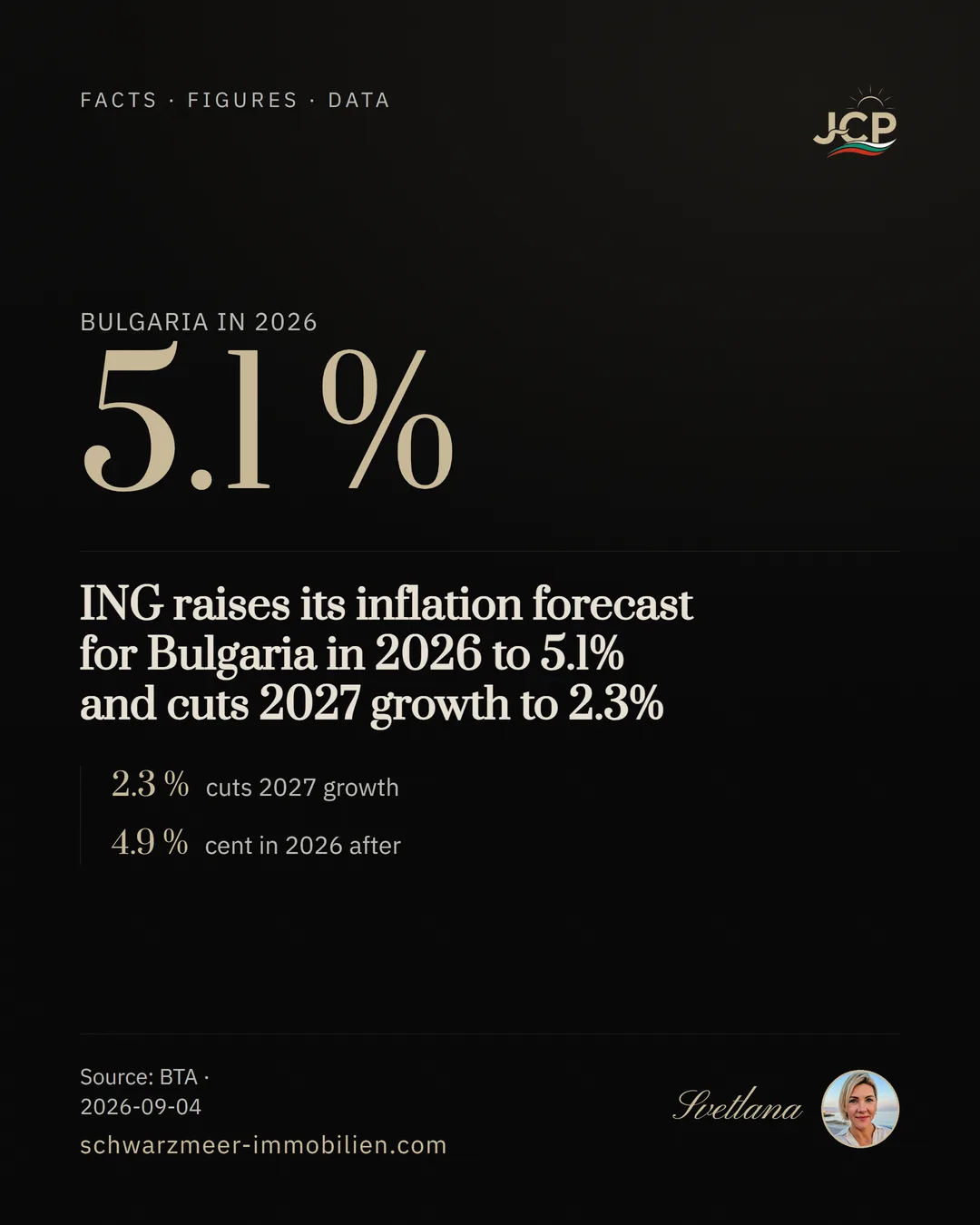
ING raises its inflation forecast for Bulgaria in 2026 to 5.1% and cuts 2027 growth to 2.3%
On 4 September 2026 the Dutch bank ING published its September forecast for Bulgaria. It expects inflation of 5.1 per cent in 2026 after 4.9 per cent in the July estimate, 3.3 per cent in 2027 instead of 2.9 per cent, and 3.2 per cent in 2028. On growth it keeps 2026 at 2.6 per cent, cuts 2027 from 2.5 to 2.3 per cent and puts 2028 at 2.0 per cent. For the euro area it assumes growth of 0.8 per cent in 2026, a contraction of 0.5 per cent for Romania and a gain of 3.4 per cent for Poland. The revision is attributed to continuing uncertainty in energy markets and to interest rates staying higher into 2027.
Assessment: Two numbers count for a buyer: the inflation that pushes construction and running costs, and the interest rate that makes financing dearer. This forecast puts both higher and for longer than it did in July, while 2027 growth eases slightly. Anyone planning to buy or renovate in 2027 should budget a generous cost buffer. Anyone letting out property still has a workable tenant base in an economy growing three times as fast as the euro area.
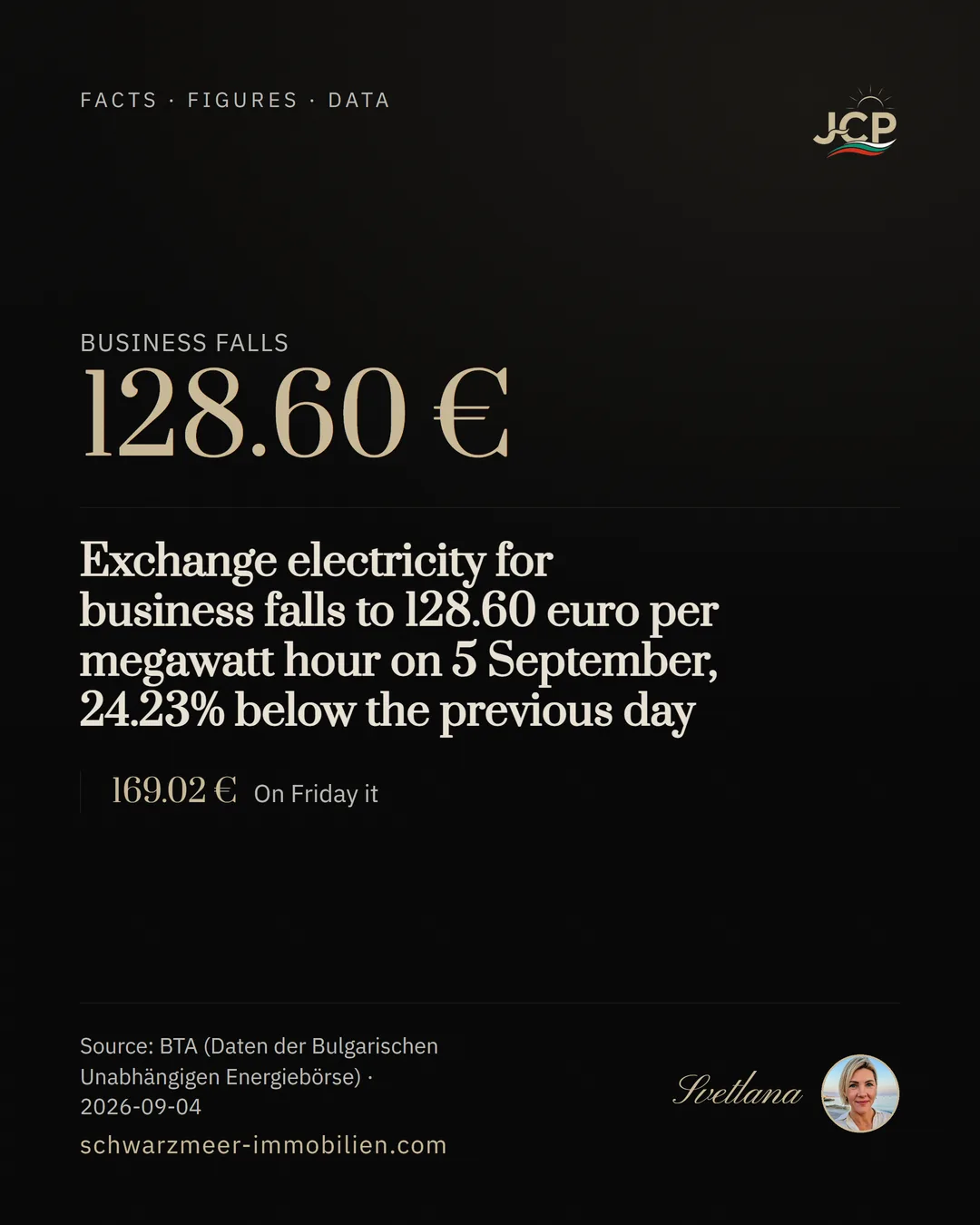
Exchange electricity for business falls to 128.60 euro per megawatt hour on 5 September, 24.23% below the previous day
In the day ahead segment of the Bulgarian Independent Energy Exchange the average price for Saturday 5 September 2026 stands at 128.60 euro per megawatt hour excluding VAT. On Friday it was 169.02 euro, a fall of 24.23 per cent. Volume traded came to 102,896.72 megawatt hours. The price applies to the free market, through which companies and larger consumers buy their electricity; households continue to buy at the regulated tariff.
TUI Group leadership comes to Bulgaria from 24 to 26 September with 150 managers, Tourism Ministry negotiates a visa on arrival
On 2 September 2026 the Tourism Ministry set out the next steps of its reform: from 24 to 26 September the leadership of TUI Group is expected in Bulgaria with around 150 senior managers, over 100,000 airline seats are secured for summer 2027, and at least 50 per cent of the tourist tax is to go into promotion and connectivity. In parallel, talks on a visa on arrival are under way, with a focus on more consular capacity in Turkey; on 27 September an association of universities for tourism studies is founded, and a QR system rates businesses against over 100 criteria. The ministry's guiding line: equal service, equal rules, against unfair competition in short-term letting and among tour operators.
Assessment: A visa on arrival for guests from Turkey would open the south coast to a market that lies right behind the border, and TUI's seat planning decides how well holiday flats are booked in May and October. I watch both points more closely than any price statistic, because they set the demand of 2027.
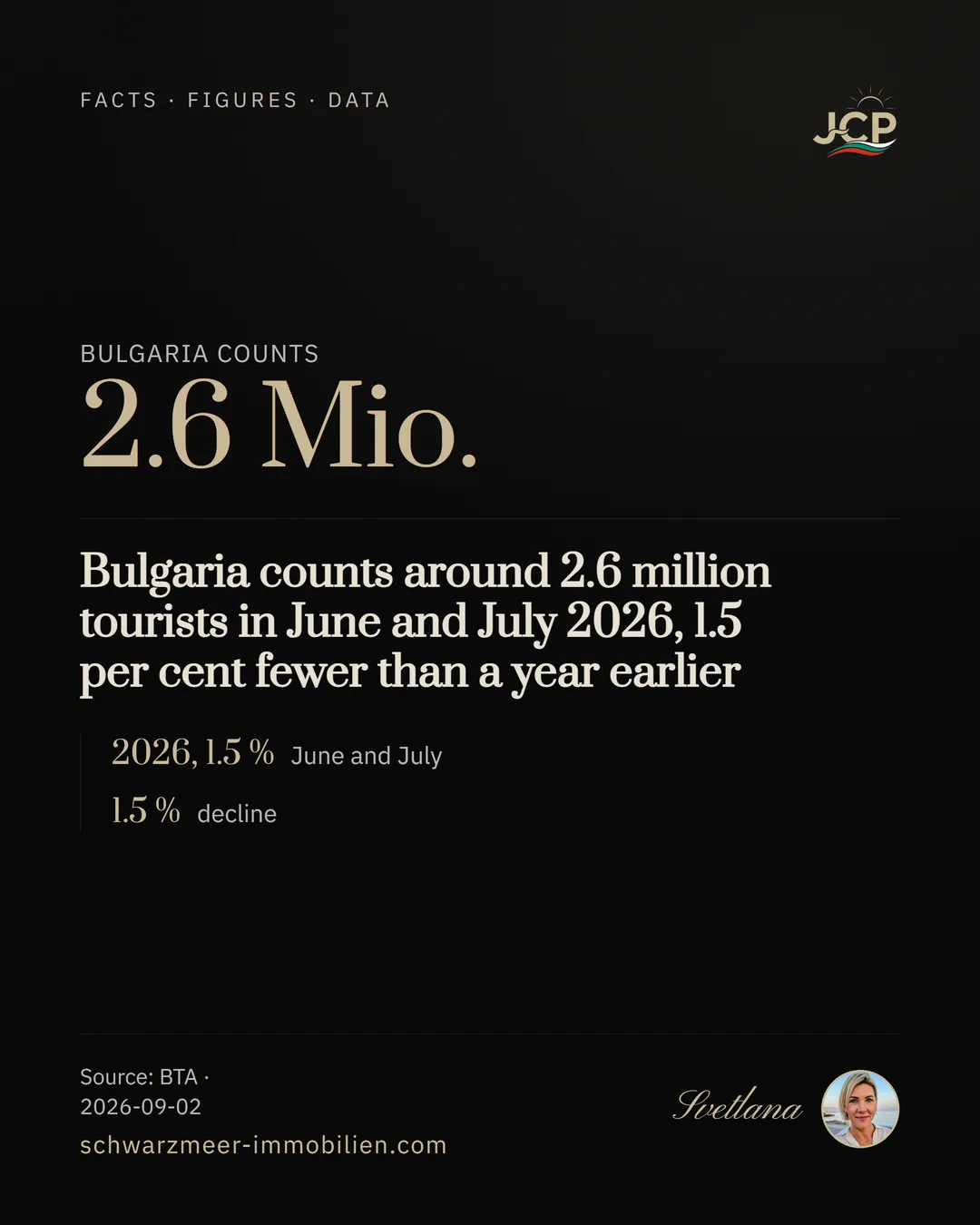
Bulgaria counts around 2.6 million tourists in June and July 2026, 1.5 per cent fewer than a year earlier
Between 1 June and 31 July 2026, 2,602,719 tourists visited Bulgaria, compared with 2,689,000 in the same period of 2025, a decline of 1.5 per cent. The Ministry of Tourism calls the drop manageable and wants to stretch the season from Easter into autumn. Around 90,000 visitors and about 1,000 journalists are expected for the Eurovision Song Contest in Burgas in May 2027, with 300,000 to 400,000 beds available; the city is compiling a list of hotels committed to reasonable room rates.
Assessment: I read this figure as a warning to landlords who rely on July and August alone: demand is stable, but it no longer grows by itself. Anyone letting on the southern coast gains by being bookable from Easter and by setting a clear price for the Eurovision month of May 2027, when beds in Burgas will be scarce. Price gouging in that window will be publicly visible, so I advise fixed rates that can be maintained afterwards.
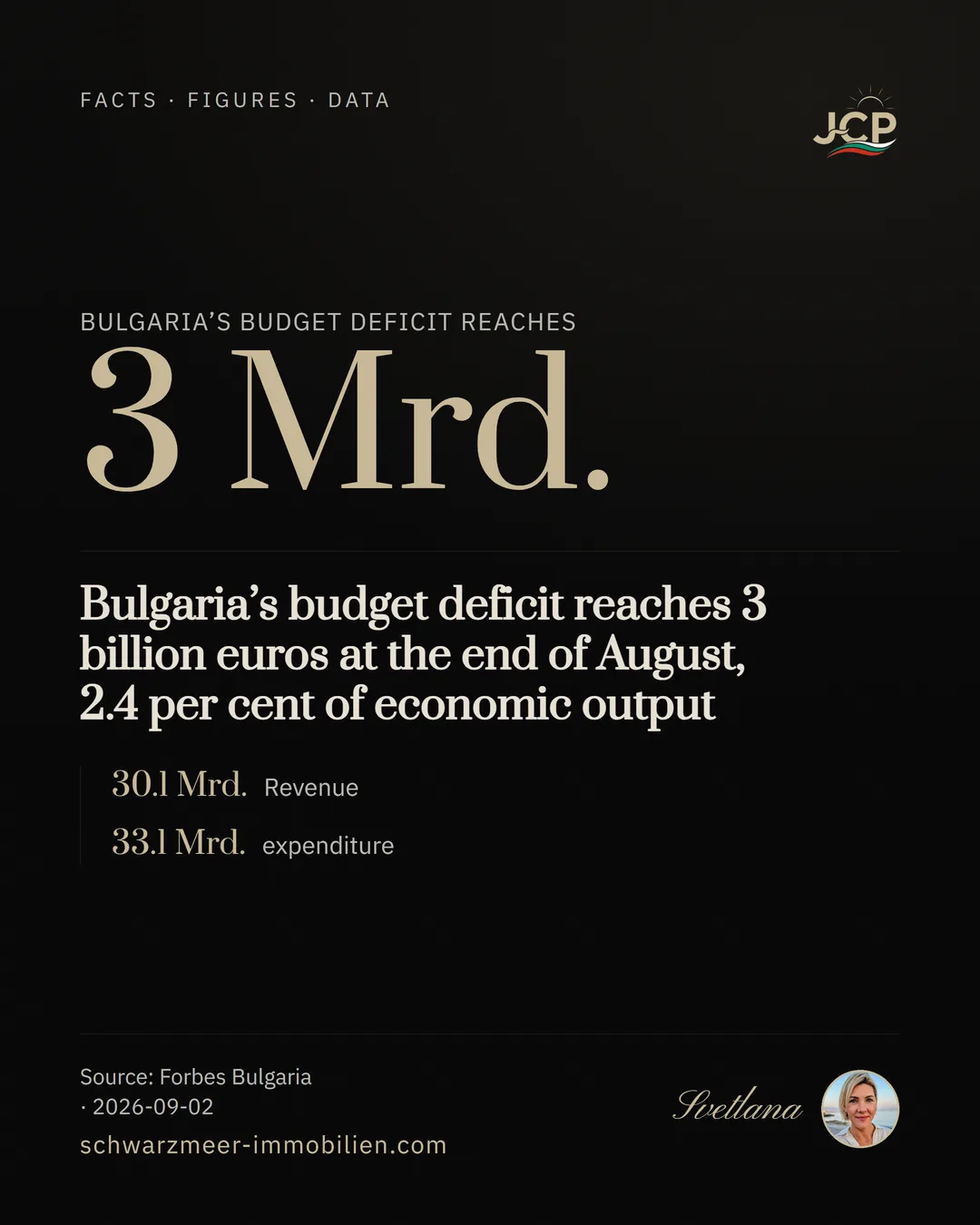
Bulgaria’s budget deficit reaches 3 billion euros at the end of August, 2.4 per cent of economic output
According to preliminary estimates by the Ministry of Finance, the consolidated budget deficit stood at 3 billion euros at the end of August 2026, or 2.4 per cent of expected economic output. Revenue reached 30.1 billion euros (60.7 per cent of the annual target), expenditure 33.1 billion euros (58.3 per cent). Compared with August 2025, revenue rose by 3.2 billion euros or 11.9 per cent, tax revenue by 2.2 billion euros. The ministry attributes the deterioration in August mainly to payments under the Recovery and Resilience Plan, whose deadline for eligible measures expired on 31 August; final figures for July and August follow at the end of September.
Assessment: A deficit below the 3 per cent threshold with revenue growing at a double-digit rate is not an alarm signal for me but the picture of an investment year. What matters to buyers is that transfer tax and property tax are municipal matters and do not depend directly on this balance. What I am watching instead is whether the state cuts capital spending in 2027, because road and water projects on the coast would then slow down.
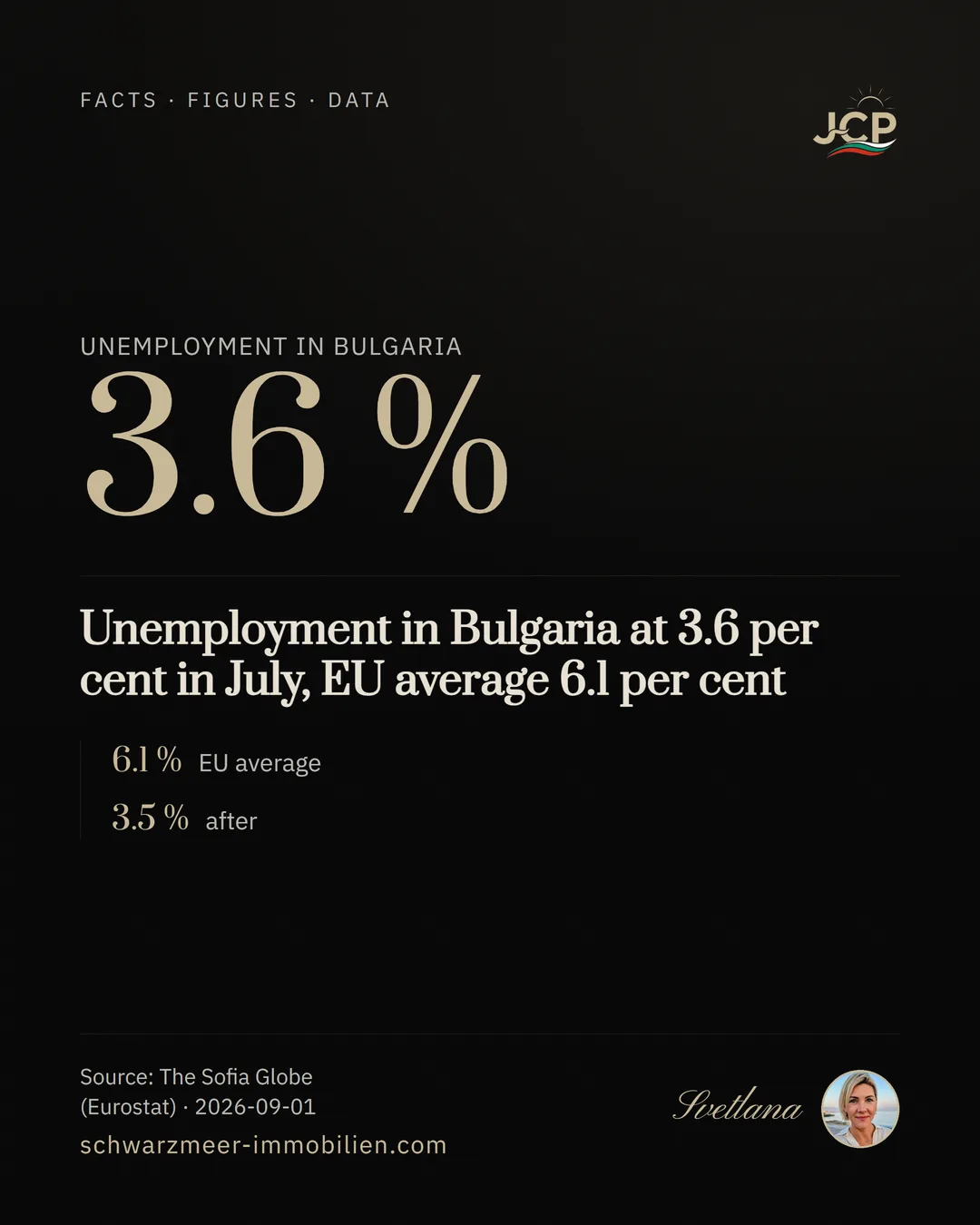
Unemployment in Bulgaria at 3.6 per cent in July, EU average 6.1 per cent
According to Eurostat data of 1 September, Bulgaria’s unemployment rate was 3.6 per cent in July 2026, after 3.5 per cent in June and 3.8 per cent in July 2025. The EU average was 6.1 per cent, the euro area 6.4 per cent. Among under-25s Bulgaria stood at 14.1 per cent, below the EU figure of 15.1 per cent and the euro area figure of 14.9 per cent.
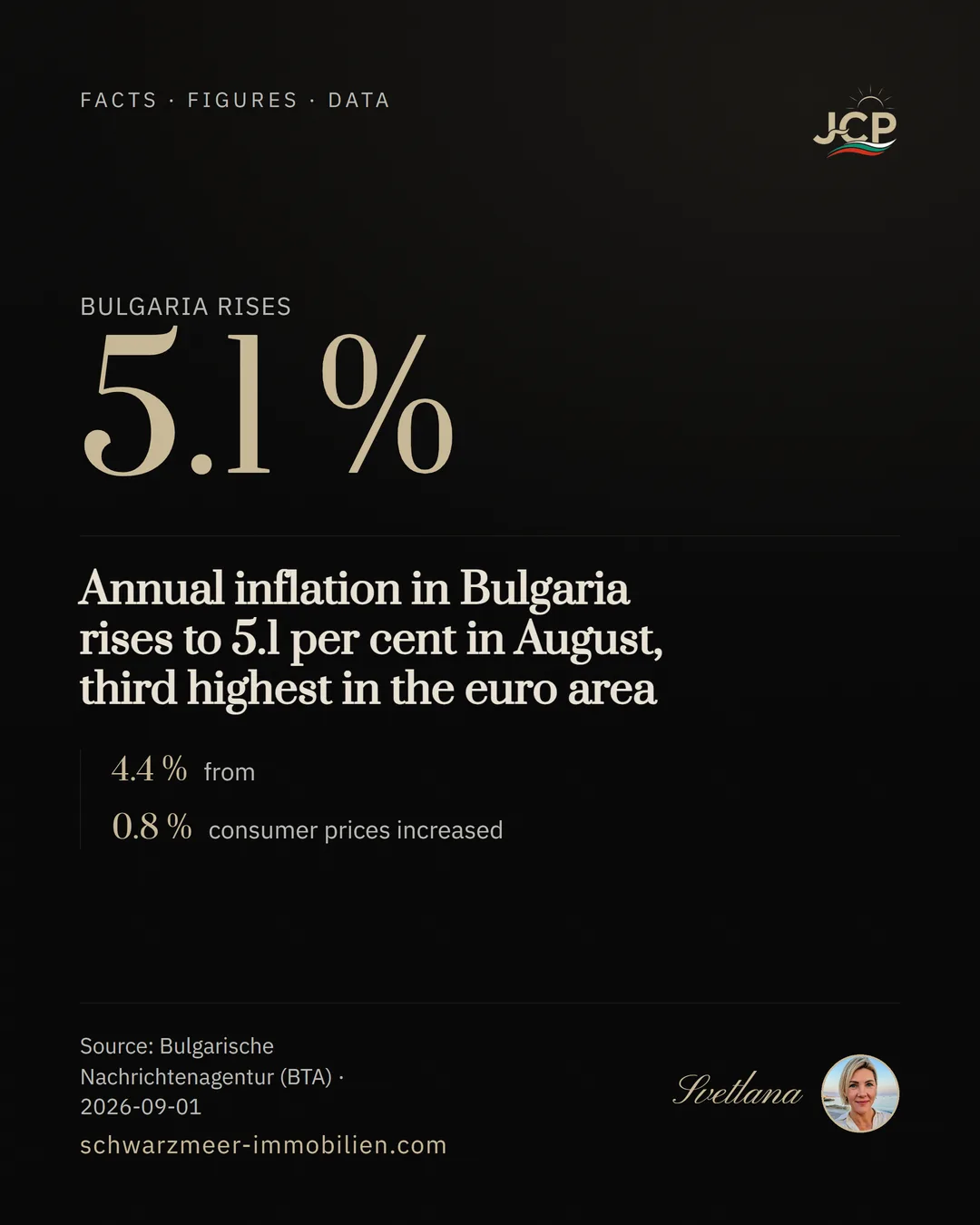
Annual inflation in Bulgaria rises to 5.1 per cent in August, third highest in the euro area
According to Eurostat's flash estimate, harmonised annual inflation in Bulgaria rose to 5.1 per cent in August, up from 4.4 per cent in July. Month on month, consumer prices increased by 0.8 per cent. Bulgaria was thus above the euro-area average of 3.3 per cent; only Lithuania at 5.8 and Cyprus at 5.2 per cent were higher. The main driver was energy, up 14.3 per cent year on year, after 10.3 per cent in July.
Assessment: For buyers, inflation above the euro-area average is a two-edged signal. It raises running costs and pressure on financing, yet also makes real assets more attractive as an investment. I see no reason to rush, but rather an argument to calculate purchase price, incidental costs and financing over several years rather than for the moment.
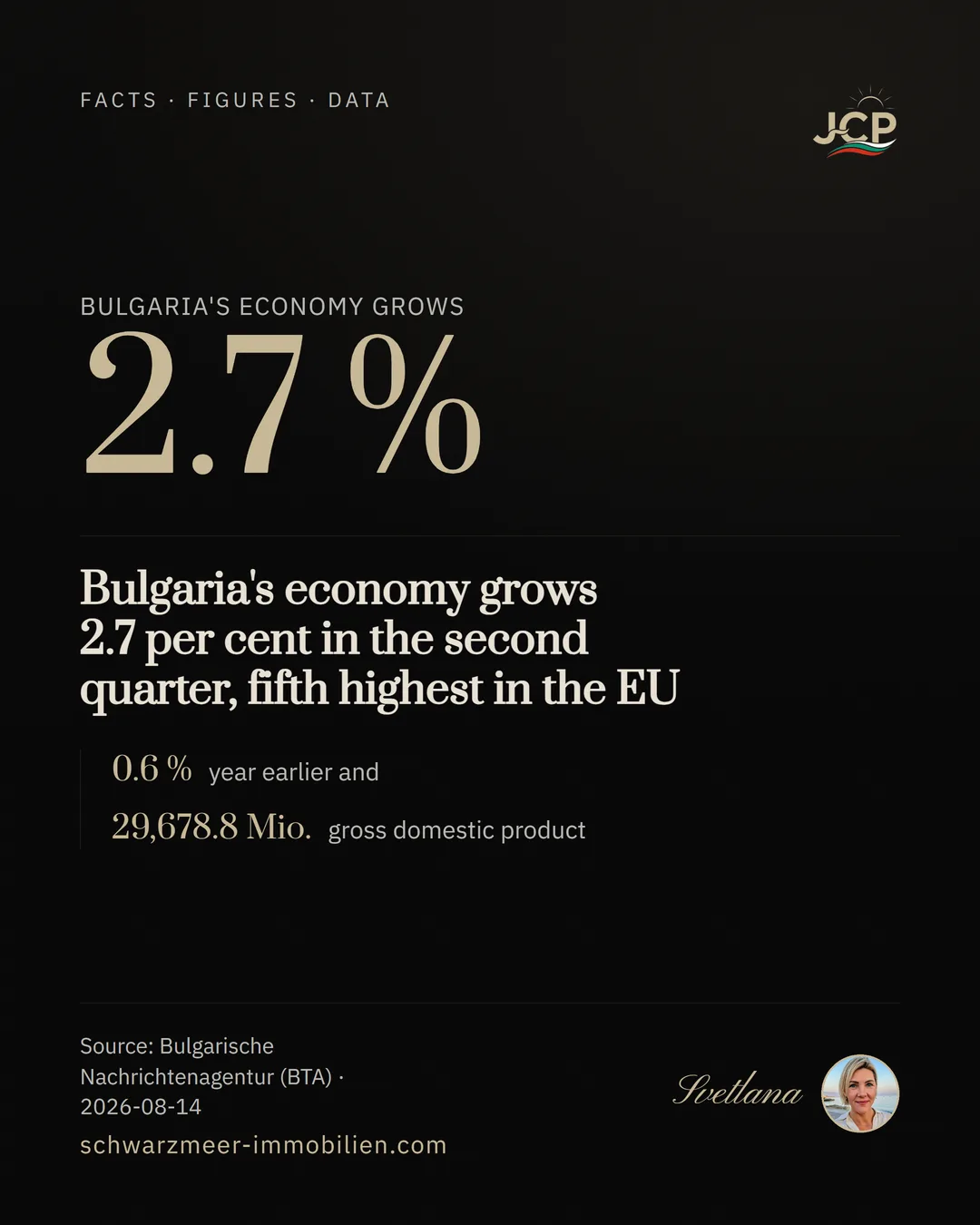
Bulgaria's economy grows 2.7 per cent in the second quarter, fifth highest in the EU
The statistics institute reports economic growth of 2.7 per cent for the second quarter of 2026 against the same quarter a year earlier and 0.6 per cent against the first quarter. In nominal terms, gross domestic product reached 29,678.8 million euro. Quarterly growth was carried by gross fixed capital formation, up 1.8 per cent, and final consumption, up 1.6 per cent. At 2.7 per cent year on year, Bulgaria was level with Spain in fifth place in the EU; in the first quarter the figure was 2.9 per cent.
Dual price display in lev and euro ended on 8 August, prices now in euro
The one-year requirement to display prices in both lev and euro ended on 8 August 2026. From 9 August, retailers show prices in euro and may state the lev equivalent voluntarily for information. During the dual year, the Consumer Protection Commission carried out 14,535 inspections, established 1,120 administrative offences and issued nearly 700 penalty decrees with sanctions of 1.31 million euro. Price monitoring continues even without the dual display.
Assessment: For buyers and owners this is a small but welcome step: prices are now clearly in euro, which lowers the risk of conversion errors in a purchase and in daily life. Importantly, price monitoring continues; unjustified mark-ups remain challengeable. I advise continuing to insist on clean euro figures in contracts and incidental costs.
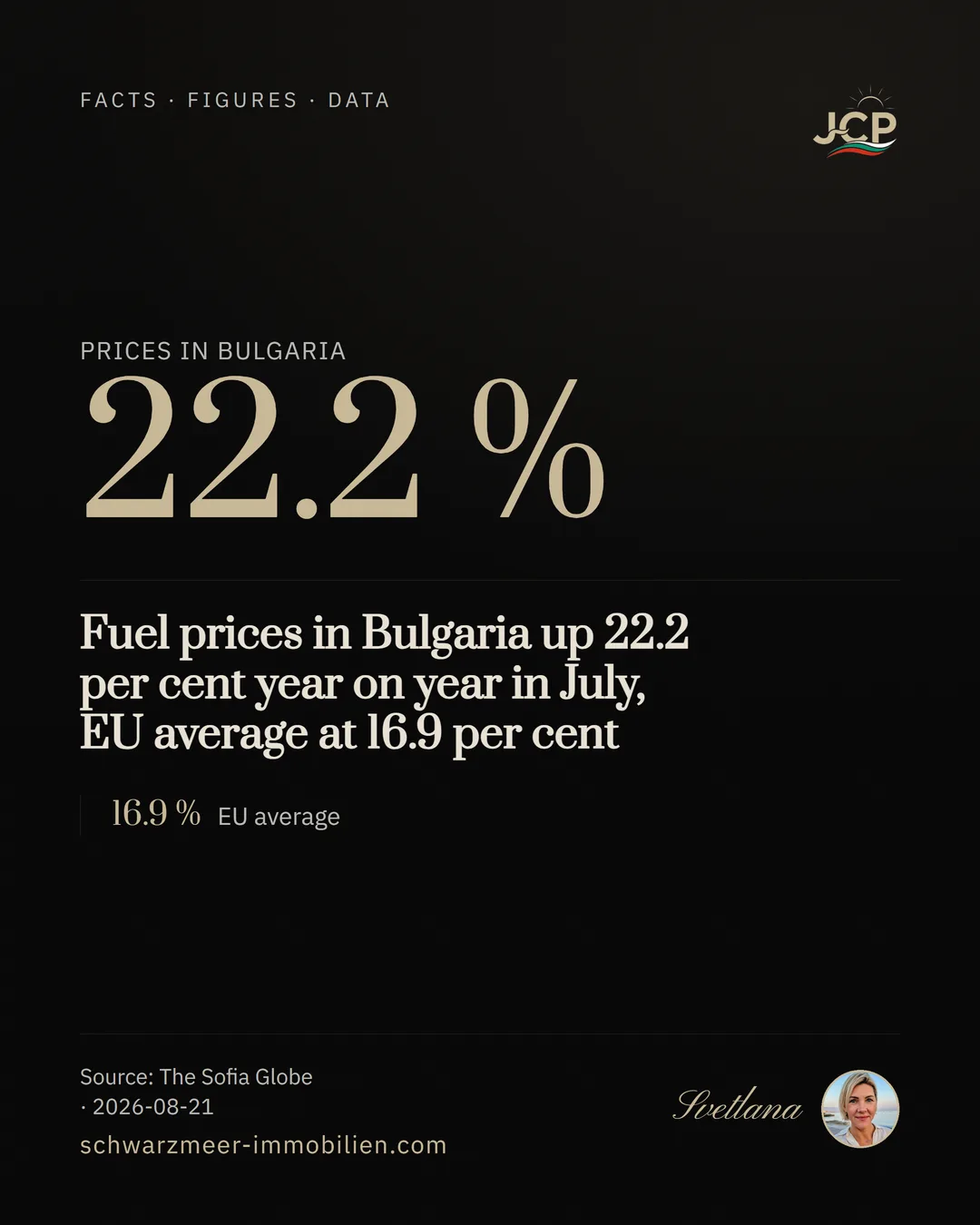
Fuel prices in Bulgaria up 22.2 per cent year on year in July, EU average at 16.9 per cent
Prices for fuels and lubricants for personal transport in Bulgaria were 22.2 per cent higher year on year in July 2026, according to Eurostat. The EU average over the same period was 16.9 per cent. Higher mobility costs feed into the running expenses of owners and tenants, especially in coastal spots that depend on the car. Diesel recently stood at around 1.76 euro a litre.
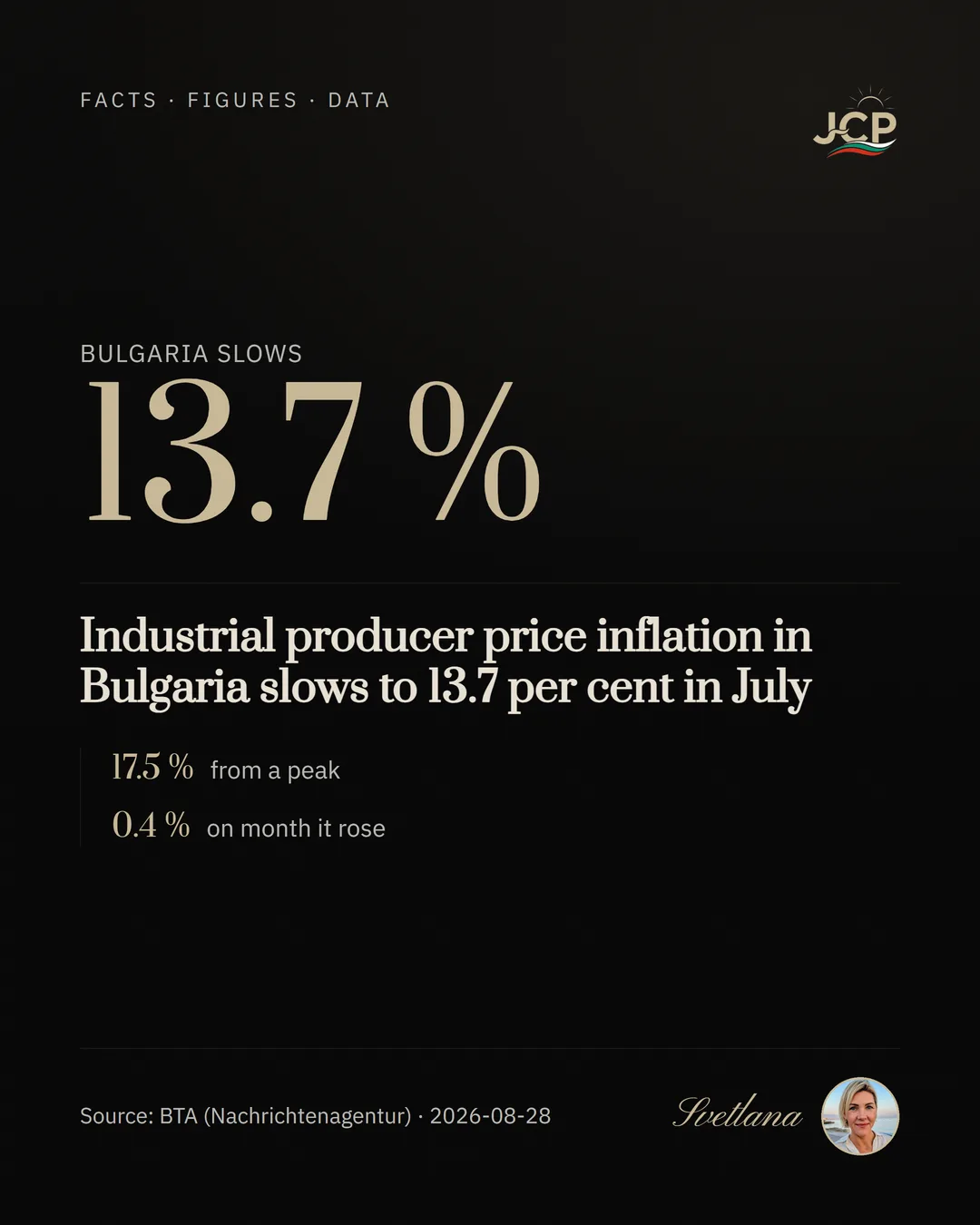
Industrial producer price inflation in Bulgaria slows to 13.7 per cent in July
The total producer price index in July 2026 stood 13.7 per cent above a year earlier, down from a peak of 17.5 per cent in May; month on month it rose 0.4 per cent. Mining posted the sharpest gain, manufacturing came in at 8.8 per cent and the electricity, gas and steam segment at 7.8 per cent. Easing input-price momentum relieves construction costs over the medium term. For buyers this is a relevant signal, because producer prices lead later building and renovation costs.
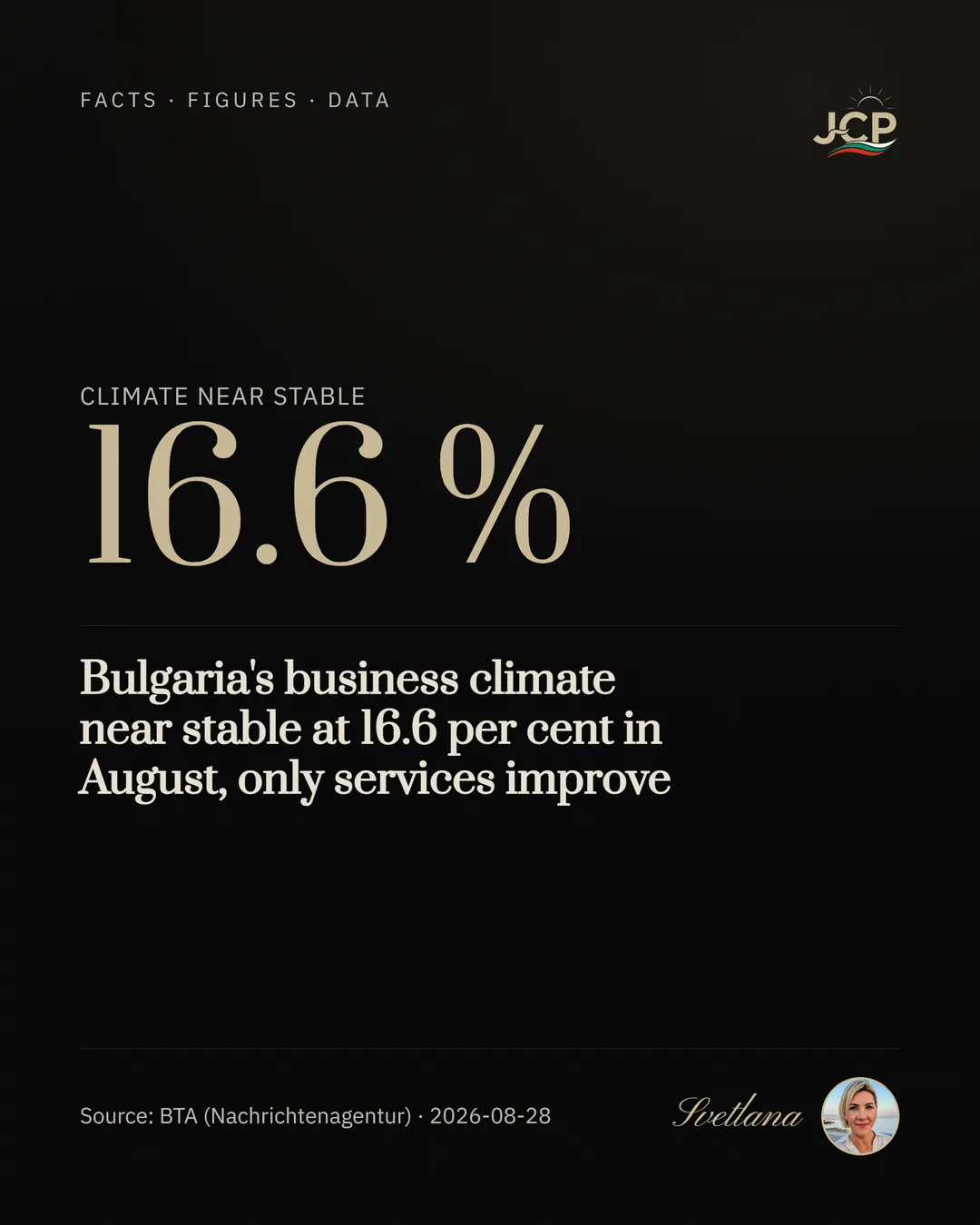
Bulgaria's business climate near stable at 16.6 per cent in August, only services improve
The composite business climate indicator edged down from 16.8 to 16.6 per cent in August 2026. Only the services sector improved, by 3 points; industry (minus 0.9), retail (minus 1.1) and construction (minus 1.6) all softened. The dip in construction reflects more cautious six-month expectations. For buyers this signals a calmer but not collapsing market environment.
Assessment: A business climate that barely moves is reassuring rather than worrying for property buyers: no euphoria, no crash. Slightly softer expectations in construction may open room to negotiate on new-build projects. I see this as a good moment to assess calmly rather than buy under time pressure.
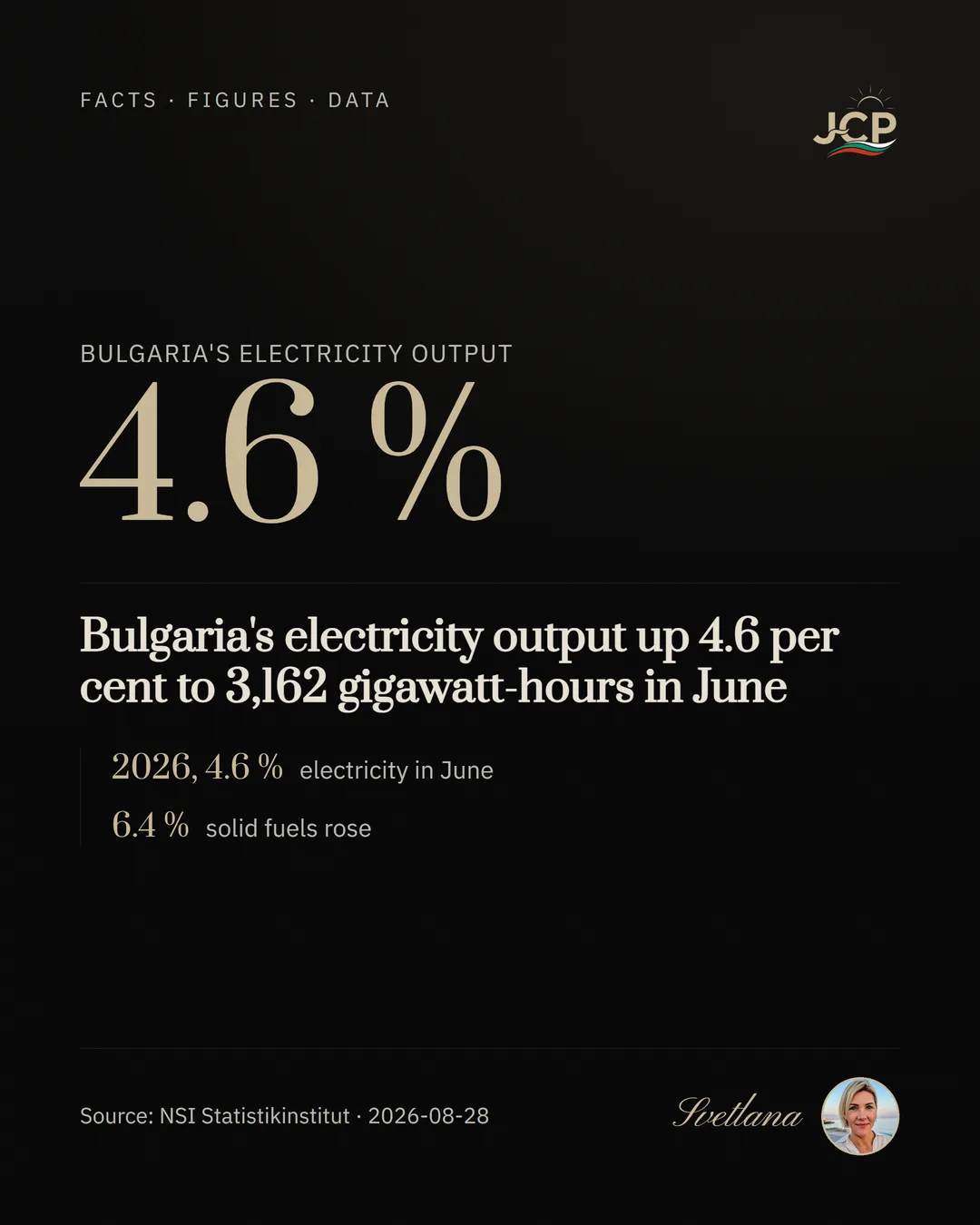
Bulgaria's electricity output up 4.6 per cent to 3,162 gigawatt-hours in June
Bulgaria generated about 3,162 gigawatt-hours of electricity in June 2026, 4.6 per cent more than a year earlier. Output of solid fuels rose 6.4 per cent to 936,000 tonnes, while domestic natural gas production held at 1 million cubic metres. Stable, slightly rising power generation supports security of supply on the coast. For owners this matters, because reliable energy is a building block of lettability and usability.
Finance Ministry projects a 660-euro minimum wage for 2027, social security ceiling at 2,400 euro
Under the Finance Ministry's budget guidelines, the minimum wage is set to rise to 660 euro in 2027 from 620 euro today – up 6.5 per cent; 680 euro is planned for 2028 and 710 euro for 2029. The maximum social security assessment base is put at 2,400 euro for 2027, 2,500 euro for 2028 and 2,600 euro for 2029. The minimum wage follows a legally anchored mechanism of four equally weighted indicators. Rising wage and contribution floors feed into the running costs of administration, cleaning and property management on the coast.
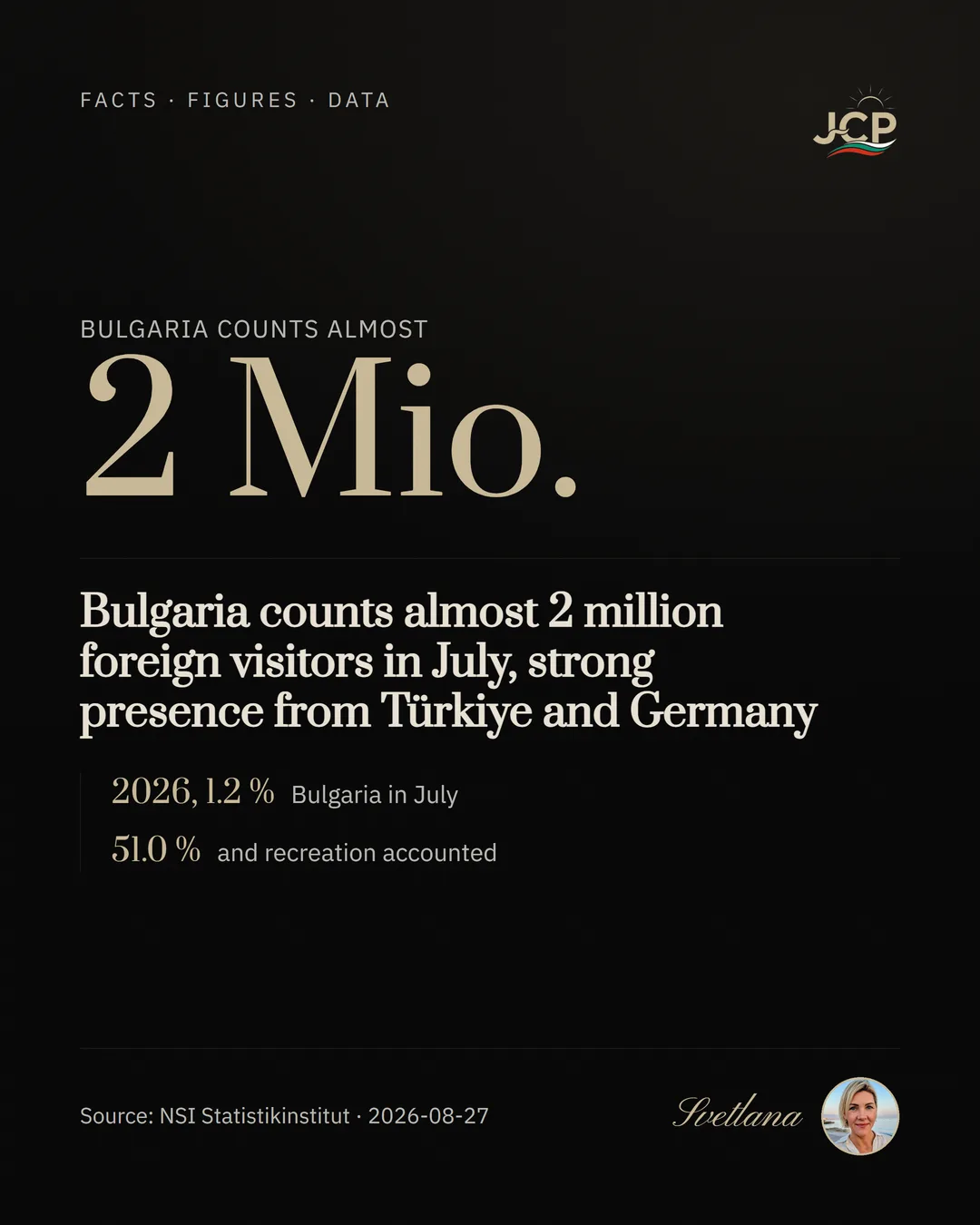
Bulgaria counts almost 2 million foreign visitors in July, strong presence from Türkiye and Germany
According to preliminary data from the statistics institute, about 1,979,700 foreign visitors arrived in Bulgaria in July 2026, 1.2 per cent fewer than a year earlier. Holiday and recreation accounted for 51.0 per cent of visits (around 1,009,000). The largest source countries were Türkiye with 312,700, Romania with 301,200, Ukraine with 202,100 and Germany with 163,500; EU citizens made up 54.4 per cent. For the south coast, this stable, broadly spread demand remains the basis for seasonal letting.
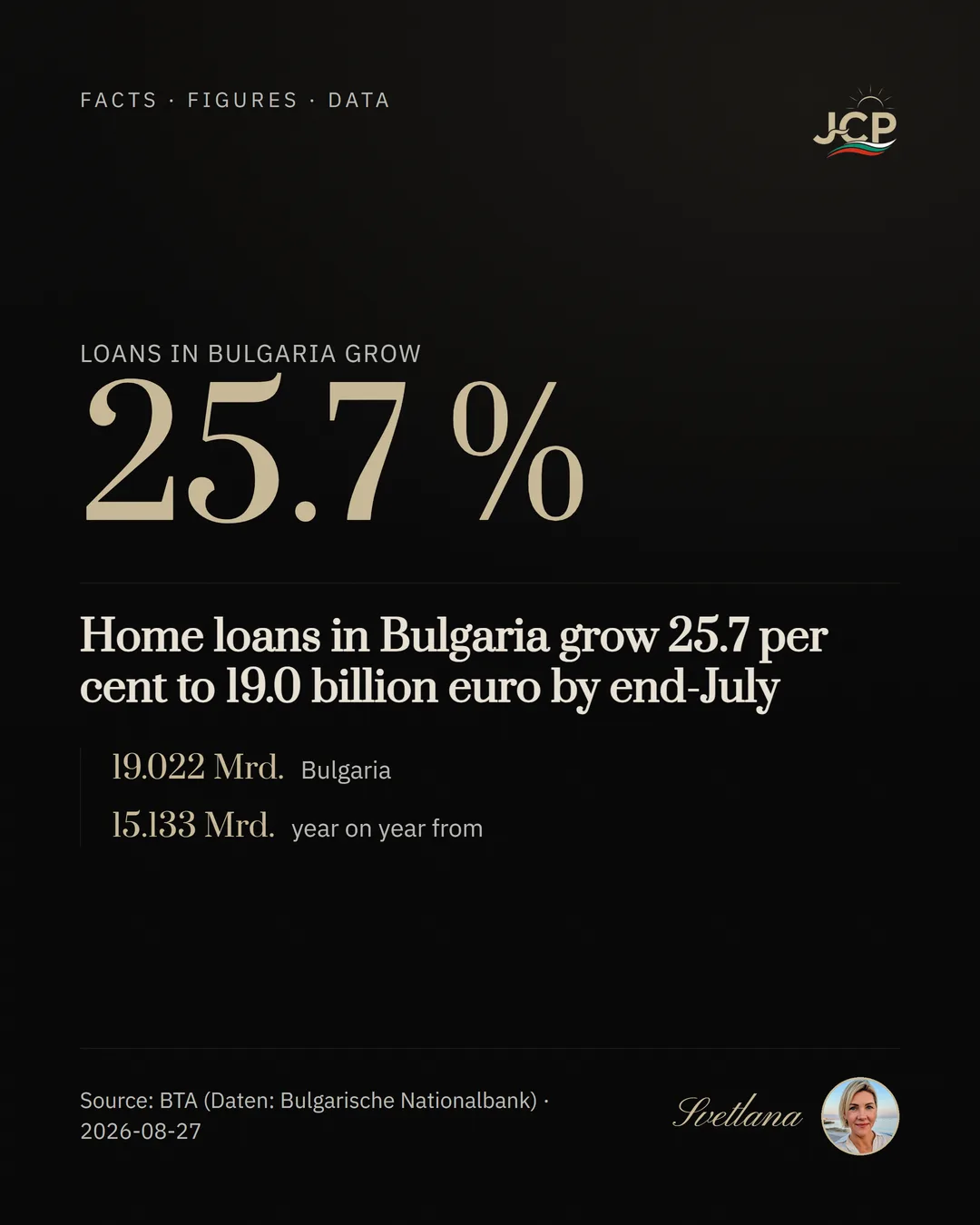
Home loans in Bulgaria grow 25.7 per cent to 19.0 billion euro by end-July
The volume of home loans to private households in Bulgaria reached around 19.022 billion euro at the end of July 2026, up 25.7 per cent year on year from 15.133 billion euro. Consumer loans rose 15.4 per cent to 12.089 billion euro and loans to non-financial companies 13.0 per cent to 29.150 billion euro. The figures come from the credit statistics of the Bulgarian National Bank. The continued double-digit growth in home loans points to strong financing demand in the property market.
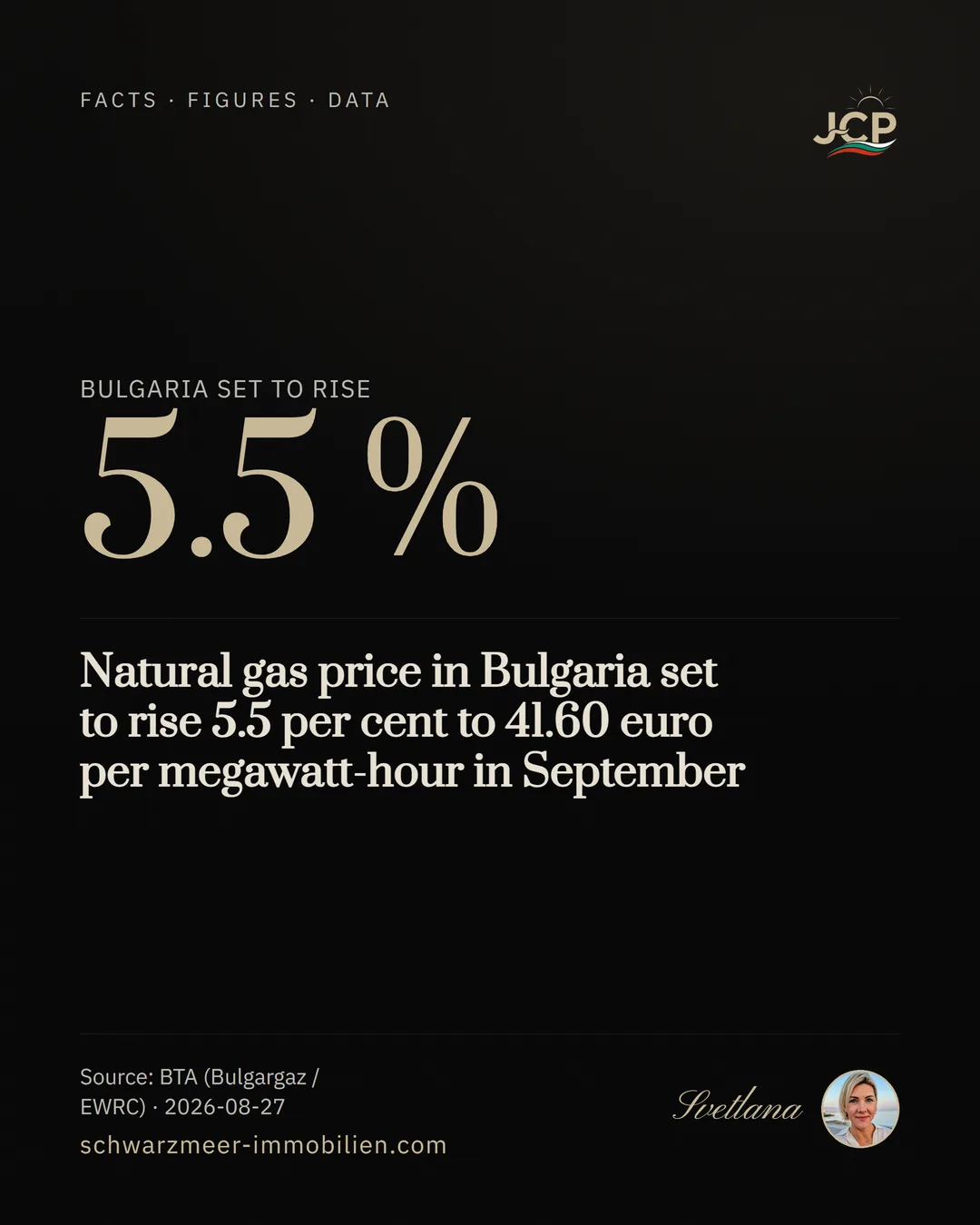
Natural gas price in Bulgaria set to rise 5.5 per cent to 41.60 euro per megawatt-hour in September
The public supplier Bulgargaz has requested a natural gas price of 41.60 euro per megawatt-hour for September 2026, up 5.5 per cent on August; the figure is exclusive of access, transmission, excise duty and VAT. The final price will be decided by the Energy and Water Regulatory Commission (EWRC) at its session on 31 August 2026. During the procedure the request was adjusted from an initial 41.31 to 41.60 euro per megawatt-hour. The gas price feeds indirectly into many households’ running costs via district heating and hot water.
Assessment: Energy prices are a running cost for owners that must not be overlooked when calculating service charges and yield. On the southern coast, where many properties heat with electricity or air-conditioning rather than district heating, the gas price acts more indirectly but remains a signal for the general energy-cost situation. I keep an eye on such regulatory decisions because they shape operating costs over time.
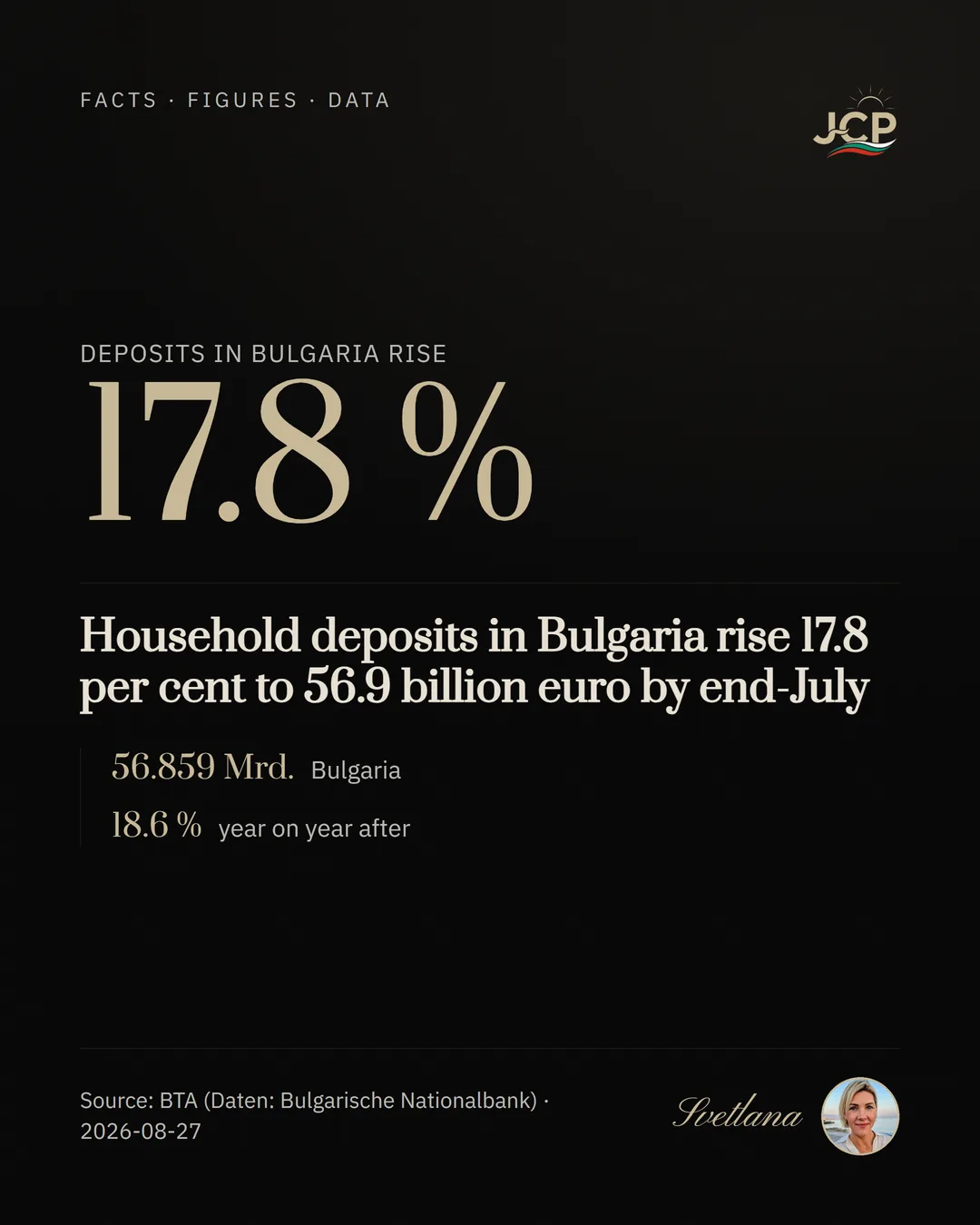
Household deposits in Bulgaria rise 17.8 per cent to 56.9 billion euro by end-July
Private household deposits in Bulgaria stood at around 56.859 billion euro at the end of July 2026, up 17.8 per cent year on year after 18.6 per cent in June. Deposits of non-financial companies rose 10.8 per cent to 27.207 billion euro. The data come from the statistics of the Bulgarian National Bank. The high level of savings shows how much capital in private hands is waiting for investment opportunities.
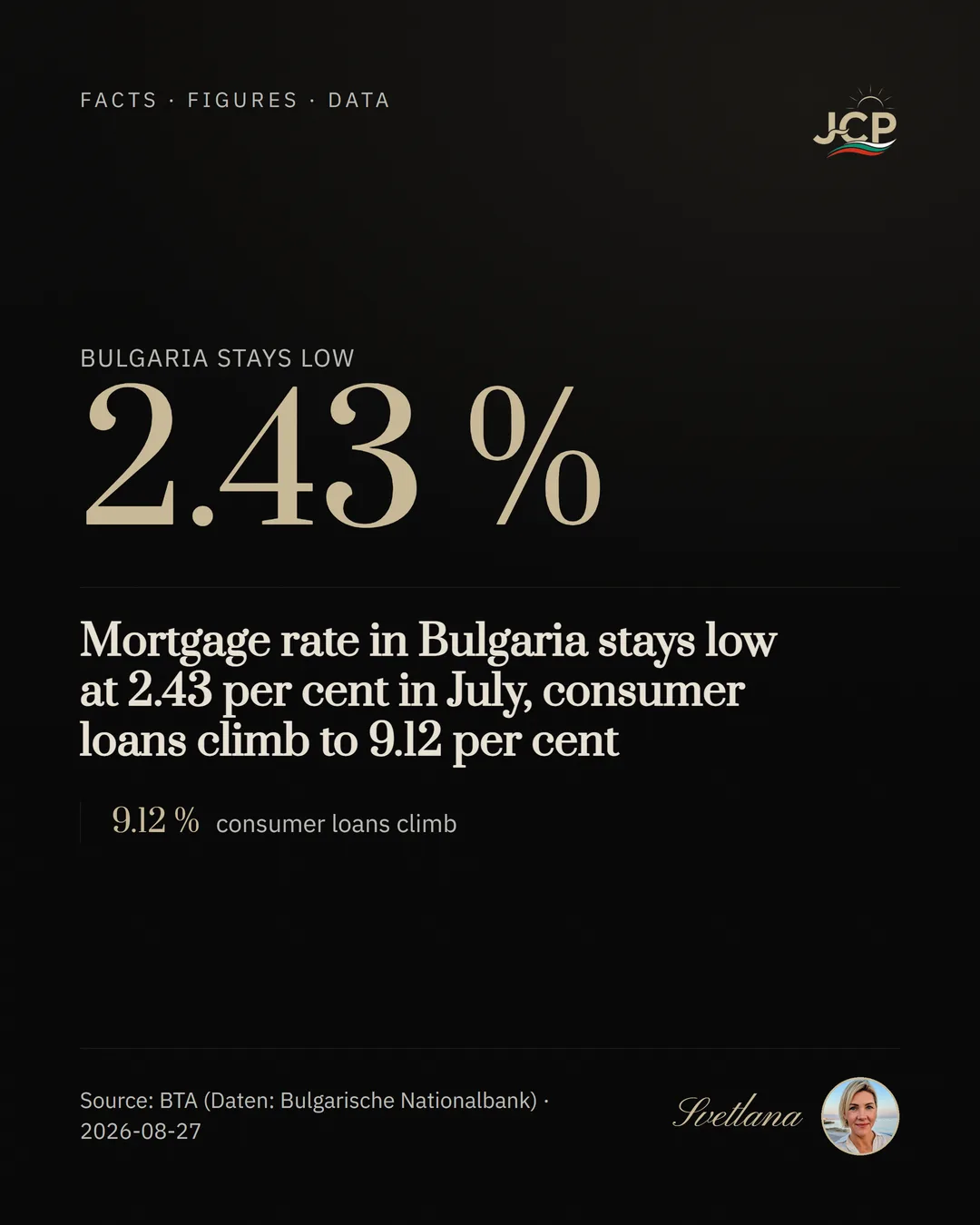
Mortgage rate in Bulgaria stays low at 2.43 per cent in July, consumer loans climb to 9.12 per cent
The average interest rate on home loans in Bulgaria was 2.43 per cent in July 2026, only 0.02 percentage points higher than in June. Consumer loans became notably more expensive: their average rate rose by 0.36 percentage points to 9.12 per cent. The figures come from the interest-rate statistics of the Bulgarian National Bank. While financing consumption becomes markedly dearer, property loans remain at a low level.
Assessment: For property buyers the low mortgage rate is the real message – it keeps financing home ownership affordable while consumer loans tighten. I see a favourable environment for soundly financed purchases but caution against basing one’s own calculation solely on permanently low rates. Those who plan for equity and a buffer stay calm even if rates turn.
Statistics institute: Burgas district completed 1,369 dwellings in the second quarter, second highest in the country
According to preliminary figures from the statistics institute, Bulgaria completed 1,269 residential buildings with 5,932 dwellings in the second quarter of 2026. Burgas district accounted for 145 buildings with 1,369 dwellings. That puts Burgas third by buildings, behind Sofia city (176) and Plovdiv (150), but second by dwellings, behind Sofia city (2,046) and far ahead of Plovdiv (375). Nationwide, 76.0 percent of new buildings are houses and 14.3 percent blocks of flats; the average living floor space per new dwelling is 64.2 square metres, and 42.8 percent have two rooms.
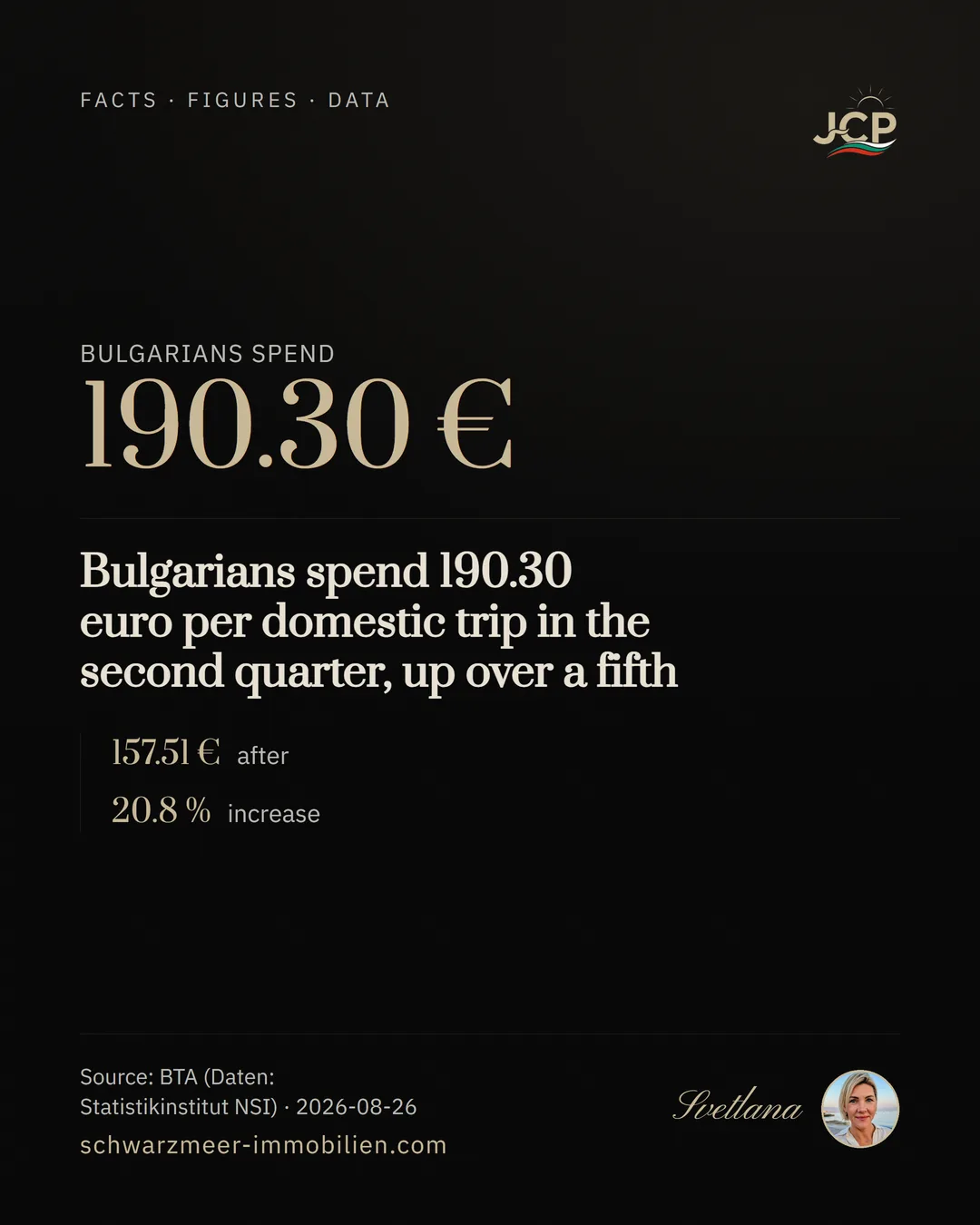
Bulgarians spend 190.30 euro per domestic trip in the second quarter, up over a fifth
The average spending of Bulgarian travellers on a private domestic trip rose to 190.30 euro per person in the second quarter of 2026, after 157.51 euro in the first quarter, an increase of 20.8 per cent. Accommodation costs alone climbed by a good 35 per cent. Around 1.3 million Bulgarians travelled in the period, more than two thirds of them within the country only. The data come from the statistics institute.
Assessment: When residents spend more on travel at home, it strengthens the domestic season and occupancy beyond foreign guests. For landlords on the southern coast, growing internal demand is a second pillar alongside international tourism. I see this as a reason to gear properties to the Bulgarian guest as well, not only to the summer flight arrival.
Banks expect steady demand for home loans in the third quarter
According to the National Bank lending survey, Bulgarian banks expect unchanged demand for home loans in the third quarter of 2026. In the second quarter demand had still been rising, supported by improved consumer confidence. Lending standards for mortgages were tightened slightly of late and are expected to stay stable in the third quarter. This points to a calm, orderly credit market.
Assessment: Steady credit demand with slightly stricter standards is exactly the mix that avoids overheated swings. For buyers with sound creditworthiness, financing conditions remain predictable, and for the market as a whole the risk of a credit-driven bubble falls. I take this as a sign of discipline that serves everyone involved in the long run.
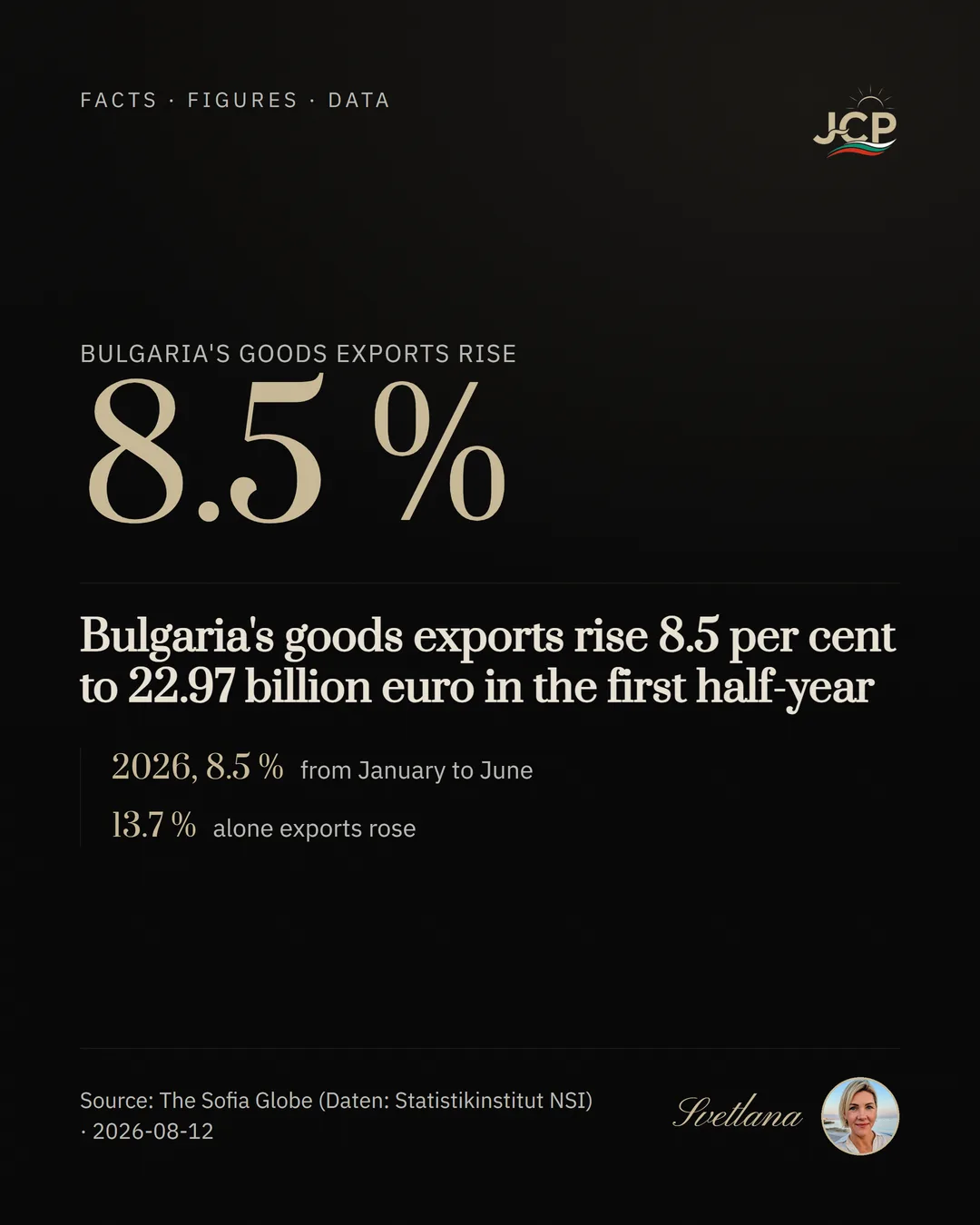
Bulgaria's goods exports rise 8.5 per cent to 22.97 billion euro in the first half-year
Bulgaria's goods exports reached around 22.97 billion euro from January to June 2026, 8.5 per cent above the same period a year earlier. In June alone exports rose by 13.7 per cent to about 4.16 billion euro. The figures come from the statistics institute and show robust foreign-trade momentum. They underline the economy's integration into European supply chains.
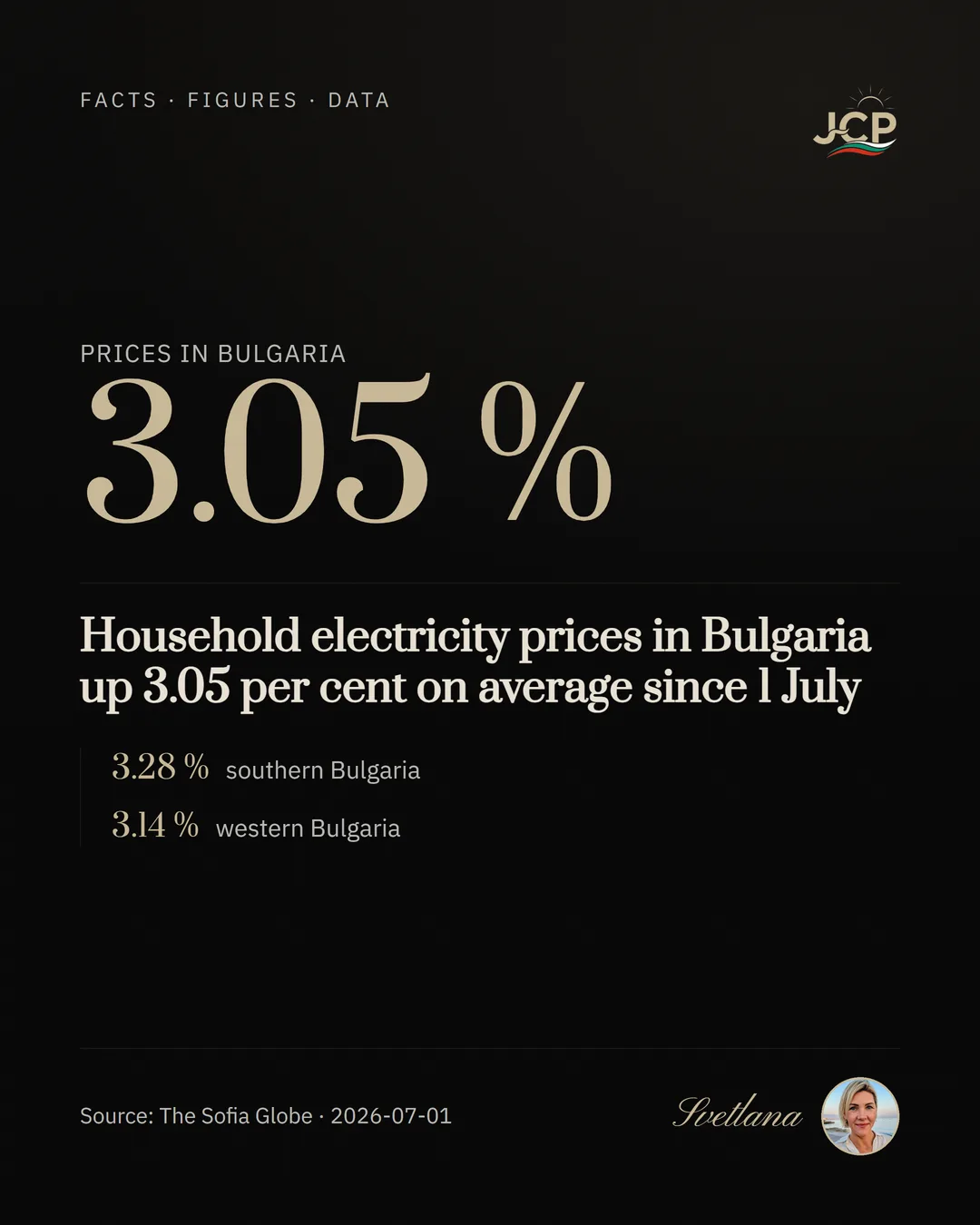
Household electricity prices in Bulgaria up 3.05 per cent on average since 1 July
The Energy and Water Regulatory Commission raised household electricity prices by an average of 3.05 per cent as of 1 July 2026; the tariff applies until 30 June 2027. The increase varies by regional supplier: EVN in southern Bulgaria up 3.28 per cent, Elektrohold in western Bulgaria up 3.14 per cent and Energo-Pro in northern Bulgaria up 2.53 per cent. The average household bill rises by less than one euro, according to the regulator. Electricity prices in Bulgaria remain among the lowest in the EU.
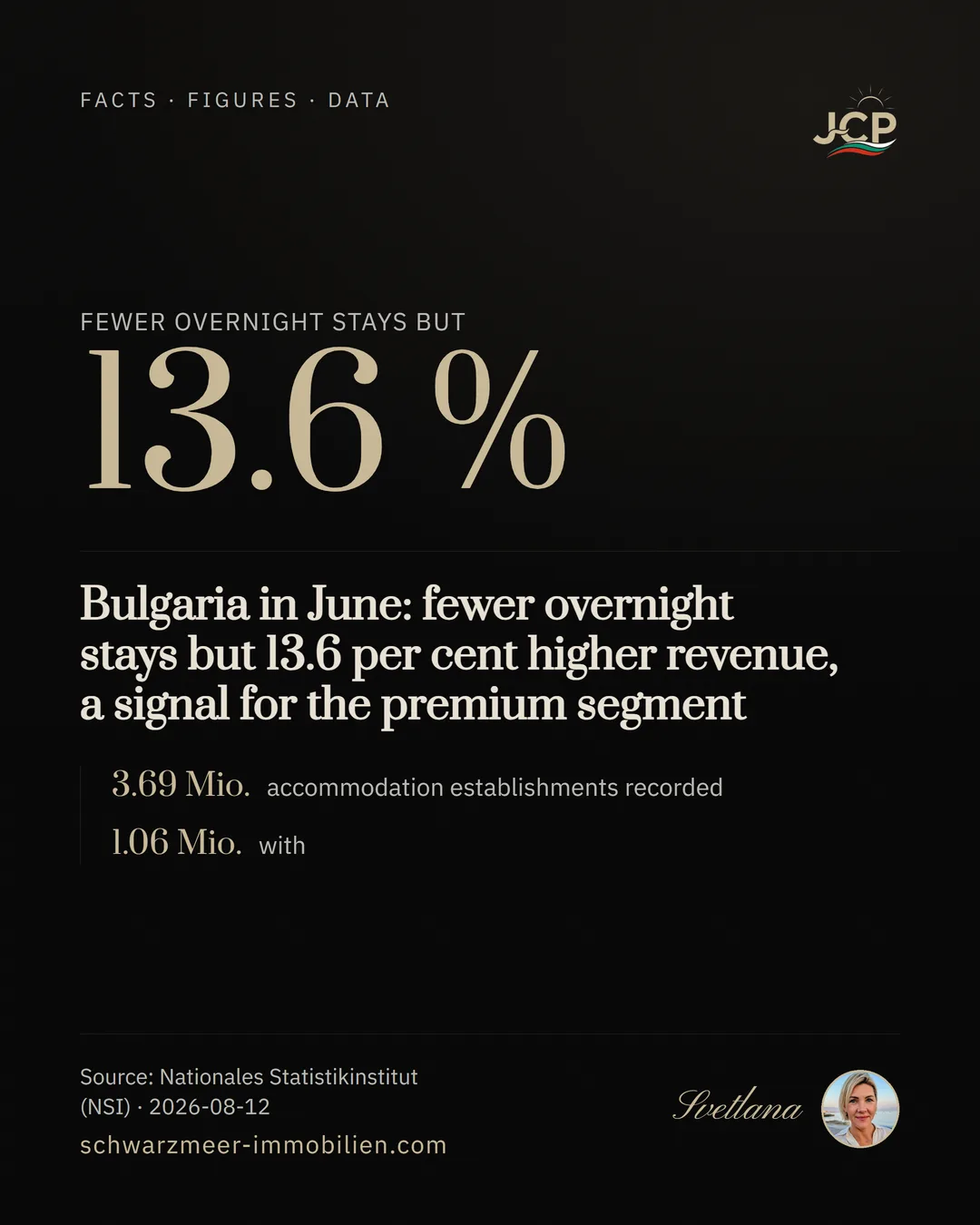
Bulgaria in June: fewer overnight stays but 13.6 per cent higher revenue, a signal for the premium segment
Bulgaria's accommodation establishments recorded around 3.69 million overnight stays in June 2026, a 3.6 per cent fall on the previous year, with 1.06 million arrivals (down 3.1 per cent). At the same time, revenue from overnight stays rose 13.6 per cent to 198.0 million euro. Fewer but markedly higher-spending guests point to higher prices and a growing premium segment. For holiday letting on the southern coast this is a relevant trend.
Dual pricing in lev and euro ended on 8 August 2026, prices now shown in euro only
After Bulgaria joined the euro on 1 January 2026, dual pricing in lev and euro had been compulsory since 8 August 2025 and expired on 8 August 2026. Prices are now shown in euro only. The officially fixed conversion rate of 1 euro = 1.95583 lev applies. Anyone reconciling old contracts or invoices converts the euro amount back at this fixed rate (euro times 1.95583 = former lev value).
Bulgaria's economy grows 2.7 per cent in the second quarter, among the fastest in the EU
Gross domestic product rose 2.7 per cent year on year and 0.6 per cent quarter on quarter in the second quarter of 2026. That puts Bulgaria fifth in the EU growth ranking, level with Spain and well above the EU average of 1.2 per cent and the euro area at 1.0 per cent. Growth was carried by private consumption at plus 7.6 per cent and fixed investment at plus 8 per cent; exports slipped 2.8 per cent. Nominal GDP reached around 29.68 billion euro (statistics institute flash estimate).
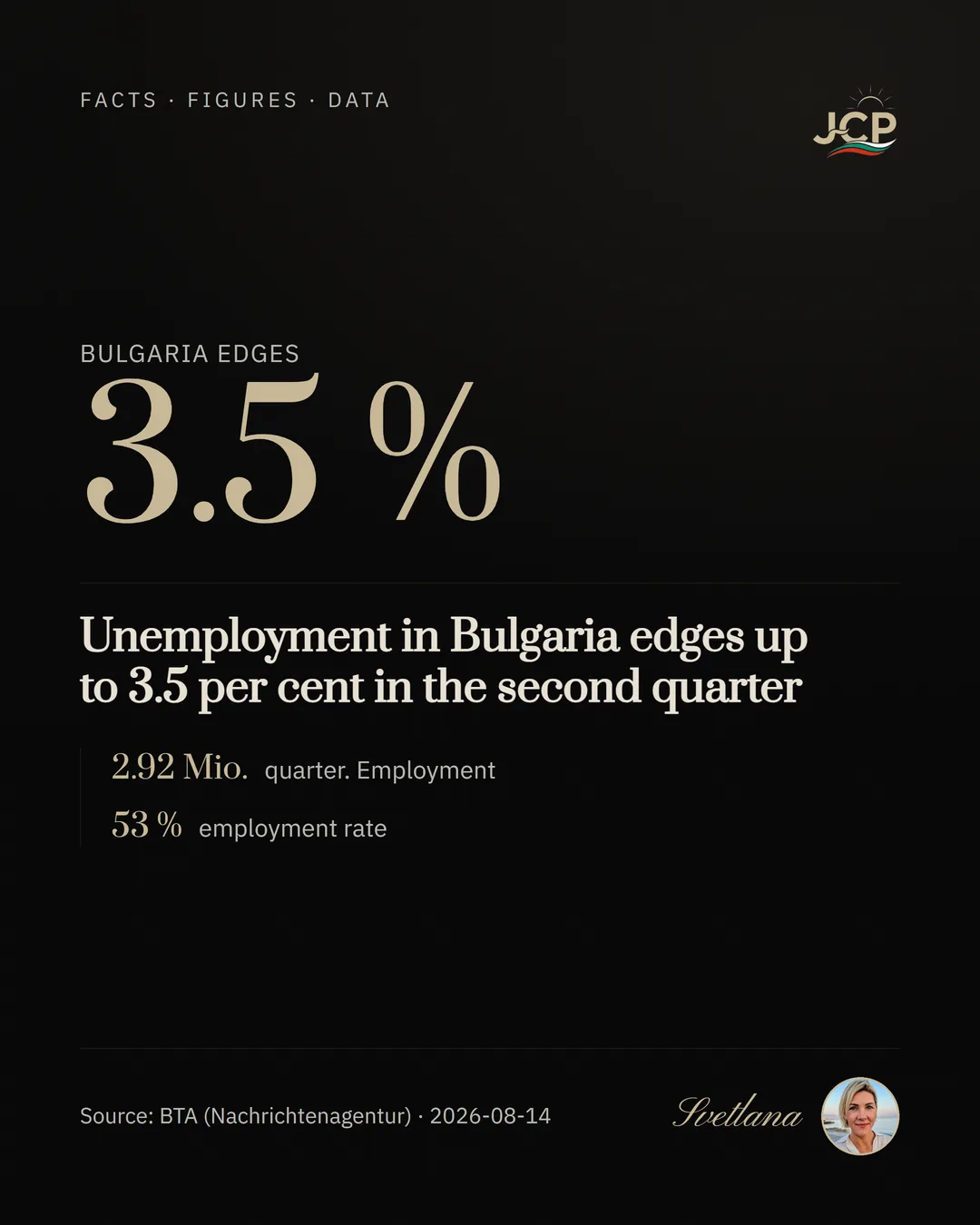
Unemployment in Bulgaria edges up to 3.5 per cent in the second quarter
In the second quarter of 2026 Bulgaria had 107,100 people out of work, a rate of 3.5 per cent after 3.2 per cent in the first quarter. Employment stood at 2.92 million, with an employment rate of 53 per cent for those aged 15 and over. Youth unemployment among 15- to 29-year-olds was 8.1 per cent. Despite the slight rise the labour market remains very tight by European standards; the data come from the statistics institute.
Assessment: A rate of 3.5 per cent means effectively full employment and therefore stable incomes around a property. For buyers that is a calm signal: a tight labour market supports local demand and value retention. I read the slight rise as normalisation, not a change of trend.
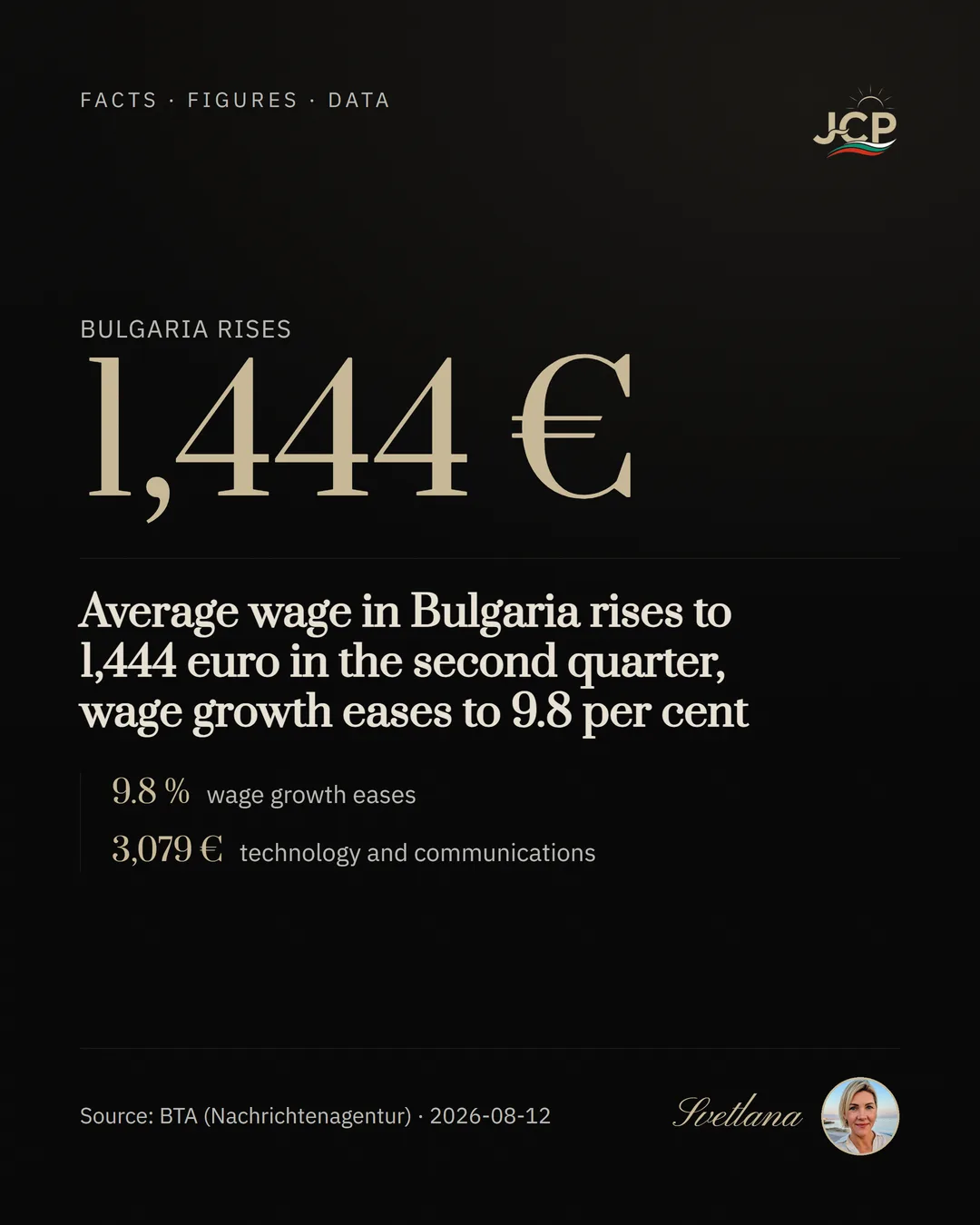
Average wage in Bulgaria rises to 1,444 euro in the second quarter, wage growth eases to 9.8 per cent
The average gross monthly wage reached 1,444 euro in the second quarter of 2026, up 2.6 per cent on the previous quarter and 9.8 per cent year on year. Pay is highest in information technology and communications at 3,079 euro and in finance and insurance at 2,140 euro, and lowest in hospitality and catering at 918 euro. The private sector grew faster at 11.5 per cent than the public sector at 4.8 per cent. The figures come from the statistics institute.
Assessment: Rising wages lift local ability to pay rent and thus the basis for rental yields. The cooling pace is rather good news, because it eases price pressure ahead of the euro changeover. For landlords I read this as sustainable, not overheated demand; for owner-occupiers as a sign of a healthy local labour market.