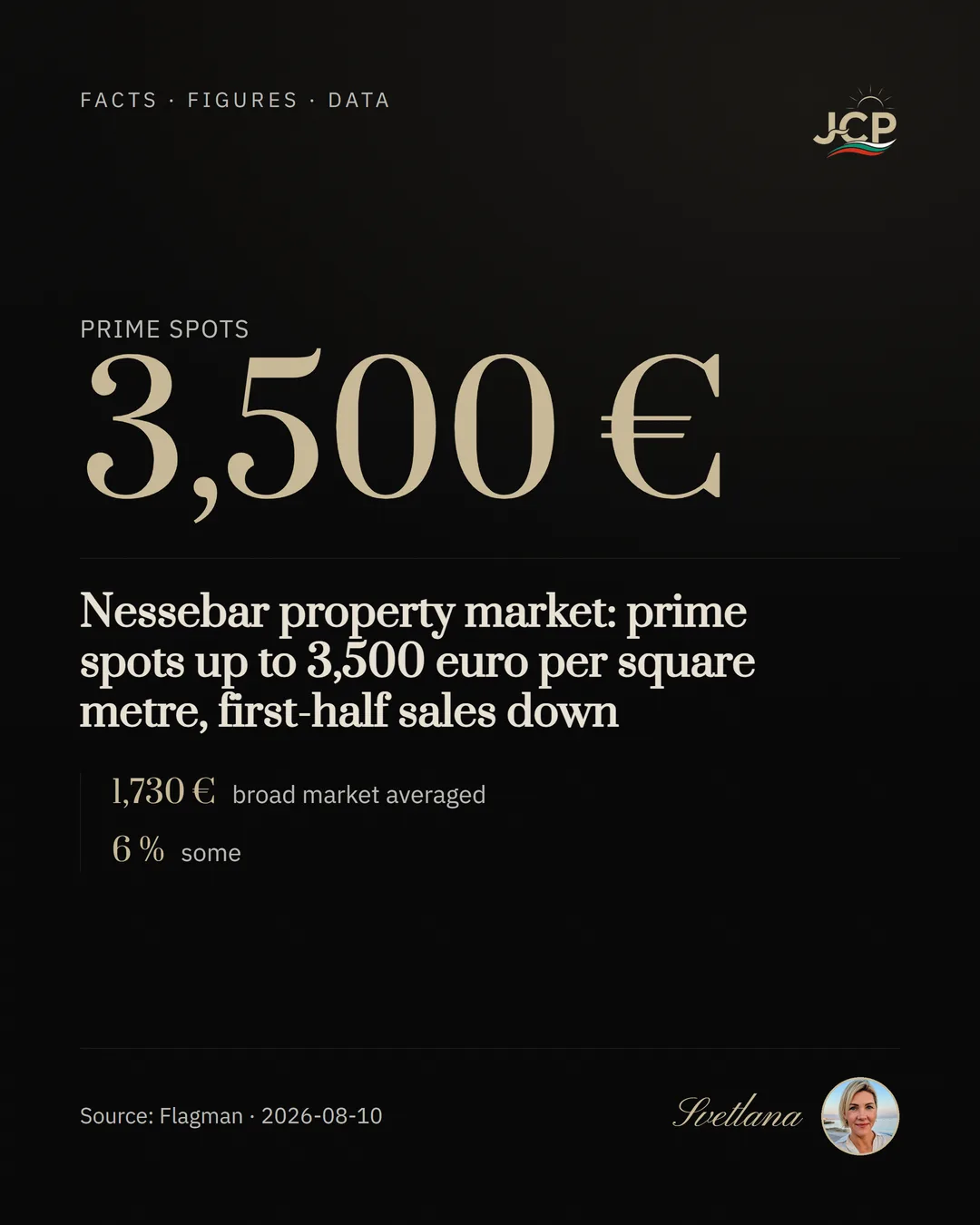
Nessebar property market: prime spots up to 3,500 euro per square metre, first-half sales down
In the best beachfront spots of Nessebar, asking prices now reach 3,500 euro per square metre, while the broad market averaged around 1,730 euro per square metre at the end of 2025, up some 6 per cent in six months. The property register recorded 2,741 sales in Nessebar municipality in the first half of 2026, down from 3,841 in the same period of 2025; for the whole of 2025 there were nearly 9,000, and more than 21,600 along the southern Black Sea coast. Market watchers put the price stability, despite lower volumes, down to the scarce supply of beach-near, year-round-capable homes with a completed occupancy permit (Act 16). The official register does not break sales down by buyer nationality; visible demand comes from Germany, the United Kingdom, Austria and Scandinavia.
Assessment: For sellers the message is two-sided: price levels in prime spots are holding, but the number of completed deals has clearly fallen. Selling now takes patience and a clean property file; that same shift gives buyers more room to negotiate and time for due diligence, without the good locations becoming cheaper. I see a more mature market: quality by the beach stays scarce and value-stable, while standard stock depends more on supply. To judge an individual case I always look at the exact location, the Act 16 status and the running costs.
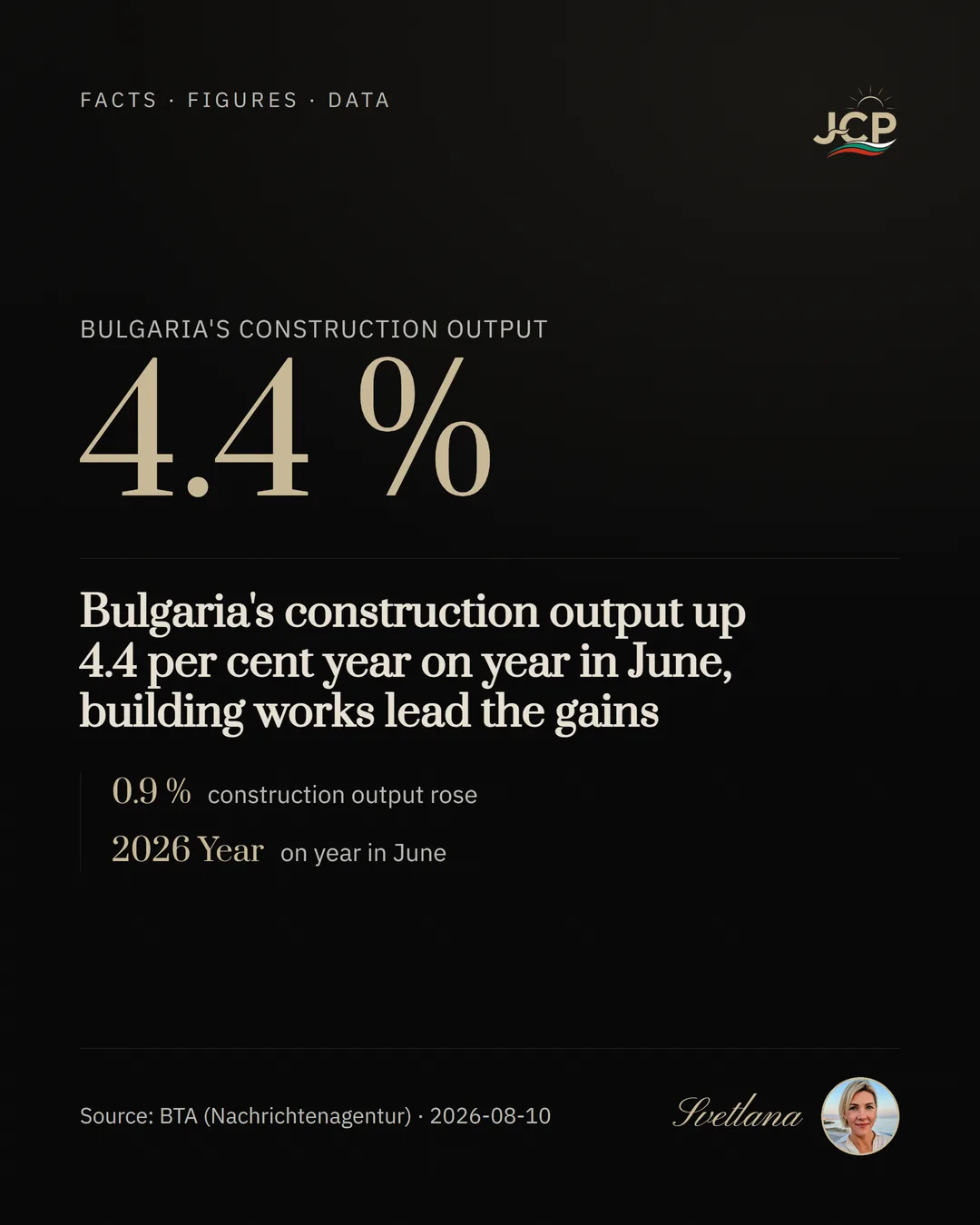
Bulgaria's construction output up 4.4 per cent year on year in June, building works lead the gains
According to preliminary figures from the statistics institute, construction output rose 0.9 per cent month on month and 4.4 per cent year on year in June 2026. Year on year, building construction grew 11.9 per cent and civil engineering 3.6 per cent, while specialised construction fell 3.1 per cent. Month on month, building construction added 2.4 per cent and civil engineering slipped 0.5 per cent. The annual increase is smaller than in previous months, so construction keeps growing, but more calmly.
Consumer watchdog reviews the euro switch: 14,535 inspections, price protection runs to August 2027
The Consumer Protection Commission carried out 14,535 inspections of dual price display in lev and euro between 8 August 2025 and 8 August 2026. These produced 1,121 violation reports, 474 settlements and 272 penalty decrees, with sanctions totalling 1.31 million euro. Since 9 August 2026 the euro has been the sole currency at the fixed rate of 1 euro = 1.95583 lev, and dual display has ended. The regime against economically unjustified price rises, carrying a maximum fine of 100,000 euro per breach, continues until 9 August 2027.
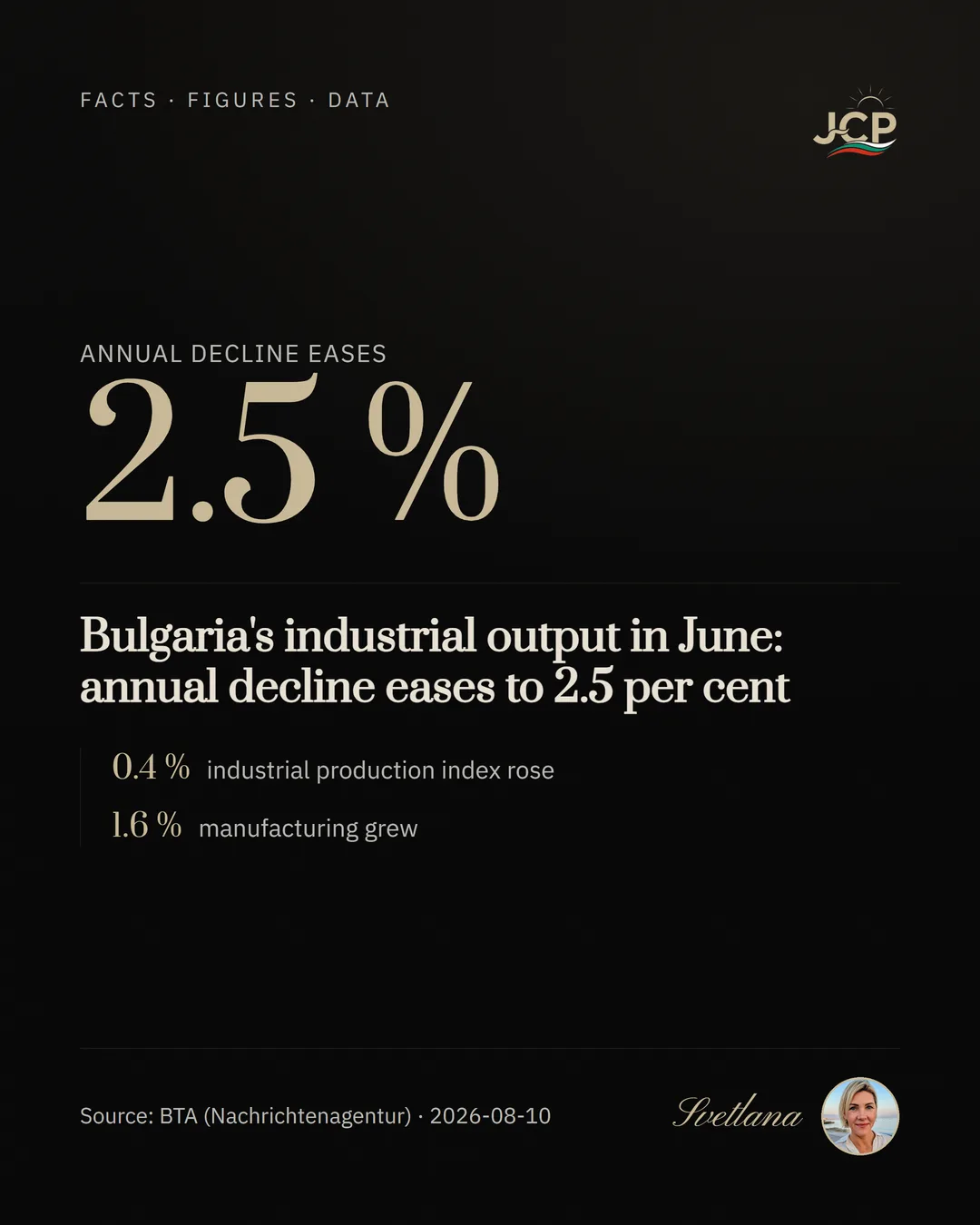
Bulgaria's industrial output in June: annual decline eases to 2.5 per cent
The industrial production index rose 0.4 per cent month on month in June 2026; against June 2025 a calendar-adjusted decline of 2.5 per cent remained, easing further. Month on month, manufacturing grew 1.6 per cent, while mining and quarrying fell 10.8 per cent and the supply of electricity, heat and gas 2.7 per cent. The figures come from the statistics institute.
Services output up 8.1 per cent year on year in May, real estate activities down month on month
The statistics office reports services output up 8.1 per cent year on year in May 2026, while the overall index was unchanged against April. Year on year, administrative and support activities rose 20.6 per cent, professional, scientific and technical activities 15.4 per cent, and information and communication 11.6 per cent. Month on month, real estate activities fell 1.5 per cent and transport and storage 0.3 per cent, while accommodation and food services gained 2.0 per cent. For the coast the accommodation figure carries most meaning: it measures the run-up to the peak months.
Assessment: Two figures matter for owners. The gain in accommodation and food services supports the coastal letting season; the slight dip in real estate activities shows that transaction handling has calmed down, not the market itself. Sellers should plan for longer marketing periods, buyers gain time for due diligence. I consider both a healthy picture rather than a turning point.
Retail turnover up 7.1 per cent year on year in June, mail order and internet retail up 26.4 per cent
Bulgarian retail turnover in June 2026 was 7.1 per cent above the same month last year at constant prices and 0.5 per cent above May. Non-food goods excluding fuel rose 9.9 per cent year on year, food, beverages and tobacco 4.1 per cent, and automotive fuel in specialised stores 3.1 per cent. The strongest growth came from mail order and internet retail at 26.4 per cent and from textiles, clothing, footwear and leather goods at 22.5 per cent. The figures, which exclude motor vehicle trade, show private demand holding up despite higher prices – an environment that supports letting and hospitality on the coast.
Consumer confidence up 2.9 points in July to minus 25.7 per cent
The consumer confidence indicator improved by 2.9 percentage points between April and July 2026, from minus 28.6 to minus 25.7 per cent. In towns it rose by 1.1 points, in rural areas by 7.7 points. Respondents view the economic situation of the past twelve months more favourably than before and expect more moderate price movement over the coming twelve months, while judging employment prospects more sceptically. Intentions to make major purchases remained positive.
Financial service providers show euro prices only from 9 August, safeguard against unjustified price rises runs to 2027
For all companies supervised by the Financial Supervision Commission – capital market, insurance and supplementary pension insurance – mandatory dual pricing ends on 8 August 2026. From 9 August, prices, tariffs and monetary values are stated exclusively in euro; a lev equivalent remains only as optional reference information. The legal basis is the Law on the Introduction of the Euro in Bulgaria. In parallel, a consumer protection regime applies from 9 August until 9 August 2027, prohibiting unjustified price increases without an objective economic cause.
Assessment: For buyers from abroad this is a simplification: insurance premiums, custody fees and pension products become directly comparable from 9 August, without mental conversion. More important still is the safeguard running to 2027 – it gives owners a starting point if premiums or administration fees rise without a factual basis. I recommend archiving policies and fee schedules in euro now, so that later increases stay demonstrable.
Bulgaria's economic output up from 32.46 to 116.02 billion euro since 2007
According to Eurostat data, Bulgaria's economic output rose from 32.46 billion euro in 2007 to 116.02 billion euro in 2025, an increase of 257.4 per cent. The European Union as a whole grew from around 10.8 to 18.8 trillion euro over the same period, or 74.1 per cent. Bulgaria's share of the Union's output thus doubled from 0.3 to 0.6 per cent, placing the country 19th among member states. In 2007 only four member states had a smaller economy than Bulgaria; today eight do.
Over 17 per cent of all property deals take place in Black Sea towns, Burgas at 1,850 euro per square metre
Market analyses presented at a trade press conference in Varna show that over 17 per cent of all property transactions in Bulgaria take place in Black Sea towns, up from 11 per cent in 2015. Prices per square metre stand at 1,990 euro in Varna, 1,850 euro in Burgas and 1,688 euro in Nessebar, against 1,546 euro in Plovdiv. For Burgas, sales in the first half of 2026 are given as around 21 per cent below the previous year, alongside a 33 per cent rise in building permits and, at 8.89 units per 1,000 inhabitants, the highest construction intensity among the major cities. Internal migration to the coast is cited as the driving factor.
Job listings down 7.1 per cent month on month in July, Burgas with the second smallest decline
In July 2026 a total of 35,204 job listings were published in Bulgaria, 2,697 fewer than in June, a decline of 7.1 per cent; year on year the figure is 10.6 per cent lower. Regionally the fall was steepest in Stara Zagora at 14.2 per cent and Ruse at 10.8 per cent, followed by Sofia at 6.4 and Plovdiv at 5 per cent. Burgas recorded a 4.5 per cent decline, Varna the smallest at 0.5 per cent. Remote work offers stayed broadly stable at 2,389 listings, a share of 7.4 per cent. The analysis comes from the recruitment provider Job Tiger.
Peak season holds its price level: over 90 per cent occupancy at Sunny Beach, discounts only from mid-September
Hoteliers on the Black Sea coast report no across-the-board discounts for August: prices remain at the level seen at the start of the peak season, with larger reductions expected only between 15 September and 1 October. The owners' association at Sunny Beach puts occupancy at over 90 per cent as of 1 August; hotels with early-booked allotments are running at close to full capacity. At the same time, guests book at ever shorter notice and plan holidays with less lead time. The observations come from Burgas, Sozopol, Lozenets and Sunny Beach.
Assessment: For landlords this is good news: the coast is holding its prices even in a year of short-notice booking behaviour, and panic discounts are absent. Private hosts should align their pricing accordingly and keep capacity open for last-minute enquiries rather than cutting rates early across the board. Prospective buyers, in turn, will find better conditions for viewing trips from mid-September, when the towns grow quieter; in my view the best window to experience locations realistically.
Permits for residential buildings up 8.2 per cent year on year in the second quarter, 1,660 planned dwellings in the Burgas region
In the second quarter of 2026, Bulgaria issued 2,216 permits for new residential buildings comprising 11,499 dwellings with a gross floor area of 1,351,492 square metres. Against the same quarter a year earlier, the number of permits rose 8.2 per cent, dwellings 14 per cent and floor area 3.6 per cent. In the Burgas region 161 permits accounted for 1,660 planned new dwellings. The figures were reported by the National Statistical Institute (NSI) and map the new-build pipeline for the coming years.
Gross external debt at 53.1 per cent of economic output at end of May, the rise driven mainly by euro introduction
Bulgaria's gross external debt reached about 66.1 billion euros at the end of May 2026, equal to 53.1 per cent of economic output, the Bulgarian National Bank reports. A year earlier the figure stood at 45.5 per cent; the 25.5 per cent rise is largely technical. It reflects obligations from issuing euro banknotes after joining the euro area on 1 January 2026, not new borrowing. By European standards the debt level remains moderate.
Bulgaria's housing stock at 4,360,805 dwellings at the end of 2025
Bulgaria's housing stock totalled 4,360,805 dwellings as of 31 December 2025. The National Statistical Institute (NSI) derives the figure from the September 2021 census, adding new build completed by the end of 2025 and subtracting demolished buildings. The stock is thus growing slowly but steadily. The annual update is a reliable reference for placing new-build numbers and market supply in context.
Assessment: For buyers this figure is less a purchase signal than a yardstick against which supply and new build can be measured. A slowly growing stock argues against oversupply and supports the value of well-located properties, especially on the sought-after coast. I use such numbers to place offers in context, and advise orienting your own choice less on the overall market than on location, condition and resale prospects.
Cash across the EU external border: a customs declaration is required from 10,000 euros
Anyone entering or leaving the EU with 10,000 euros or more in cash, or the equivalent in another currency, must declare the amount to customs in the country of entry or exit. The threshold applies per person; for a travelling group it counts for each person separately. Cash means banknotes, coins and certain bearer instruments. For buyers carrying their own funds in cash, declaring in good time is the simplest way to avoid later questions.
Assessment: Most buyers transfer the purchase price anyway, but when carrying cash the 10,000-euro threshold is often overlooked. I clearly recommend the transfer route with a clean record, which also makes proving the source of funds to the bank and notary easier later. Those who still travel with cash should over-declare rather than under-declare.
Fuel prices in Bulgaria: diesel rises to EUR 1.76 per litre in July
As of 1 August 2026, diesel in Bulgaria costs an average of EUR 1.76 per litre, up EUR 0.26 or 17.33% within a month and the sharpest rise of any fuel. Petrol A95 stands at EUR 1.54 (up 4.05%), LPG at EUR 0.65 and CNG at EUR 1.27 per kilogram. The background is a roughly 24% rise in Brent crude oil in July. For owners on the coast these are noticeable travel and running costs, foreseeable given the longer distances between Burgas and the coastal towns.
Bulgaria's annual inflation slows to 4.1 per cent in July
Bulgaria's annual inflation, measured by the Harmonised Index of Consumer Prices, fell to 4.1 per cent in July, down from 5.2 per cent in June and 6.3 per cent in May. Prices rose by 0.4 per cent compared with June. In the euro area inflation stood at 2.9 per cent; Bulgaria remains the second highest after Latvia (5.6 per cent). The clear downward trend supports purchasing power and, with it, demand in the property market.
Bulgaria's natural gas price rises 4.6 per cent in August to 39.43 euros per megawatt-hour
The Energy and Water Regulatory Commission has set the regulated natural gas price for August at 39.43 euros per megawatt-hour, up 4.6 per cent on July. Despite the rise, regulated prices remain about 30 per cent below the European market level. The figure excludes transport, excise duty and VAT. For owners of gas-heated coastal properties, the regulated price is a calculable cost factor.
Bulgaria's banks lift half-year profit to EUR 1.1 billion as home lending grows
Bulgaria's banking system posted a net profit of EUR 1.1 billion in the first half of 2026, up 7.2% year on year. According to the Bulgarian National Bank, lending to households rose 5.6% in the second quarter, including EUR 1.2 billion of new residential mortgages. The share of non-performing loans fell to 2.65%, while deposits reached EUR 101.3 billion. A stable, well-capitalised banking sector keeps property financing dependable.
Assessment: For buyers who finance part of the price, the health of the banks matters more than any advertisement. I read these figures as a market that lends readily for homes without letting risk slip. Owner-occupiers gain predictable terms, landlords a liquid environment for refinancing. Svetlana clarifies individual borrowing capacity in advance with the bank and notary.
Bulgaria's producer prices up 17.1% year on year in June, energy eases month on month
According to the statistics institute NSI, Bulgarian industrial producer prices in June 2026 stood 17.1% above a year earlier, while easing 0.5% from May. In energy (electricity, gas, steam) the annual rise was 20.4%, though prices there fell 1.4% month on month. On the domestic market the annual increase was slightly higher at 18.3%. For builders and owners these are the leading signals for construction, renovation and running costs.
Unemployment in Bulgaria at 3% in June, half the EU average
Bulgaria's unemployment rate stood at 3% in June 2026, half the EU average of 6%. The seasonally adjusted figures come from Eurostat, as reported by Forbes Bulgaria. A year earlier the rate was 3.6%; in the euro area it currently stands at 6.3%. Together with Cyprus, Bulgaria is among the EU countries with the lowest unemployment.
Bulgaria's electricity output up 18.3% in May, domestic generation stays strong
According to the statistics institute NSI, Bulgaria generated 3,057 gigawatt-hours of electricity in May 2026, 18.3% more than a year earlier. Output of solid fuels rose 24.9% to 834,000 tonnes, while domestic natural gas production stayed very low at under 0.5 million cubic metres. Among fuels, diesel production grew 27.8%. Stable domestic energy generation supports security of supply on the Black Sea coast too.
More than 1.4 million foreign visitors to Bulgaria in June, over half for recreation
According to preliminary figures from the statistics institute NSI, Bulgaria recorded 1,424,100 visits from abroad in June 2026, essentially level with a year earlier (down 0.2%). More than half, about 744,500, travelled for recreation. Most guests came from Romania (246,600), Turkey (242,200), Germany (122,200), Greece (110,000) and Ukraine (109,200). Stable, broadly spread demand underpins the coastal letting market.
Assessment: A visitor flow at last year's level means dependable occupancy for holiday landlords on the southern coast. I find the mix of source countries valuable, because it spreads risk across several markets. Turkish, German and Ukrainian guests also mirror the demand I see among prospective buyers. Owner-occupiers benefit from the good connectivity this travel brings.
Business climate in Bulgaria rises in July, construction up by 4.5 points
The overall business climate indicator in Bulgaria rose by 0.7 percentage points in July 2026 against June, the NSI statistics institute reported. The improvement was driven above all by industry and construction. In the construction sector the indicator gained 4.5 percentage points, with firms rating their situation more favourably and expecting more orders over the coming six months. A confident construction sector is an early sign of continued building activity.
Assessment: For buyers a confident construction sector cuts both ways, and that is exactly how I frame it: more building brings fresh supply and more modern properties, but in sought-after spots it can also raise competition for land. For owners of existing coastal flats, sustained demand in construction rather supports stable values. I see a healthy market environment here, not a sign of overheating. For an individual decision the specific location still matters more than the national index.
Number of active enterprises in Bulgaria rises to 415,087 in 2024, up 2.7%
In 2024 a total of 415,087 active enterprises were registered in Bulgaria, up 2.7% on 2023, the NSI statistics institute reported. Enterprises with ten or more employees made up only 7.1% of all businesses but provided 67.6% of jobs. The figures paint the picture of a broad, growing business landscape.
Assessment: A broad, growing business base is for me a quiet foundation behind property demand, because it supports employment and purchasing power. For landlords on the coast, what matters most is that the economy and jobs stay stable overall. I read such structural data not as a short-term signal but as background for long-term decisions. For an individual purchase, the specific location remains more important than the national statistics.
Minimum wage in Bulgaria at EUR 620.20, labour costs remain the lowest in the EU
The statutory gross minimum wage in Bulgaria has stood at EUR 620.20 a month since January 2026. Average labour costs were around EUR 12 per hour in 2025, remaining the lowest in the European Union, while the average gross monthly wage was about EUR 1,331. For 2026 the European Commission expects nominal wage growth of 5.7% and 2.7% in real terms. The figures come from Germany Trade and Invest.
Housing loans in Bulgaria reach EUR 18.68 billion at end-June, up 26.4%
At the end of June 2026, housing loans to private households in Bulgaria stood at EUR 18.682 billion, up 26.4% year on year. Total household lending reached EUR 31.545 billion (up 21%), with consumer loans at EUR 11.844 billion (up 14.8%). Credit demand thus keeps growing strongly, if slightly more slowly than in May. The figures come from Bulgarian National Bank statistics.
Assessment: I read these figures as a sign of a healthy but not overheated financing environment. For buyers on the coast, strong lending means banks continue to actively support property finance – those who plan soundly will find room to move. At the same time the pace calls for care: I advise calculating your instalment conservatively and not buying at the top of your limit. For owners, broad demand underpins the value of their properties.
UniCredit Bulbank raises 2026 inflation forecast to 5 per cent, growth seen at 2.9 per cent
UniCredit Bulbank expects inflation of 5 per cent in 2026, easing to 4 per cent in 2027 and 3.1 per cent in 2028. The bank projects real economic growth of 2.9 per cent in 2026 and 2.5 per cent in 2027. The general government deficit is seen widening to 4.8 per cent of GDP in 2026 before narrowing to 3.3 per cent by 2028. The figures fall in the first year after euro adoption.
Tax authority steps up coastal checks: 1,500 inspections and what landlords should note
Between 29 June and 25 July 2026 the National Revenue Agency carried out nearly 1,500 checks along the Black Sea coast and recorded 470 violations. In Burgas province 811 outlets were inspected and 319 breaches documented, mostly missing fiscal receipts and discrepancies between the till and reported turnover. Nationwide, 2026 inspections now exceed 27,500 with almost 11,000 violations. Anyone letting a coastal property should account for income properly through a registered cash register.