Market, region and lifestyle on the Black Sea coast. Concise, factual, each with a source.
Page 9 of 17.
Region · Burgas2026-08-25
Bulgaria Air adds up to two extra daily flights between Sofia and Burgas ahead of Eurovision 2027
Bulgaria Air is boosting the Sofia–Burgas–Sofia route for the Eurovision Song Contest, adding up to two extra flights a day from 2 to 19 May 2027. The service uses the Airbus A220, the newest type in its fleet. Afternoon departures join the regular evening flights in the run-up to the shows, with additional morning returns after the final on 15 May. For owners on the southern coast, the connection via Sofia widens noticeably for that period.
Bulgaria releases another 150 million euro for municipal projects, up to 600 million euro available in 2026
For 2026, an additional 150 million euro is available to the department responsible for regional development and public works. In total, up to 600 million euro is earmarked this year for the investment programme for municipal projects, anchored in the State Budget Act. The funds go into regional infrastructure, the urban environment and water and sewerage services. The decision names no allocation to individual municipalities.
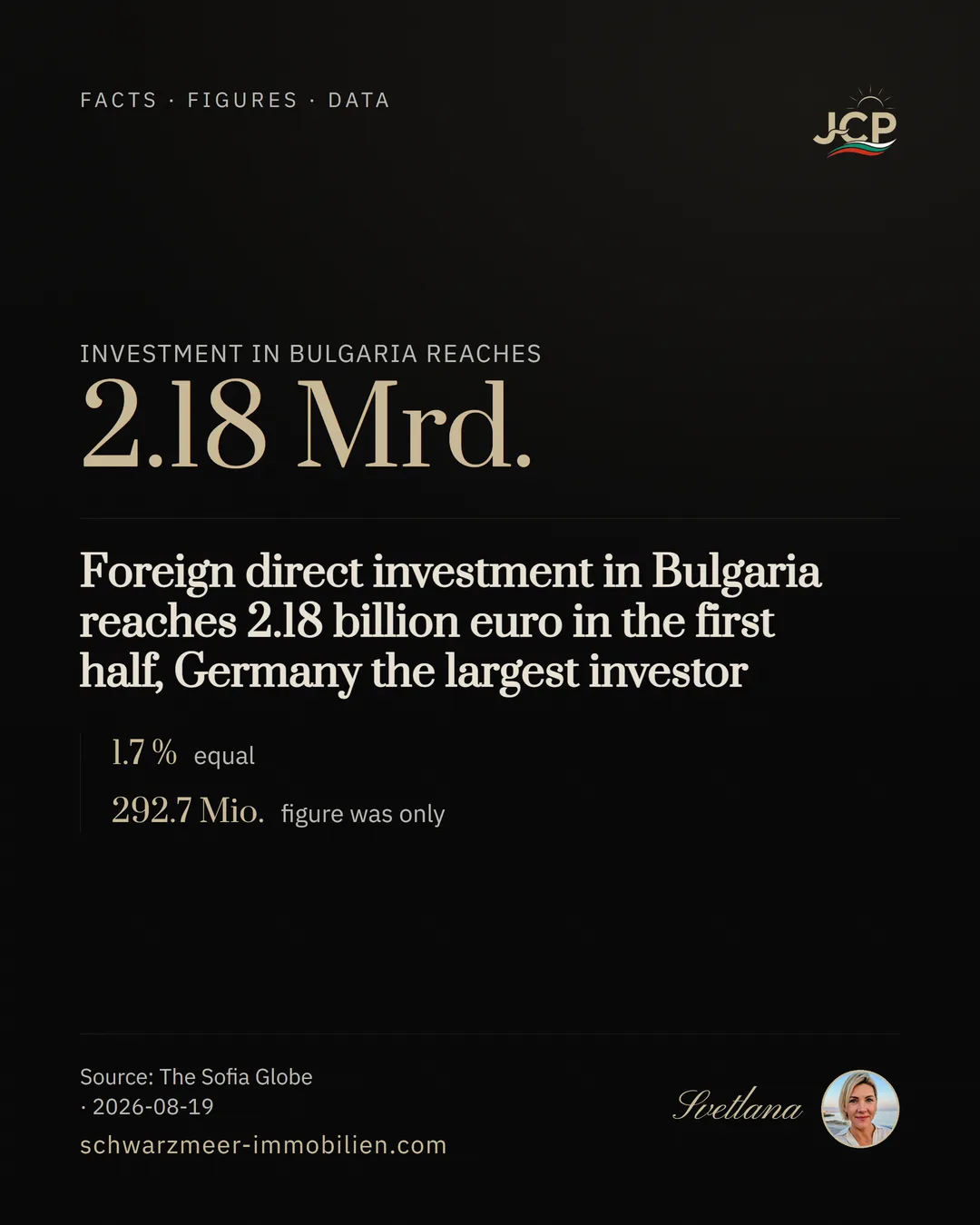
Foreign direct investment in Bulgaria reaches 2.18 billion euro in the first half, Germany the largest investor
According to the Bulgarian National Bank, foreign direct investment reached around 2.18 billion euro in the first half of 2026, equal to 1.7 per cent of gross domestic product. In the same period a year earlier the figure was only 292.7 million euro after revision. The largest share came from reinvested earnings at around 1.65 billion euro. By country of origin, Germany led with 372.5 million, Luxembourg with 353.4 million and Austria with 269.9 million euro.
Assessment: That Germany is the largest direct investor fits what I see among buyers from the German-speaking countries: confidence in the location is growing. The jump over last year is notable, but should not be overstated, because a large part comes from reinvested earnings. For the property market the signal counts: foreign capital stays and grows in the country.
Eight investors pay deposits for plots in Phase 2 of Burgas Industrial Park, 20 parcels still free
At Burgas Industrial Park, eight investors have paid deposits for second-phase plots, with 20 parcels still available. The site works cost more than 20 million euro and were funded through the EU Recovery and Resilience Plan. Work ran from 1 October 2025 to the end of June 2026 and covered roads, cycle lanes, water and sewerage, the power grid, a pumping station and video surveillance. One company has already started building, and 24 firms are operating on an adjacent street.
Black Sea motorway: concept and detailed plan due by end of 2027, coastal route down to Malko Tarnovo, built under concession
The ministry of regional development and public works intends to finish the concept and detailed plan for the roughly 94-kilometre Black Sea motorway between Varna and Burgas by the end of 2027. The route is part of a coastal corridor running from Malko Tarnovo via Burgas and Varna to Durankulak, with Bulgaria working alongside Turkey and Romania. Construction is to proceed under a concession: a private investor builds the road and is paid through a general road-use charge, without necessarily requiring toll booths. For the southern coast, the extension towards Malko Tarnovo means better connection of the corridor to the Turkish border.
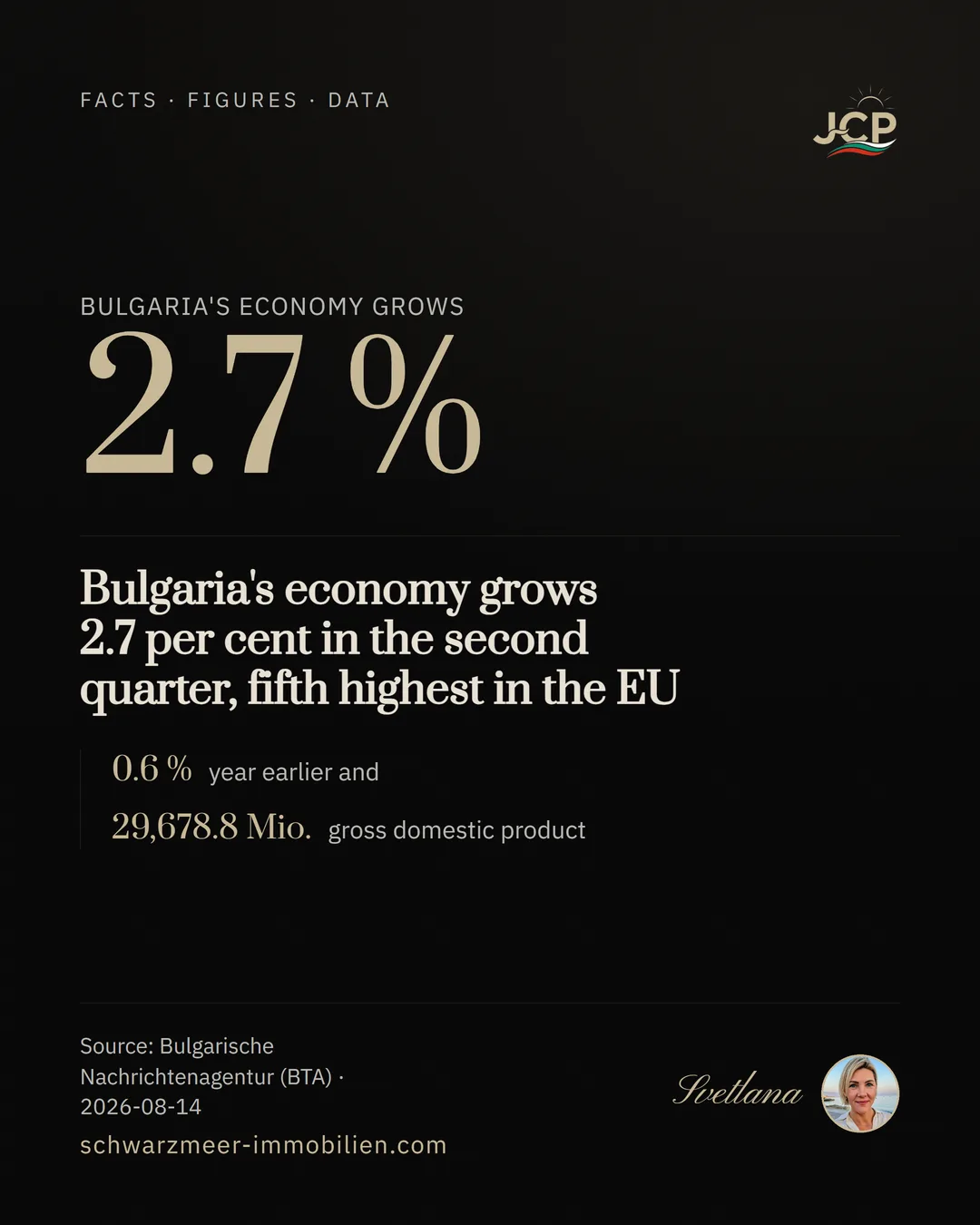
Bulgaria's economy grows 2.7 per cent in the second quarter, fifth highest in the EU
The statistics institute reports economic growth of 2.7 per cent for the second quarter of 2026 against the same quarter a year earlier and 0.6 per cent against the first quarter. In nominal terms, gross domestic product reached 29,678.8 million euro. Quarterly growth was carried by gross fixed capital formation, up 1.8 per cent, and final consumption, up 1.6 per cent. At 2.7 per cent year on year, Bulgaria was level with Spain in fifth place in the EU; in the first quarter the figure was 2.9 per cent.
Dual price display in lev and euro ended on 8 August, prices now in euro
The one-year requirement to display prices in both lev and euro ended on 8 August 2026. From 9 August, retailers show prices in euro and may state the lev equivalent voluntarily for information. During the dual year, the Consumer Protection Commission carried out 14,535 inspections, established 1,120 administrative offences and issued nearly 700 penalty decrees with sanctions of 1.31 million euro. Price monitoring continues even without the dual display.
Assessment: For buyers and owners this is a small but welcome step: prices are now clearly in euro, which lowers the risk of conversion errors in a purchase and in daily life. Importantly, price monitoring continues; unjustified mark-ups remain challengeable. I advise continuing to insist on clean euro figures in contracts and incidental costs.
Mayors in Burgas region speed up spatial development plans, the state pledges faster approval
Mayors in the Burgas region have committed to working faster on their general spatial development plans (PUP), and the state intends to speed up approval. Nationwide, 52 municipalities still lack a comprehensive spatial plan. For the region's tourism-driven municipalities these plans matter most, because they steer local development. The same talks covered the planned Black Sea motorway and the need for roughly 800 kilometres of new motorways and expressways.
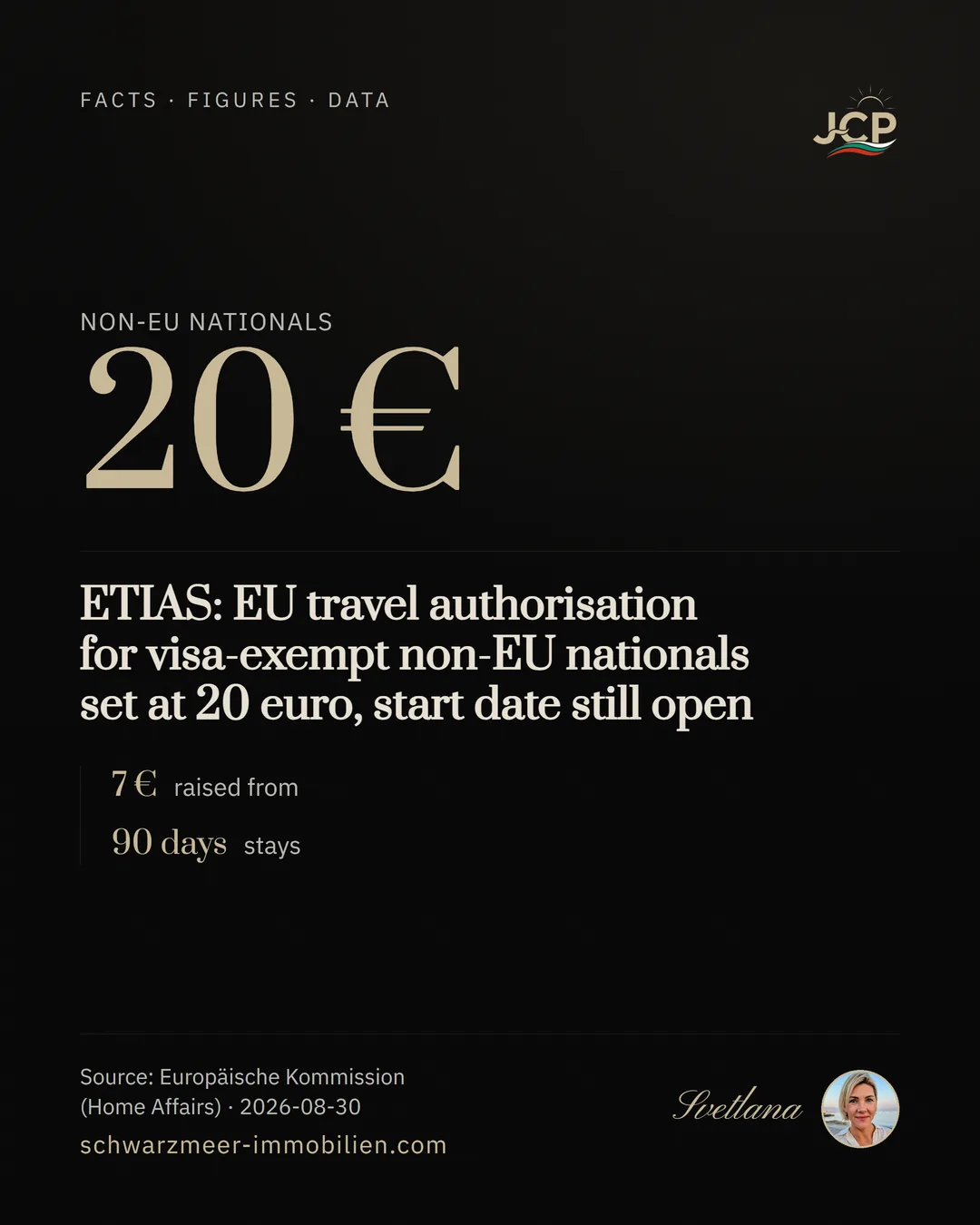
ETIAS: EU travel authorisation for visa-exempt non-EU nationals set at 20 euro, start date still open
The European Travel Information and Authorisation System (ETIAS) will charge 20 euro for the travel authorisation of visa-exempt non-EU nationals, raised from 7 euro. The authorisation covers short stays of up to 90 days within any 180-day period across 30 European countries, Bulgaria among them. The system is not yet operational; the European Commission intends to announce the exact start date several months in advance. For owners from visa-exempt states such as Israel, it is a predictable, minor entry formality.
Southern coast air links grow in 2027: Jet2 to serve eleven Burgas routes, ICC bundles three German cities
For the 2027 summer season several airlines are expanding their links to Bulgaria's Black Sea coast. From May 2027 Jet2 adds eleven routes to Burgas, including from Birmingham, Glasgow, Manchester and East Midlands. From 9 May to 3 October 2027, ICC connects Hanover, Düsseldorf and Leipzig/Halle with Varna and Burgas, with at least 14 flights a week and three weekly services each on Hanover–Burgas and Leipzig/Halle–Burgas. Corendon adds Cologne/Bonn, Austrian flies Vienna from 8 May, and Bulgaria Air runs up to two daily Sofia–Burgas flights around the Eurovision Song Contest in May.
Sofia University expands its Burgas branch: four degree programmes, Korean offered for the first time with six places
The Burgas branch of Sofia University 'St Kliment Ohridski' is launching four programmes for the coming academic year. A bachelor in Korean-language teaching is offered for the first time, with six state-funded places; Japanese (three places) and Chinese (four places) enter their second cohort. The 'Musical Media Technologies and Sound Direction' programme reaches its fourth year and uses a newly built professional studio. Applications run from 8 to 11 September, entirely online.
Assessment: A growing academic offer strengthens Burgas as a location beyond the season: students and teaching staff mean year-round demand for housing, especially smaller units for letting. For buyers, educational infrastructure is part of a city's quality that supports value. I see this as a quiet but reliable signal for central locations.
Sozopol: three mixed-use residential buildings in the town centre notified for environmental review
The municipality of Sozopol has notified an investment proposal: the construction of one mixed-use residential building each on three plots in the town (UPI VI-406, IX-409 and X-410, cadastre 67800.3.406/409/410). The project is going through the notification and environmental-review procedure under the Spatial Planning Act. It sits in a central location on and around the old-town peninsula. New residential buildings requiring permits signal continued construction activity in the core of Sozopol.
Chernomorets: development and regulation plan approved for a plot in the Halvad area
The municipality of Sozopol has published Mayor's order No 8-z-682 of 27 July 2026. It approves a detailed development and regulation plan (PUP-PRZ) for plot 61042.13.30 in the 'Halvad' area near Chernomorets. Such plans set building, density and access for a specific plot. For the coastal corridor around Sozopol it is a further step in development.
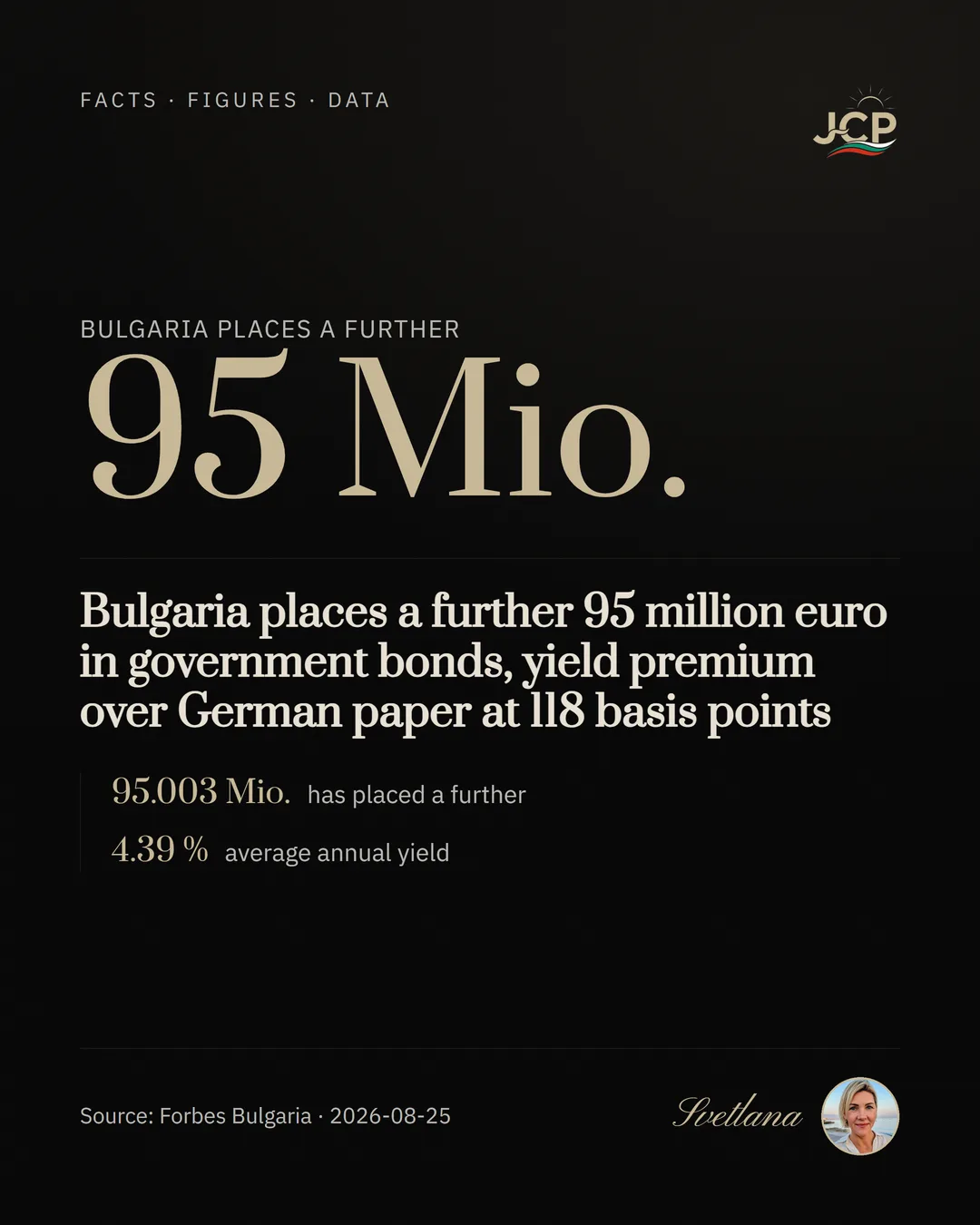
Bulgaria places a further 95 million euro in government bonds, yield premium over German paper at 118 basis points
The finance ministry has placed a further 95.003 million euro of ten-year government bonds on the domestic market, maturing in February 2036. The average annual yield was 4.39 per cent, the premium over comparable German bonds 118 basis points. Demand reached 253.265 million euro, a bid-to-cover of 1.69. Issuance since the start of the year totals 4.105 billion euro; the yield on this maturity rose step by step from 4.18 per cent in April through 4.34 per cent in May to 4.39 per cent most recently.
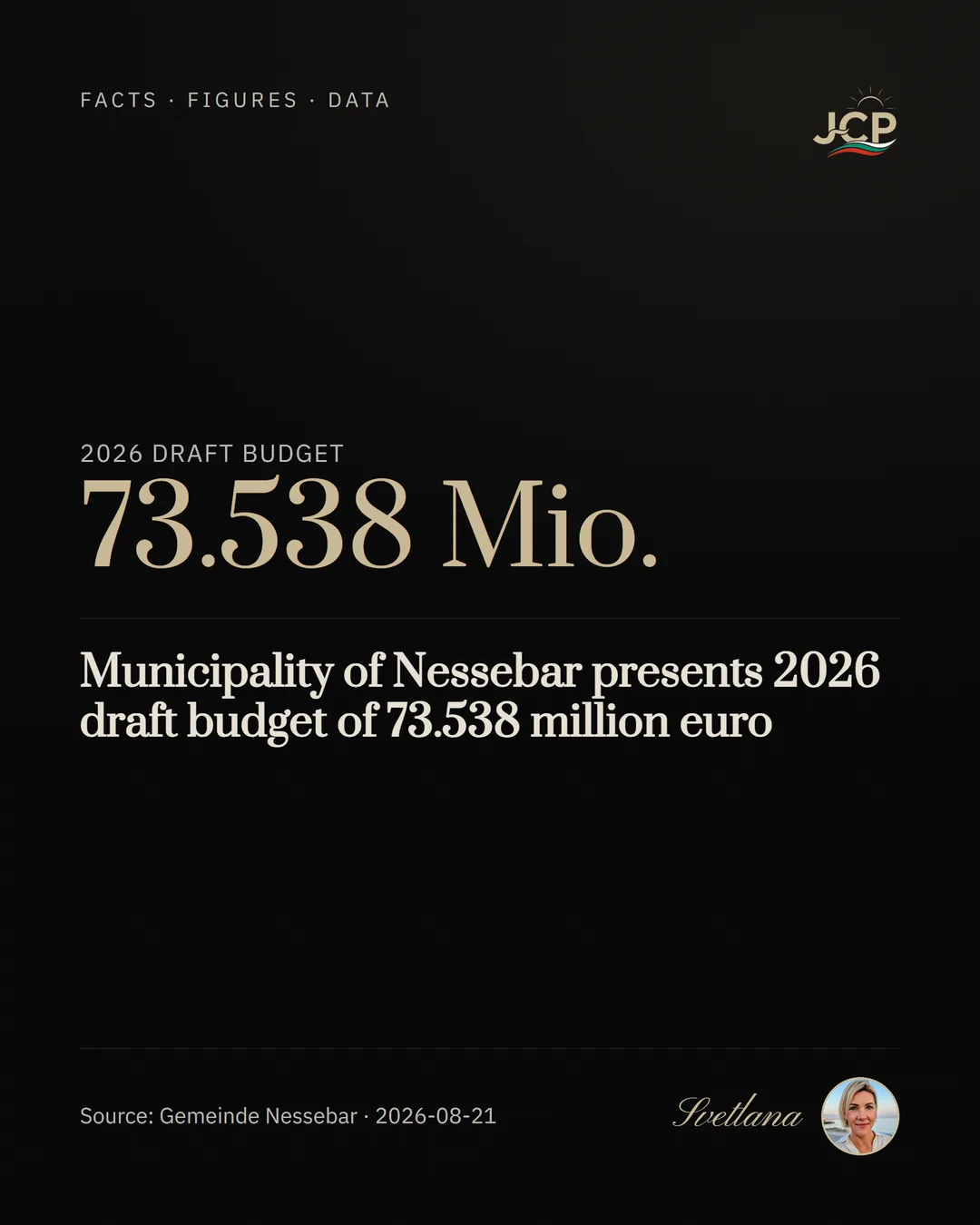
Municipality of Nessebar presents 2026 draft budget of 73.538 million euro
The municipality of Nessebar has publicly presented its 2026 draft budget of 73.538 million euro. With Sunny Beach, Sveti Vlas and Ravda, Nessebar covers one of the country's economically strongest stretches of coast. The size of the budget reflects the municipality's financial strength, which funds investment in infrastructure, education and public spaces. The draft is going through public consultation before adoption by the council.
Assessment: A municipal budget of this size is a tangible location signal: municipalities with means maintain roads, water and public spaces, and that supports property values across the whole area. For buyers in Sunny Beach or Sveti Vlas, the municipality's financial strength is an argument that reaches beyond the single flat. With any property I always look at how the responsible municipality invests.
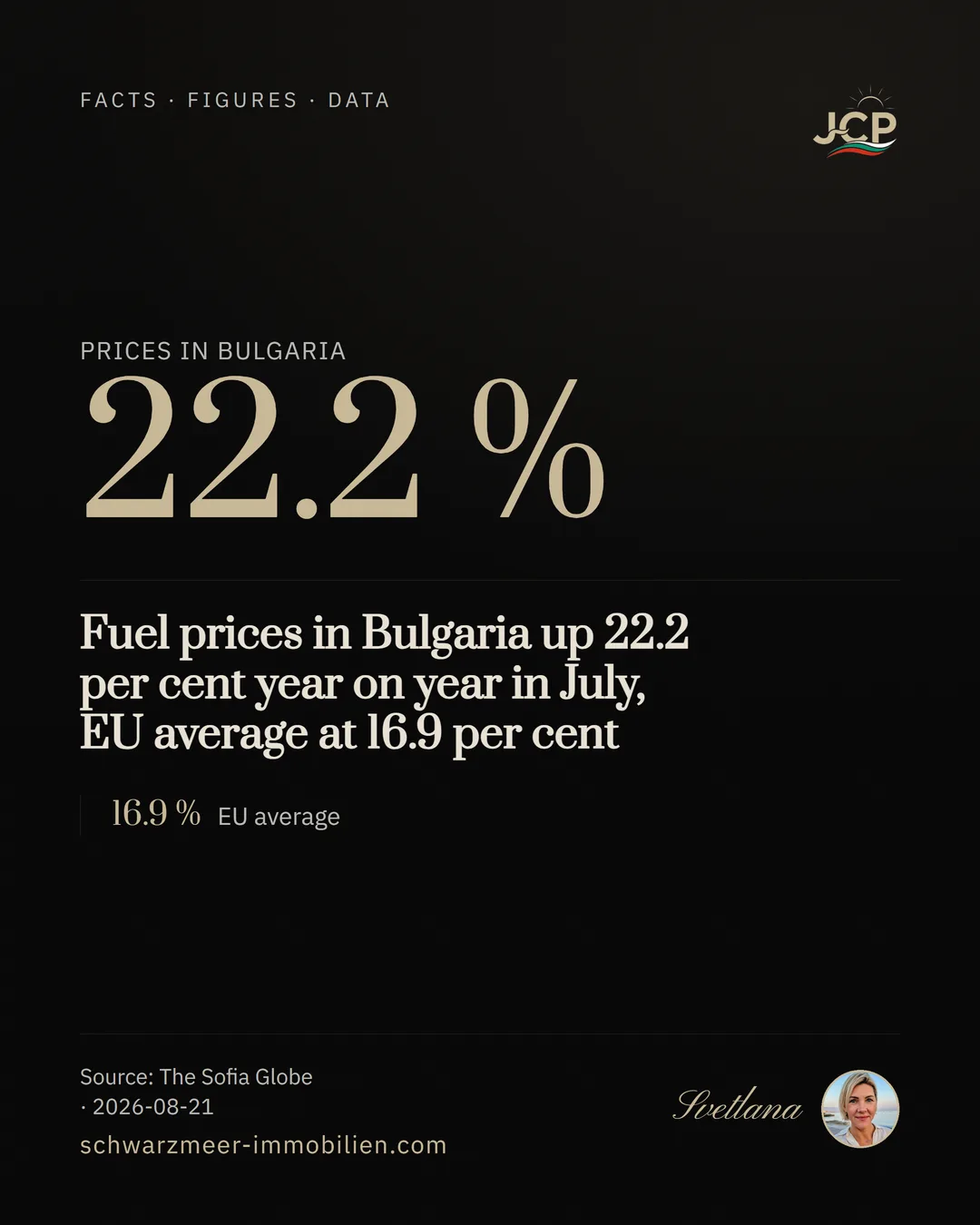
Fuel prices in Bulgaria up 22.2 per cent year on year in July, EU average at 16.9 per cent
Prices for fuels and lubricants for personal transport in Bulgaria were 22.2 per cent higher year on year in July 2026, according to Eurostat. The EU average over the same period was 16.9 per cent. Higher mobility costs feed into the running expenses of owners and tenants, especially in coastal spots that depend on the car. Diesel recently stood at around 1.76 euro a litre.
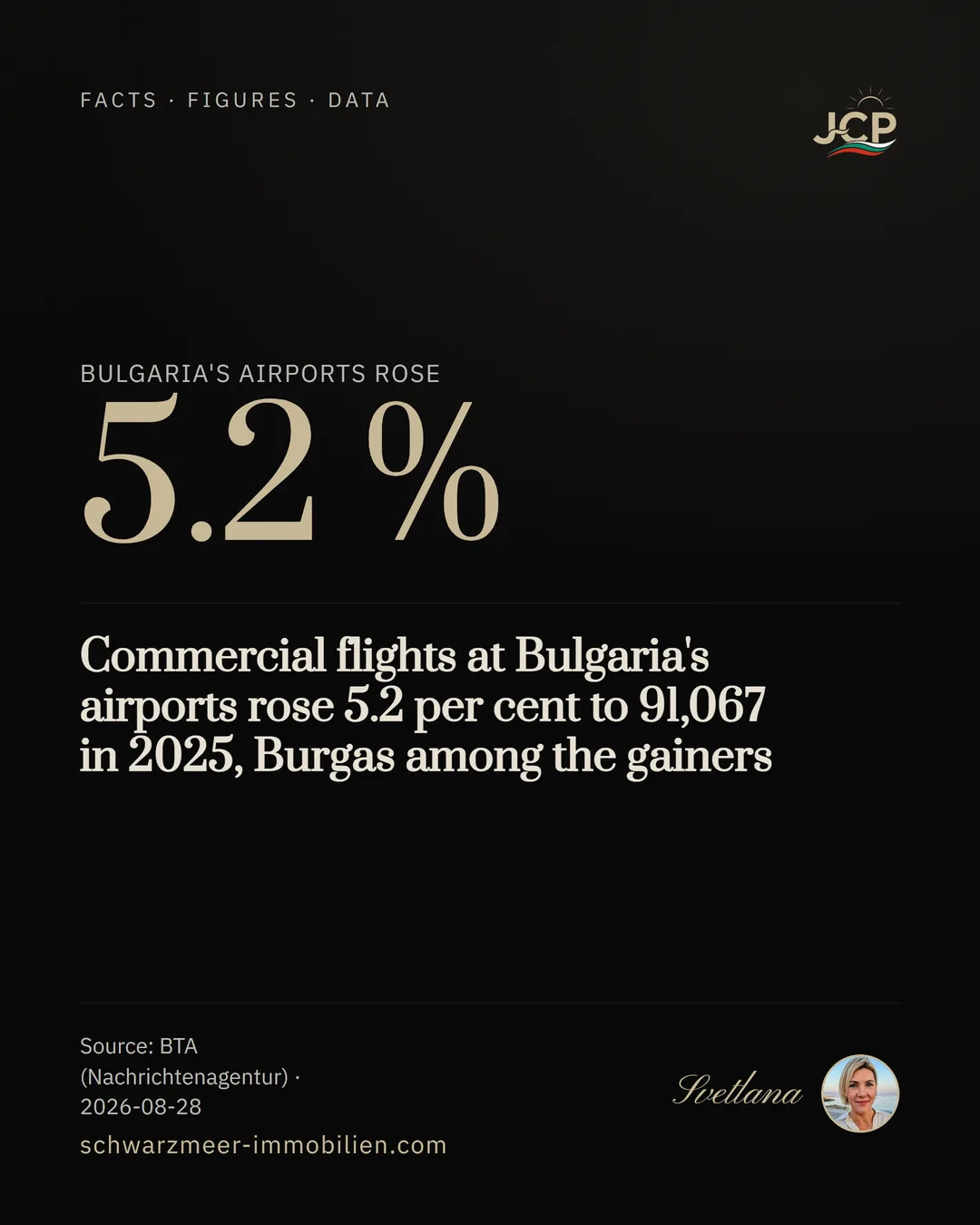
Commercial flights at Bulgaria's airports rose 5.2 per cent to 91,067 in 2025, Burgas among the gainers
Bulgaria's four airports with scheduled service recorded 91,067 commercial flights in 2025, up 5.2 per cent on 2024, according to Eurostat using EUROCONTROL data. Sofia saw the largest absolute rise with 2,229 additional flights, Varna 1,994 and Burgas 75. Across the EU, 6.9 million flights were counted, 3.8 per cent more than the year before. For owners on the south coast, the growing connectivity through Burgas and Varna matters most.
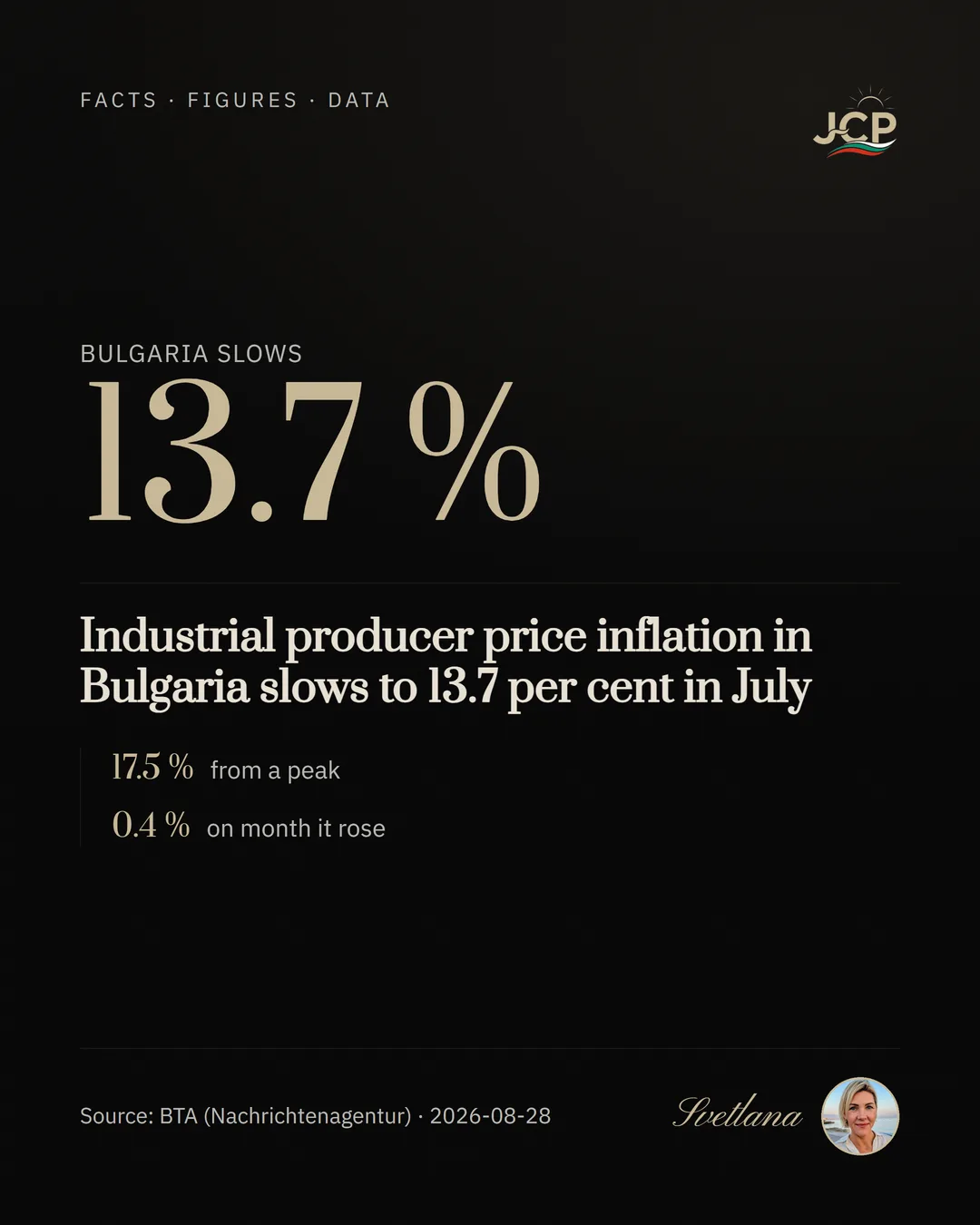
Industrial producer price inflation in Bulgaria slows to 13.7 per cent in July
The total producer price index in July 2026 stood 13.7 per cent above a year earlier, down from a peak of 17.5 per cent in May; month on month it rose 0.4 per cent. Mining posted the sharpest gain, manufacturing came in at 8.8 per cent and the electricity, gas and steam segment at 7.8 per cent. Easing input-price momentum relieves construction costs over the medium term. For buyers this is a relevant signal, because producer prices lead later building and renovation costs.
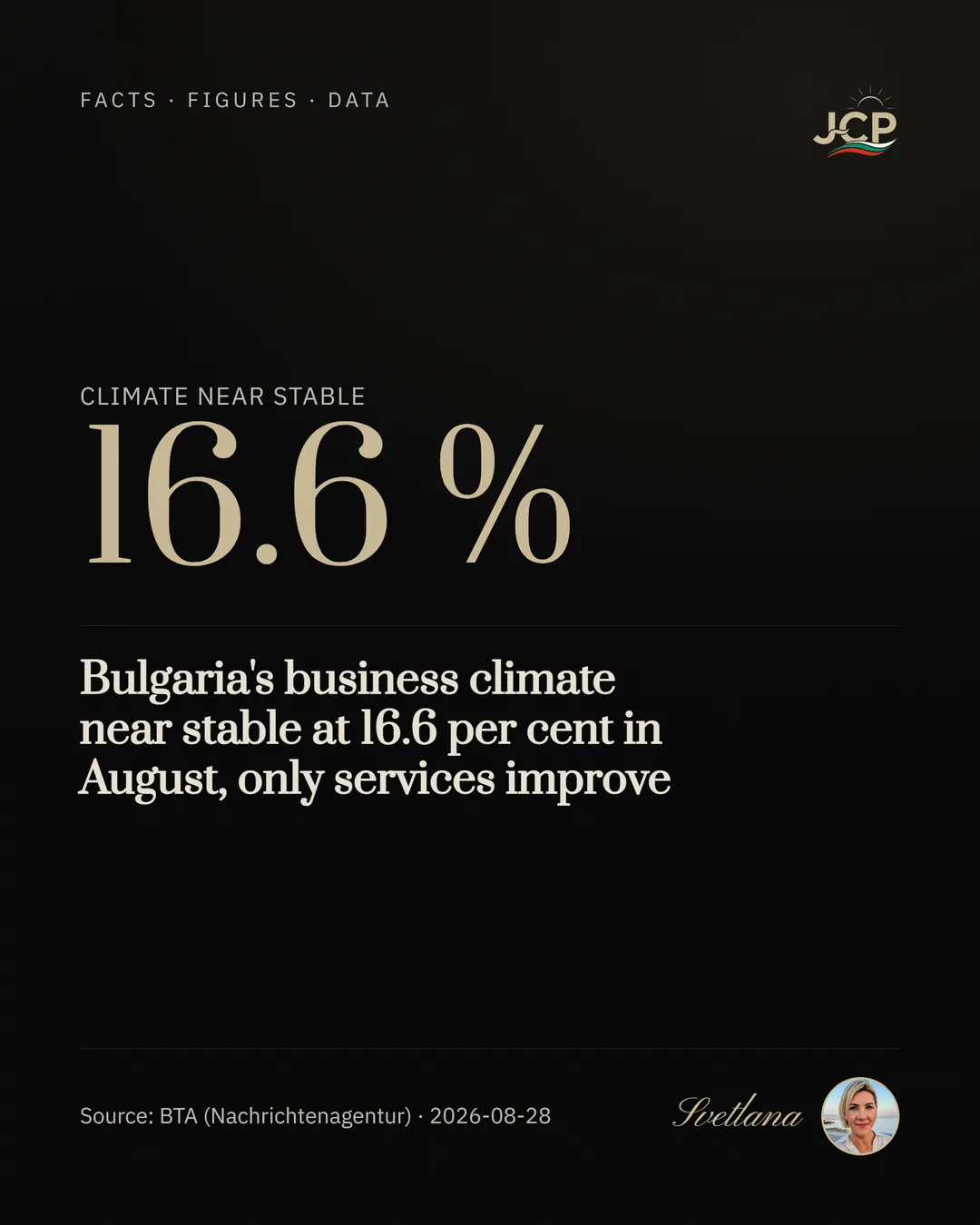
Bulgaria's business climate near stable at 16.6 per cent in August, only services improve
The composite business climate indicator edged down from 16.8 to 16.6 per cent in August 2026. Only the services sector improved, by 3 points; industry (minus 0.9), retail (minus 1.1) and construction (minus 1.6) all softened. The dip in construction reflects more cautious six-month expectations. For buyers this signals a calmer but not collapsing market environment.
Assessment: A business climate that barely moves is reassuring rather than worrying for property buyers: no euphoria, no crash. Slightly softer expectations in construction may open room to negotiate on new-build projects. I see this as a good moment to assess calmly rather than buy under time pressure.
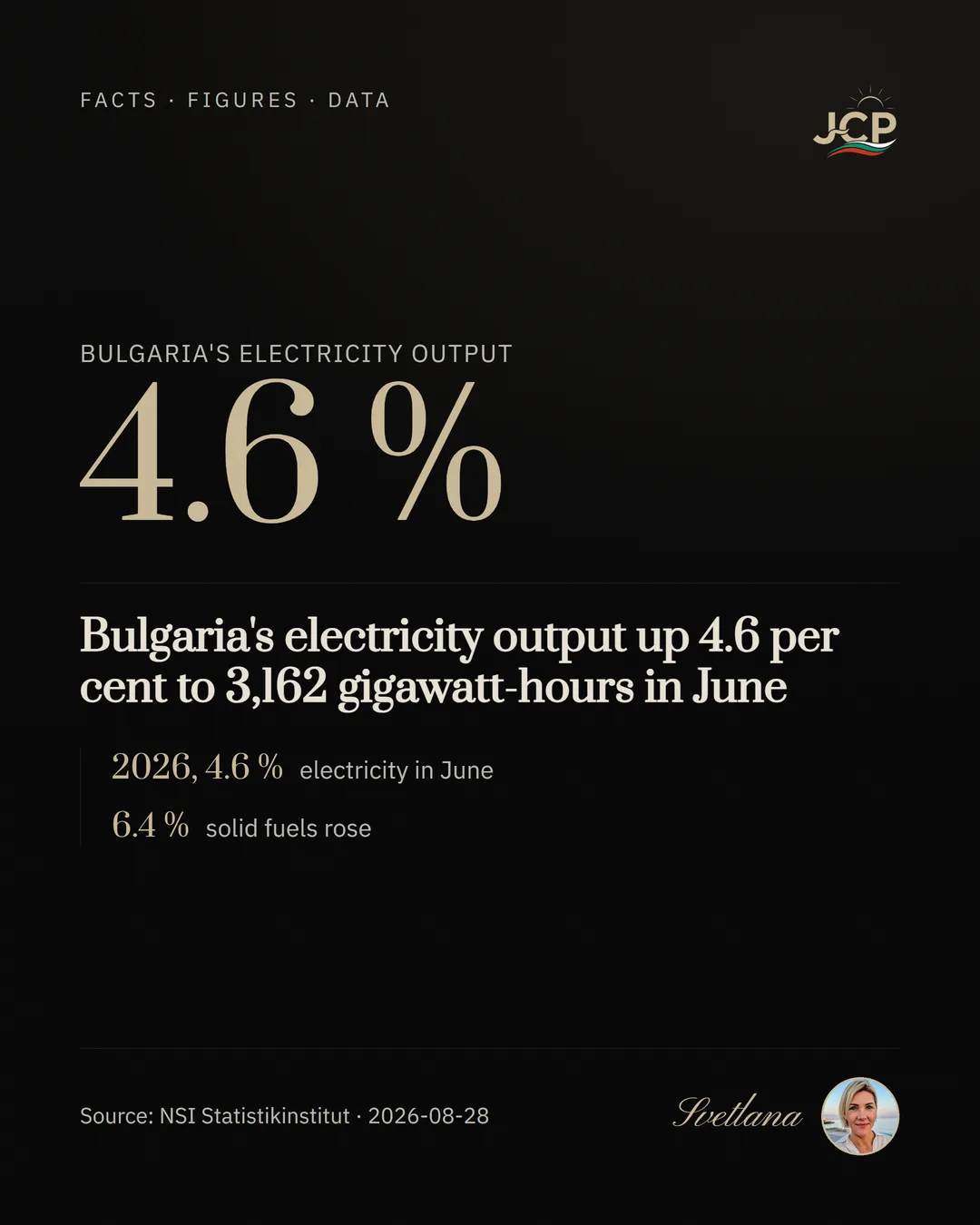
Bulgaria's electricity output up 4.6 per cent to 3,162 gigawatt-hours in June
Bulgaria generated about 3,162 gigawatt-hours of electricity in June 2026, 4.6 per cent more than a year earlier. Output of solid fuels rose 6.4 per cent to 936,000 tonnes, while domestic natural gas production held at 1 million cubic metres. Stable, slightly rising power generation supports security of supply on the coast. For owners this matters, because reliable energy is a building block of lettability and usability.
Finance Ministry projects a 660-euro minimum wage for 2027, social security ceiling at 2,400 euro
Under the Finance Ministry's budget guidelines, the minimum wage is set to rise to 660 euro in 2027 from 620 euro today – up 6.5 per cent; 680 euro is planned for 2028 and 710 euro for 2029. The maximum social security assessment base is put at 2,400 euro for 2027, 2,500 euro for 2028 and 2,600 euro for 2029. The minimum wage follows a legally anchored mechanism of four equally weighted indicators. Rising wage and contribution floors feed into the running costs of administration, cleaning and property management on the coast.
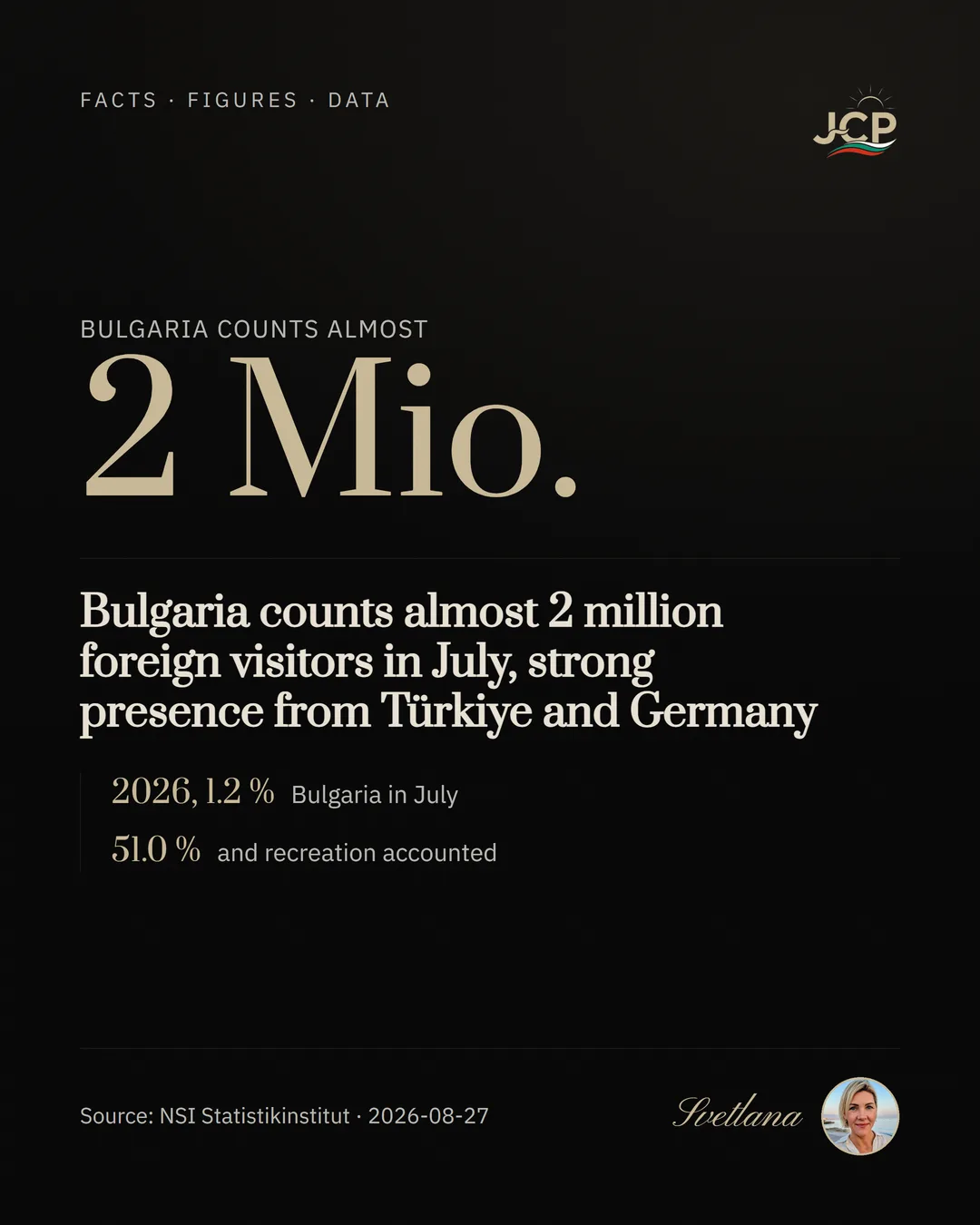
Bulgaria counts almost 2 million foreign visitors in July, strong presence from Türkiye and Germany
According to preliminary data from the statistics institute, about 1,979,700 foreign visitors arrived in Bulgaria in July 2026, 1.2 per cent fewer than a year earlier. Holiday and recreation accounted for 51.0 per cent of visits (around 1,009,000). The largest source countries were Türkiye with 312,700, Romania with 301,200, Ukraine with 202,100 and Germany with 163,500; EU citizens made up 54.4 per cent. For the south coast, this stable, broadly spread demand remains the basis for seasonal letting.
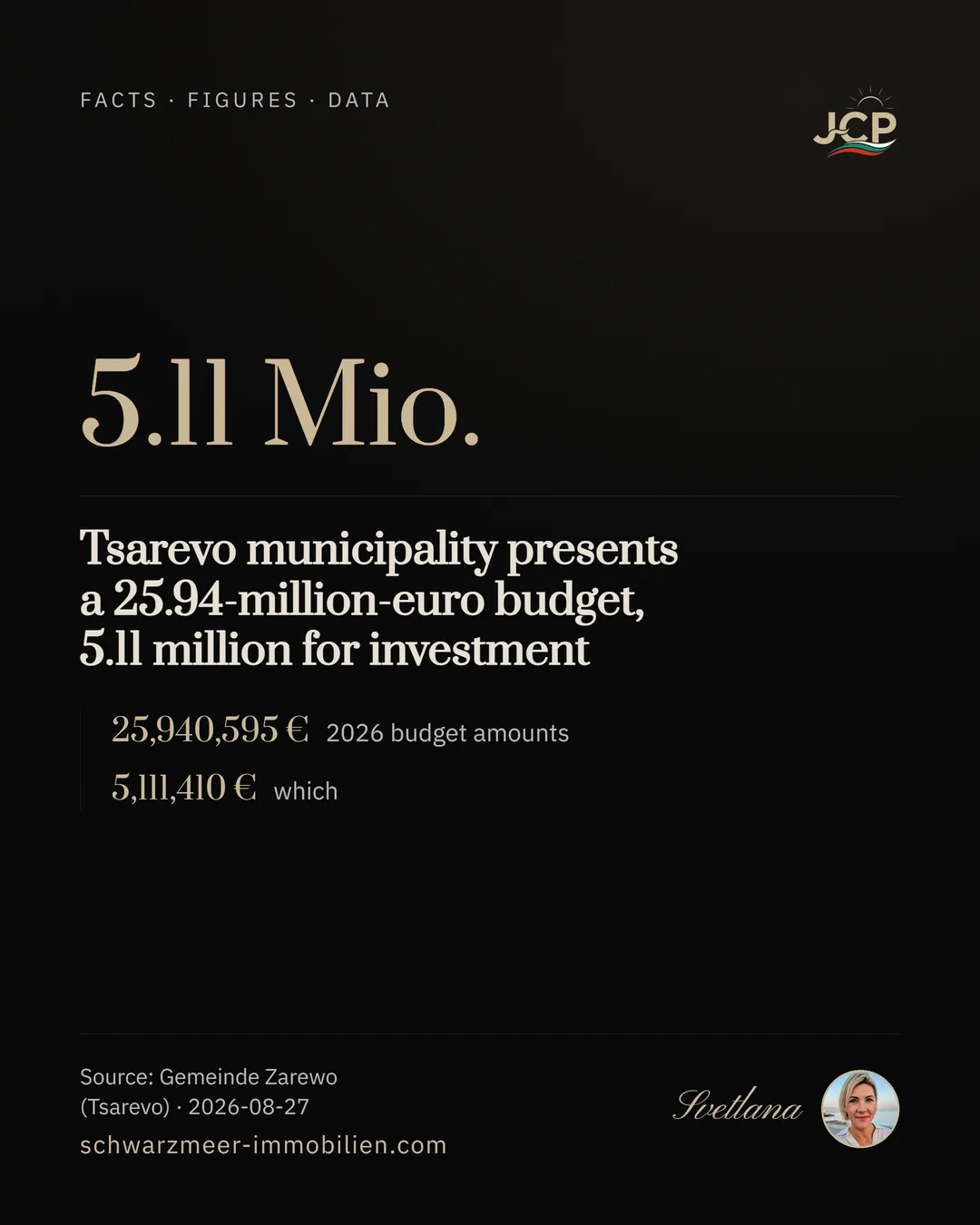
Tsarevo municipality presents a 25.94-million-euro budget, 5.11 million for investment
Tsarevo municipality's 2026 budget amounts to 25,940,595 euro, of which 5,111,410 euro for the investment programme on municipal facilities and 4,959,585 euro for EU-funded projects. Planned items include the Lozhenets–Velika road with a contractor selected, wastewater treatment plants in Sinemorets and Varvara, a new water pipeline network for the Strandzha villages and the modernisation of Tsarevo's fishing port. For the Rezovo–Sveti Vlas coastal corridor these are concrete location signals. Anyone buying around Ahtopol, Lozhenets or Sinemorets should keep these projects in view.
Bonus-malus system for motor third-party liability in Bulgaria in force since 25 August
On 25 August 2026, amendments to Regulation No 49/2014 (motor third-party liability) and Regulation No 54/2016 (Guarantee Fund registers) entered into force, establishing a bonus-malus system for liability cover. The model is centralised: the Guarantee Fund keeps a register of the past five years' claims history, which insurers access free of charge electronically; the driver submits nothing. Each insurer calculates the class under its own risk policy, likely felt in premiums from early 2027. Anyone keeping a vehicle on the coast should query their own class and compare offers for the same history.
Sozopol: recreation and resort buildings in the Mapi locality announced for environmental review
Sozopol municipality has publicly announced an investment proposal to build recreation and resort buildings, together with a secondary street, on the plot identified as 67800.43.58 in the Mapi locality. The step is public participation within the environmental impact assessment under the Spatial Planning Act (ZUT); the documents are held in the Environment Ministry's EIA register. Building parameters are not yet named in the notice. For prospective buyers in Sozopol this shows ongoing construction activity, and also how early projects can be tracked officially.
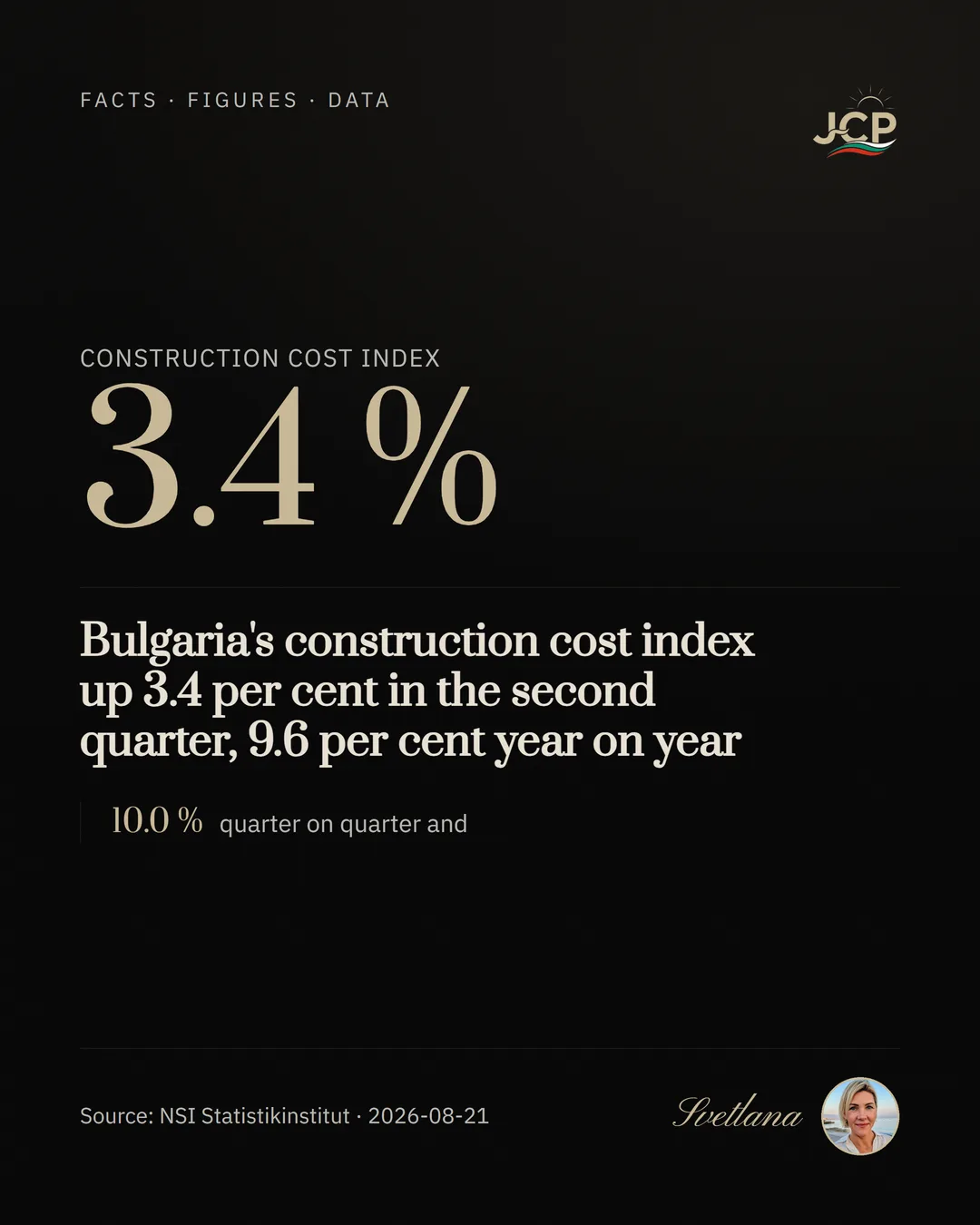
Bulgaria's construction cost index up 3.4 per cent in the second quarter, 9.6 per cent year on year
The total construction cost index rose 3.4 per cent in the second quarter of 2026 against the previous quarter and 9.6 per cent against the second quarter of 2025. Producer prices for building materials climbed 3.4 per cent quarter on quarter and 10.0 per cent year on year. The index combines material prices, energy costs and construction wages. For buyers of new builds and for renovators, this is the cost base against which quoted prices and add-ons are set.
Assessment: A near ten per cent annual rise in construction costs explains why new-build prices on the coast are barely easing – the cost side stays firm. For off-plan buyers this is an argument to negotiate price-escalation clauses and completion dates carefully. Right now I often see a better price-to-risk ratio in finished properties with a valid occupancy permit than in early construction phases.
Over 3,000 MW for new data centres in Bulgaria, with Burgas among the planned sites
Bulgaria has an installed generating capacity of 16,000 MW across nuclear, coal, hydro and renewables. Sites near 400 kV lines have been identified with a combined capacity of over 3,000 MW for new data centres, including Stolnik, Kremikovtsi and Burgas, with market readiness in one to two years. The stated advantages are lower energy costs than in Western Europe, access to dark fibre, state incentives and EU funding via the Territorial Just Transition Plan.
Bulgaria launches 3.58 million euro EU programme to attract investors
The Bulgarian Investment Agency has launched an EU-funded project worth 3.58 million euro to strengthen Bulgaria as a destination for foreign direct investment. The focus is on the northern regions, which have so far lagged behind other parts of the country. By 2027 the project aims to reach more than 400 potential investors, organise 22 events, hold 25 individual meetings and introduce five new services for investors.
CHECKLIST: when your own company (EOOD) pays rent – how to keep the expense deduction clean
If you use part of your coastal flat through a Bulgarian company (EOOD or OOD), costs can be deducted proportionally – but only with a clear split. Under the corporate income tax act (ZKPO), property costs under mixed use are divided by the ratio of area or time of use; only the business share is deductible, and every expense needs an accounting document under Article 10 ZKPO. The privately used share triggers the expense tax (danak varhu razhodite), which is 3 per cent on benefits in kind for private use. Before acting, agree the split and the evidence with a licensed Bulgarian accountant so the arrangement does not turn into a back payment.
CHECKLIST: residence permit in Bulgaria – first the legal ground, then the application
A residence permit (VNZh) in Bulgaria is not granted on request but requires a legal ground. According to the EU immigration portal for third-country nationals these include employment, one’s own company or business activity, an investment or real-estate basis, family reunification or proof of stable, sufficient own means without recourse to public assistance – always together with mandatory health insurance valid in Bulgaria. Only once a viable ground and the evidence are in place is the application filed with the Migration Directorate; without a ground there is no permit but illegal stay. Before hiring an intermediary it pays to check the official source and to fix the scope of services in writing rather than paying in advance “on spec”.
Assessment: The most common mistake is to see the permit as a purchasable commodity – in truth the legal ground is the core, everything else is evidence work. For buyers from third countries, especially Russian-speaking clients, this is the decisive switch before any payment. I check the viable ground first and have each case aligned with the authorities through Svetlana’s network.