Market, region and lifestyle on the Black Sea coast. Concise, factual, each with a source.
Page 10 of 15.
Market · Bulgarien2026-09-08
Trade association expects diesel above 1.90 euros per litre, petrol and diesel up 6 to 7 cents recently
The association of fuel traders, producers, importers and transporters expects diesel to rise above 1.90 euros per litre next week. Its representative Dimitar Hadzhidimitrov puts the increase of recent weeks at roughly 6 to 7 cents for both petrol and diesel. He cites tight refining capacity, low stocks and plants running below full utilisation. On top of that comes the lag in purchasing: about three months pass between buying the crude and taking delivery, which is why traders do not build stocks at elevated prices. For comparison, on 1 August diesel averaged 1.76 euros per litre across the country.
Assessment: Fuel is no minor item on the southern coast, because almost every trip to the property, the bank and the notary runs by road. For landlords the price bites twice: in their own journeys and in the travel costs of tradespeople, which experience shows are passed on in service contracts. So I budget the winter running costs with a mark-up and insist that new contracts state the travel flat rate in figures.
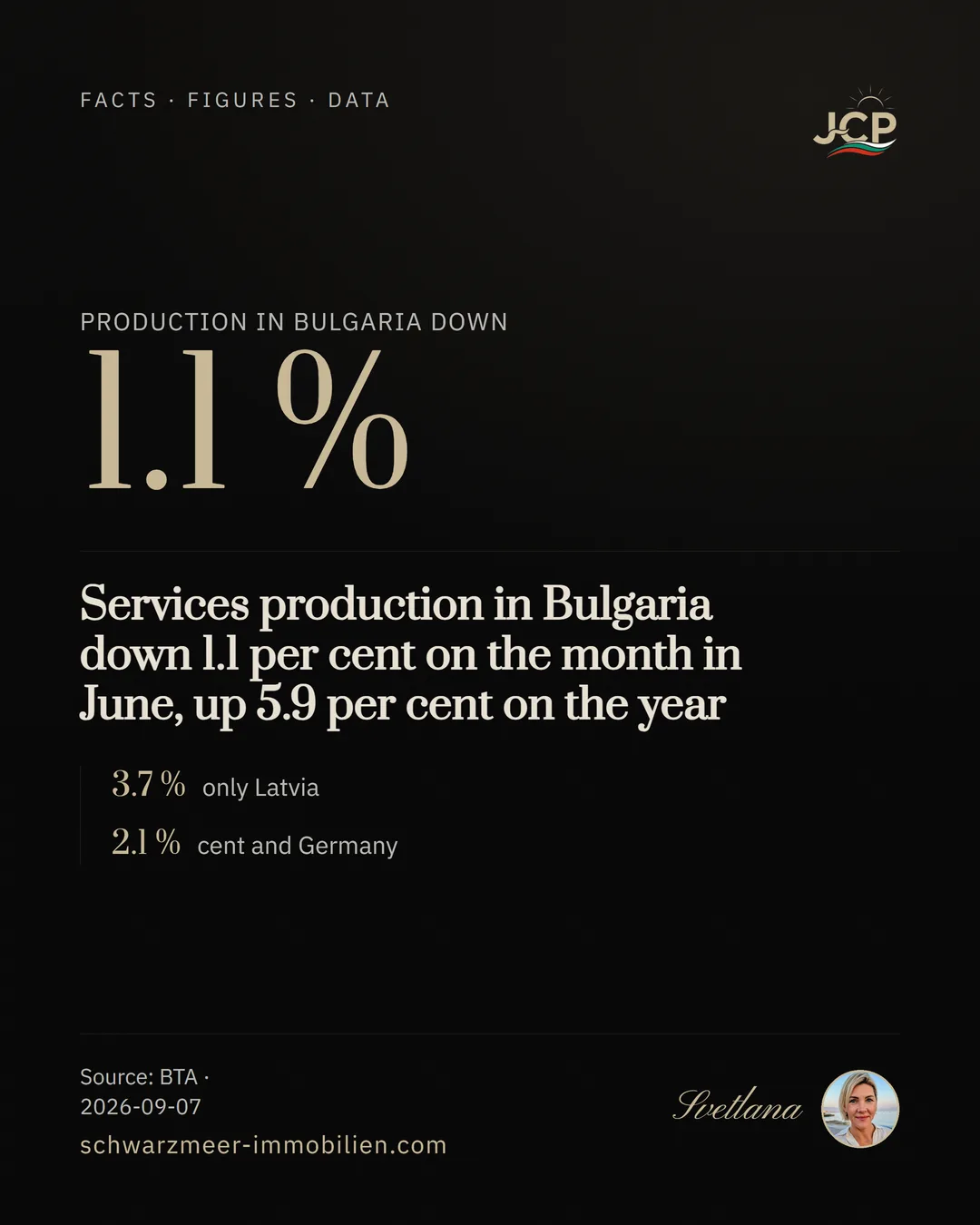
Services production in Bulgaria down 1.1 per cent on the month in June, up 5.9 per cent on the year
According to Eurostat figures published on 7 September, services production in Bulgaria fell by 1.1 per cent in June 2026 against May. That is the third largest monthly decline in the European Union; only Latvia at 3.7 per cent and Germany at 2.1 per cent saw sharper drops. Year on year Bulgaria remains well above the Union average, at 5.9 per cent against 1.5 per cent. Across the Union the index fell by 0.2 per cent on the month in June, and by 0.3 per cent in the euro area. The strongest monthly gains were reported by Luxembourg at 7.8 per cent and Portugal at 3.1 per cent.
Commercial register has converted all company capital into euros ex officio, the 30 September annual accounts deadline stands unchanged
The Registry Agency has converted the capital shown in the commercial register for all limited liability companies, joint stock companies and cooperatives into euro, ex officio and free of charge. Owners need file nothing and pay nothing for it. The founding documents themselves, that is the articles and the partnership agreement, are only adapted with the next filing that is due anyway. Publication of the annual accounts is expressly unaffected: it must be filed by 30 September, regardless of whether the capital conversion paperwork has been brought up to date.
Commercial register reports longer processing times and advises filing shareholder resolutions earlier
The Registry Agency reports that processing in the commercial register and in the register of non-profit legal entities is currently taking longer than usual. The reason is the increased volume of filings arising from the duties of merchants under the Law on the Introduction of the Euro in the Republic of Bulgaria. The agency advises all merchants and non-profit legal entities planning a general meeting to submit their filings as early as possible. The notice gives no figure for the actual duration.
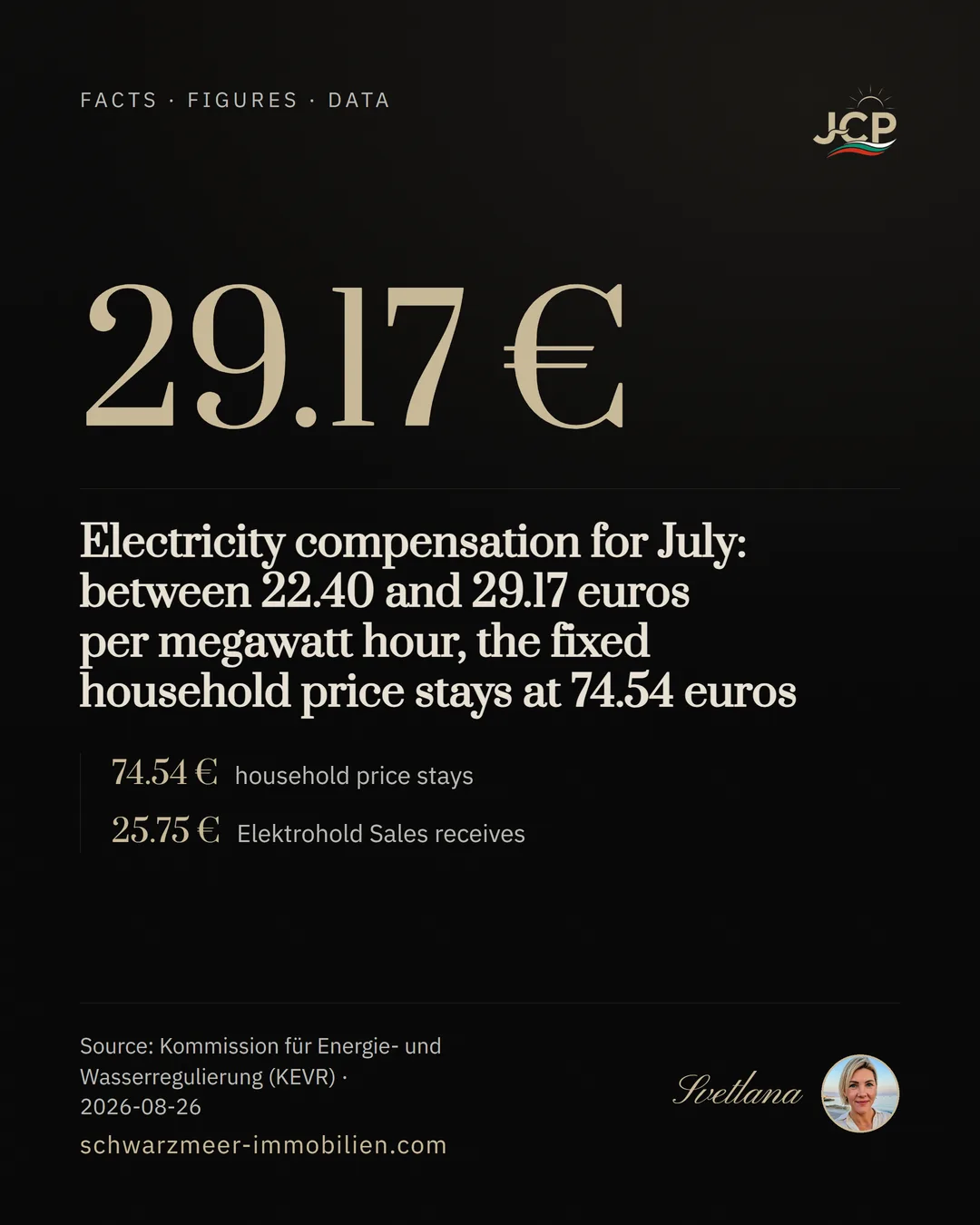
Electricity compensation for July: between 22.40 and 29.17 euros per megawatt hour, the fixed household price stays at 74.54 euros
On 26 August the Energy and Water Regulatory Commission set the compensation amounts for July 2026 that cover part of household electricity costs. Elektrohold Sales receives 25.75 euros per megawatt hour excluding VAT, EVN Bulgaria Electricity Supply 22.40 euros, Energo-Pro Sales 25.18 euros and ESP Zlatni Pyasatsi 29.17 euros. What is compensated is the gap between the fixed household price of 74.54 euros per megawatt hour and the higher procurement prices of that month. The funds come from the Electricity System Security Fund; the legal basis lies in the amendments to the Energy Act.
Assessment: The figure an owner should keep in mind is not the compensation but the fixed price of 74.54 euros per megawatt hour. It shows where the bill would stand without support, and it explains why the service charge forecast for a holiday property should not simply be rolled forward from the last annual statement. For a buyer that means heating load and insulation belong in the viewing, not in the first winter bill.
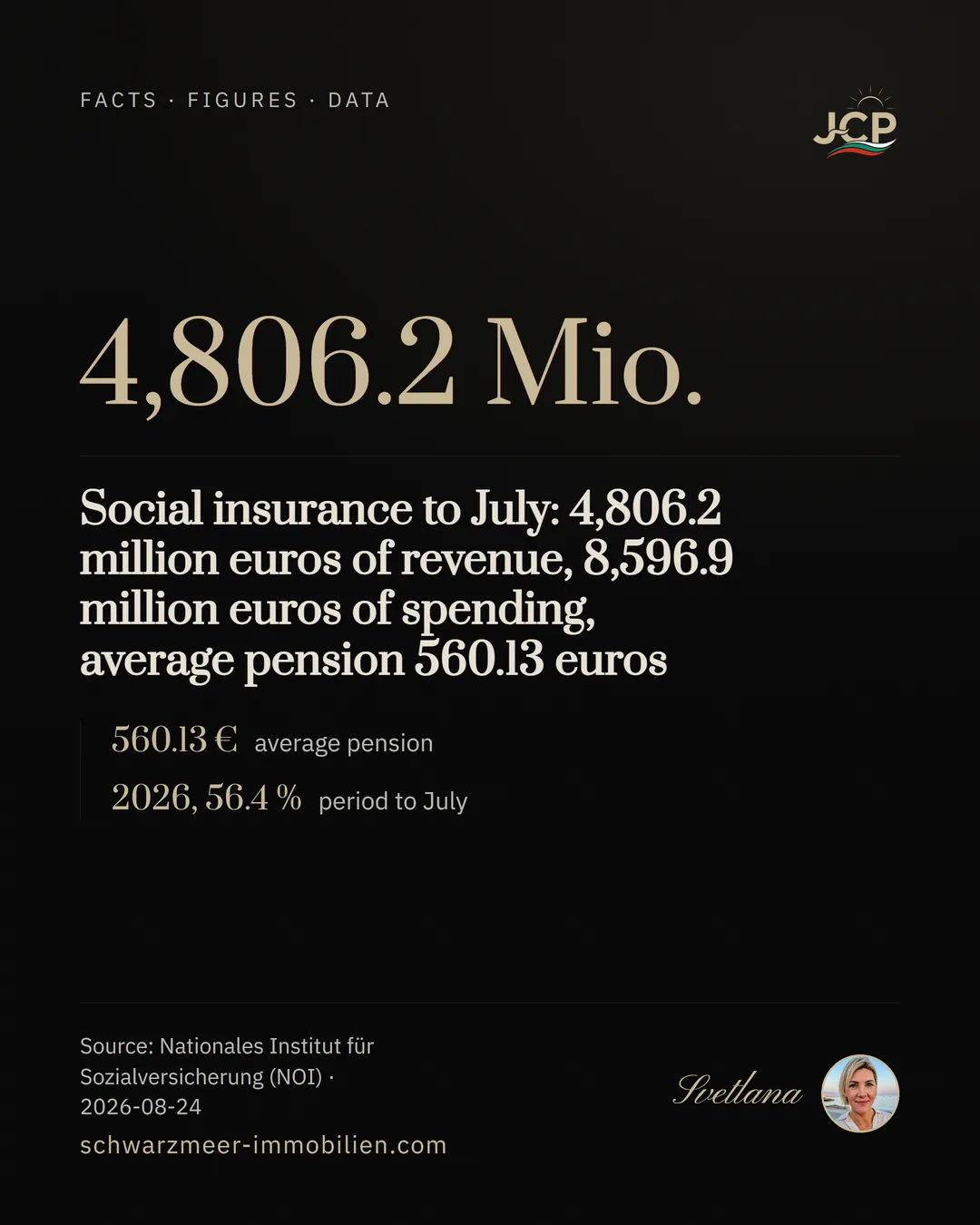
Social insurance to July: 4,806.2 million euros of revenue, 8,596.9 million euros of spending, average pension 560.13 euros
The National Social Security Institute reports revenue of the consolidated state social insurance budget of 4,806.2 million euros for the period to July 2026, 56.4 per cent of the annual plan and 439.4 million euros or 10.1 per cent more than a year earlier. Spending stood at 8,596.9 million euros, 56.3 per cent of plan and 744.1 million euros or 9.5 per cent above the same period of 2025. Of that, 7,655.0 million euros went on pensions, an increase of 694.7 million euros or 10 per cent. The number of pensioners rose by 11,784 to 2,069,181, and the average monthly pension by 7.9 per cent from 519.07 to 560.13 euros. Cash benefits and allowances absorbed 883.9 million euros.
Regulator adopts incentives for water utility mergers: costs may be spread over up to three years, plan changes within 60 days
On 21 August the Energy and Water Regulatory Commission adopted the final ordinance on regulatory incentives for mergers of water and sewerage operators. Economically justified costs directly connected with a merger are recognised and may be spread over up to three years. Business plans involving a merger receive priority review, and amendments to already approved plans are processed within 60 days. Also recognised are investments in integrating systems, in connecting pipelines, in modernising facilities and in shared information systems. The basis is the amendment to the Water Act in force since 8 June 2026 and a commitment under the national recovery and resilience plan; the stated aim is socially bearable prices.
Burgas State Opera in October: Carmen on the 6th, My Fair Lady on the 13th, La Traviata on the 23rd
Burgas State Opera opens October on the 6th with Georges Bizet's Carmen in the opera hall at 19:00, conducted by Ivan Kozhuharov and directed by Darina Glavanakova-Bakardjieva. My Fair Lady by Frederick Loewe follows on 13 October, the symphonic programme Musical Ikebana on 16 October under Deyan Pavlov with guests from the Musashino Academy in Tokyo, Imre Kalman's The Queen of the Czardas on 20 October and Giuseppe Verdi's La Traviata on 23 October. On 26 October the ballet Don Quixote to music by Ludwig Minkus is on the bill, choreographed by Marius Petipa and Alexander Gorsky. All of these performances begin at 19:00 in the opera hall.
Burgas hosts the second festival of Bulgarian folklore ensembles from abroad on 18 to 20 September: around 400 performers from eight countries
Around 400 performers from some 20 groups and eight European countries will appear in Burgas from 18 to 20 September 2026. The organiser is the Association of Bulgarian Folklore Ensembles Abroad, together with the Executive Agency for Bulgarians Abroad and CIOFF Bulgaria. Friday and Saturday are given over to the individual groups with ten minutes each, while Sunday brings a joint parade and a gala concert with all participants. The first edition took place in Veliko Tarnovo from 23 to 26 July 2025 with nine groups; the association turns ten in 2026 and intends to hold the meeting annually.
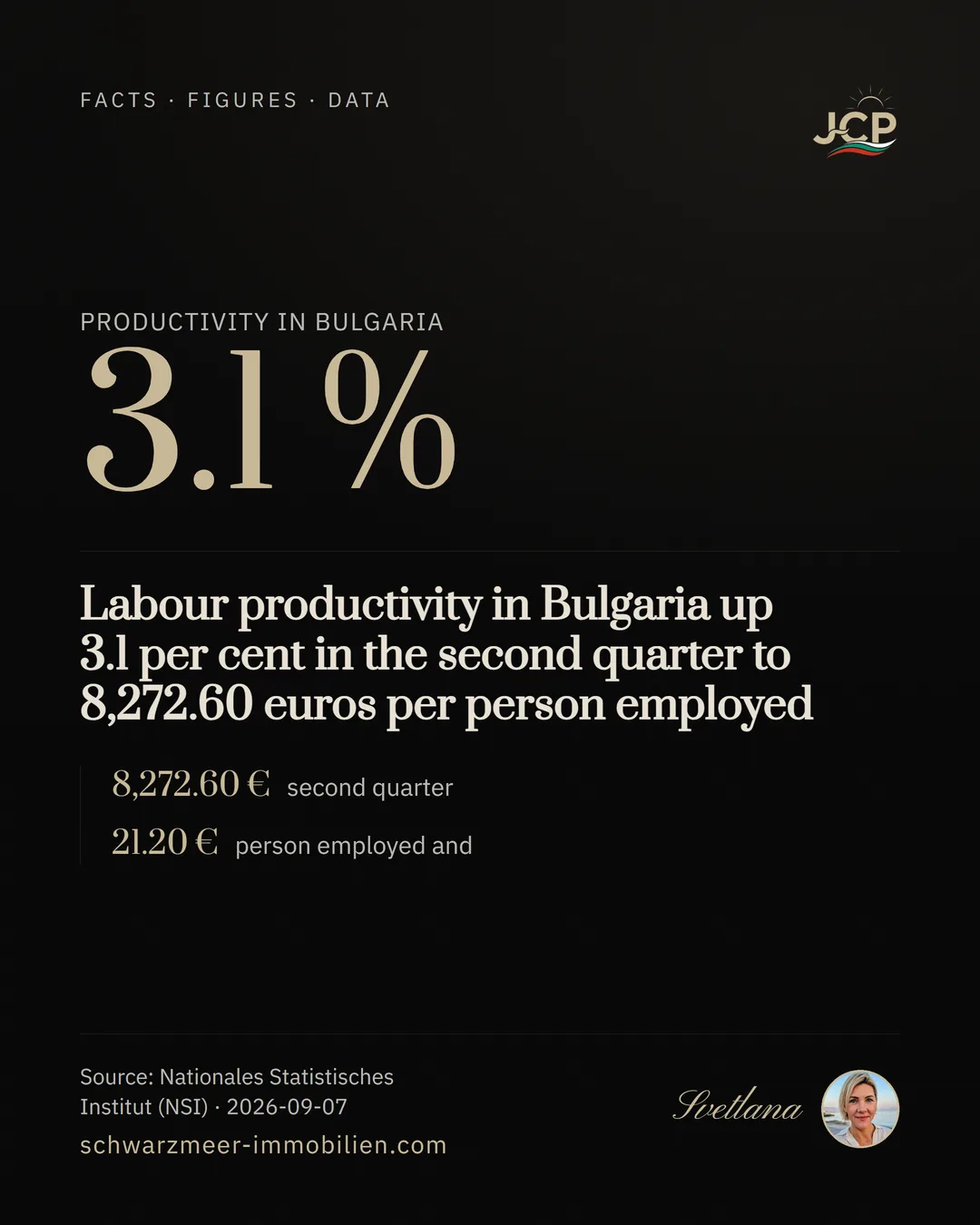
Labour productivity in Bulgaria up 3.1 per cent in the second quarter to 8,272.60 euros per person employed
The statistics institute reports gross domestic product of 8,272.60 euros per person employed and 21.20 euros per hour worked for the second quarter of 2026. In real terms output per person employed stands 3.1 per cent above the same quarter of 2025, while gross value added rose by only 0.3 per cent per person employed and 0.5 per cent per hour worked. A total of 3,661,800 people worked 1,428.3 million hours. By sector, industry leads with 7,898.20 euros of value added per person employed, ahead of services with 7,298.40 euros and agriculture with 1,305.80 euros; the employment share of services grew while industry and agriculture lost ground.
Assessment: For landlords and developers on the coast this is the wage side of the arithmetic. With value added per hour worked up by only 0.5 per cent in real terms, the pay steps announced for 2027 are not carried by productivity. So I keep budgeting rising rates for management, cleaning and maintenance, and I advise putting a price clause into any service contract that runs beyond twelve months.
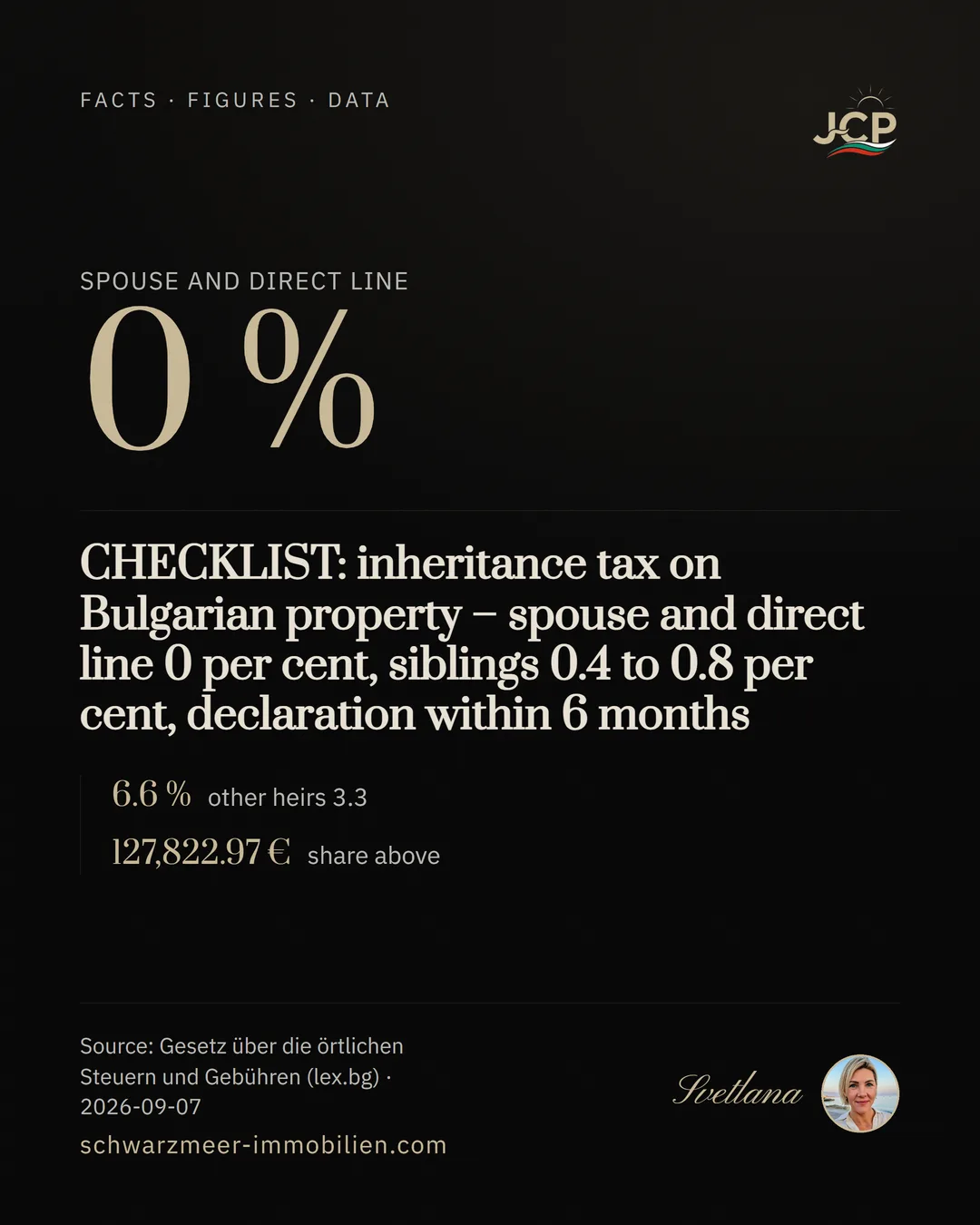
CHECKLIST: inheritance tax on Bulgarian property – spouse and direct line 0 per cent, siblings 0.4 to 0.8 per cent, declaration within 6 months
The Local Taxes and Fees Act exempts the surviving spouse and the heirs in the direct line from inheritance tax without limit (Art. 31 para 2). Siblings and their children pay 0.4 to 0.8 per cent, all other heirs 3.3 to 6.6 per cent, and only on the part of the share above 127,822.97 euros; the council sets the exact rate within that band (Art. 36). The declaration goes within six months to the municipality of the deceased person's last residence, or, where that residence was abroad, to the municipality holding the larger part of the estate (Art. 32). Since 1 January 2026 the estate is valued in euros, property according to the tax valuation under Annex 2, and funeral costs of 511.29 euros are deductible (Art. 33, Art. 34). Balances on accounts of a deceased person and payments under a life policy are released by the bank only against a municipal certificate; where the tax is unpaid, the bank withholds it and transfers it to the municipality within one month (Art. 41). The thresholds still appear in the statute in the former currency and are converted here at the official rate 1 EUR = 1,95583 BGN.
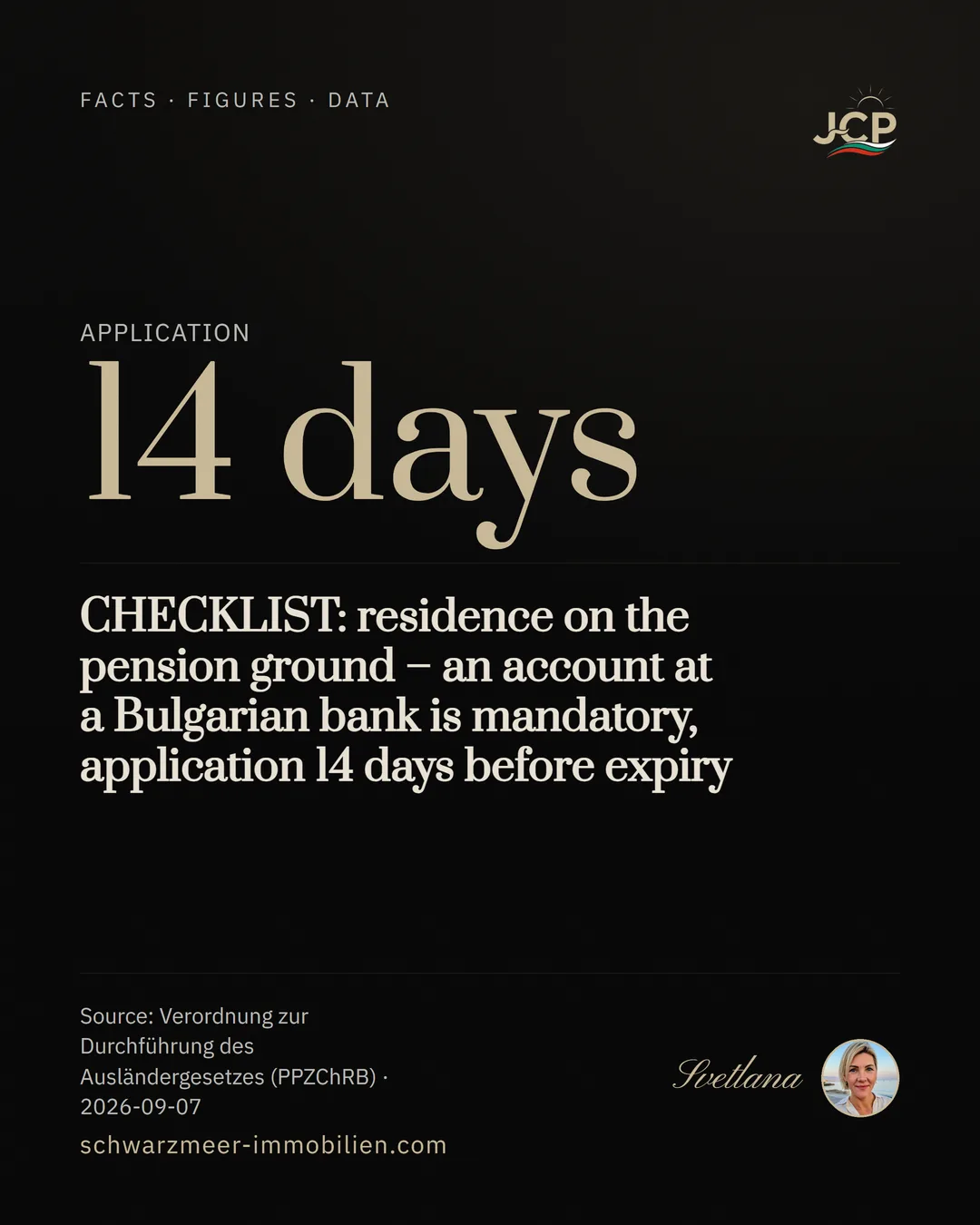
CHECKLIST: residence on the pension ground – an account at a Bulgarian bank is mandatory, application 14 days before expiry
The regulation implementing the Aliens Act requires two documents on top of the general list for residence on the pension ground: proof from the competent authority of the home state that a pension has been granted, and a document from a bank on Bulgarian territory confirming an existing account into which the pension transfers will be paid (Art. 23). The general list in Art. 14 para 1 covers the application lodged in person at the Migration Directorate or the regional interior directorate, the passport copy showing the visa and the last entry stamp together with the original for comparison, the receipt for the state fee under Art. 10 para 3 of Tariff No. 4, proof of secured accommodation, compulsory health insurance valid in Bulgaria for anyone not covered under the Health Insurance Act, proof of stable and regular means at least equal to the monthly minimum wage or the minimum pension, and a police clearance certificate on first application. The application must be lodged no later than 14 days before the permitted stay expires and is decided within 14 days (Art. 14 para 2). For the accommodation proof the regulation prescribes no particular type of document; ownership and tenancy both qualify.
Visa D: stays of up to 360 days for staff posted for a certified investment, interview without exception
The foreign ministry leaflet on visa D sets out two variants. The standard one is valid for up to six months and allows a stay of up to 180 days (Art. 15 para 1 of the Aliens Act). Validity of up to one year with a right of stay of up to 360 days may be granted to researchers, students on programmes of up to one academic year, specialising trainees and interns, and to people posted by a foreign employer to control and coordinate a contract for tourism services or to carry out investments certified under the Investment Promotion Act (Art. 15 para 2). The application must be lodged solely at the diplomatic or consular mission covering the applicant's permanent residence; in a third country only by way of exception, with reasons given and a guaranteed return. The interview with the applicant is mandatory, no exceptions are allowed, and the visa D lapses once a residence permit is issued.
CHECKLIST: check the building manager in the official register under Art. 47b of the Condominium Management Act before buying
The regional development ministry keeps a public register of professional managers of condominium property under Art. 47b of the Condominium Management Act. Each entry shows the running number, the company identification code EIK, the company name and legal form, the registered and correspondence address, the management, the owners of the capital, and the number and validity period of the certificate. Certificates are issued for five years; one entry in the register runs from 2 April 2026 to 2 April 2031. Three steps before the preliminary contract: note the name of the management company from the property particulars, match it in the register against the EIK and the certificate number, and check that the certificate runs beyond the planned completion date. If the company is not listed there, that proves no irregularity, but it is reason enough to read the wording of the complex's management contract before paying a deposit.
Assessment: In gated holiday complexes on the coast the management decides on costs and on the condition of the property, often for decades. The register check takes a few minutes and shows whether a vetted company with a valid certificate stands behind the management or a developer construction without authorisation. I see this above all as a price factor: a complex with cleanly run management resells more easily later than one with disputed fees.
CHECKLIST: putting a new building of the fourth and fifth category into operation – service 2062 of Burgas municipality, 30 days processing
For buildings of the fourth and fifth category the certificate of putting into operation is issued not by the national construction supervision but by the municipality. In Burgas this runs as service 2062 on the basis of Art. 177 para 3 of the Spatial Planning Act and Regulation No. 2 of 31 July 2003 on putting buildings into operation and on minimum warranty periods. The processing period is 30 days; the application with annexes, the title document and the final report of the construction supervisor have to be filed, and the certificate issued has no expiry. Payment is in cash at the counter, by card at the terminal, electronically or by bank transfer using payment code 448001. Filing is possible in person, by email or by post.
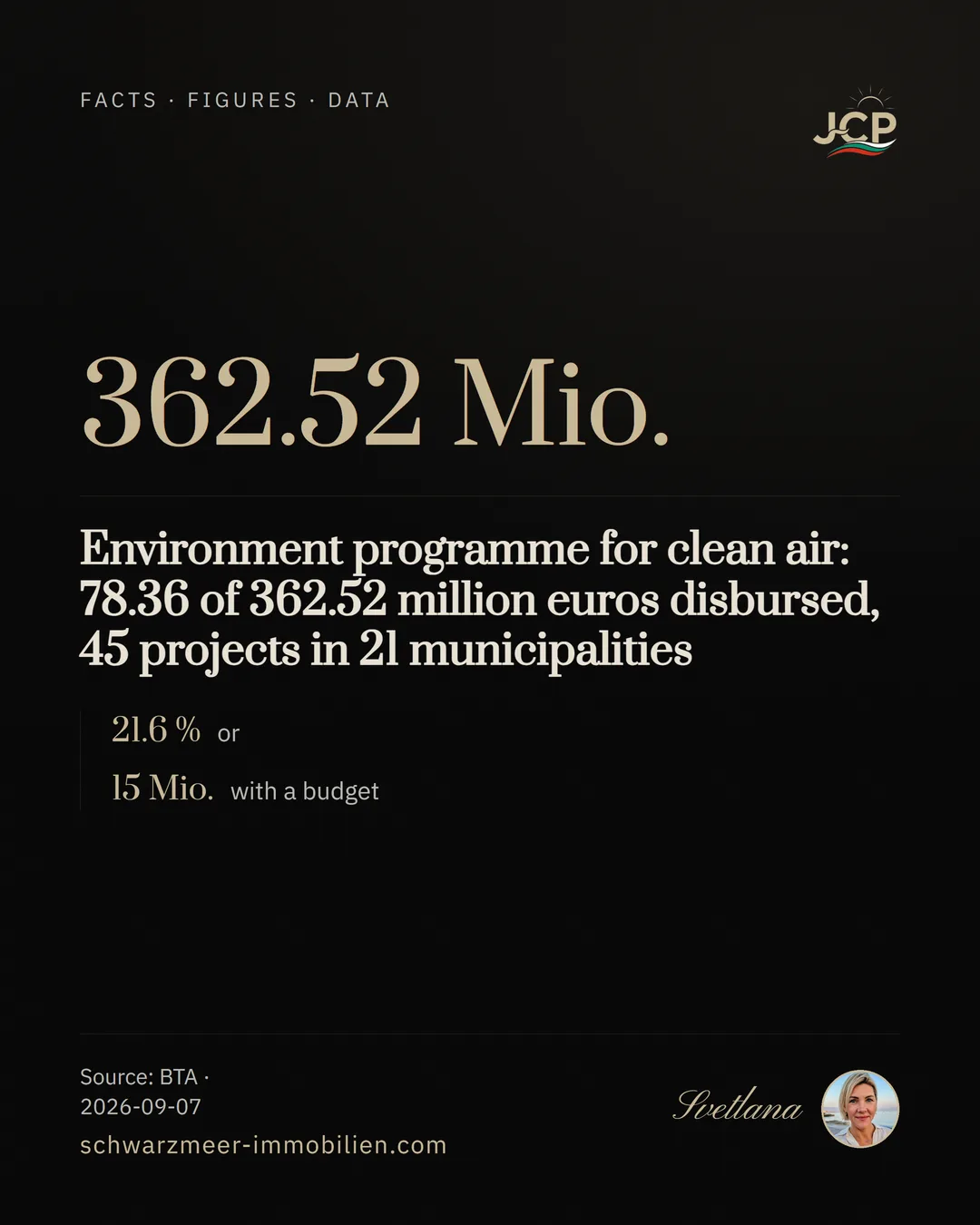
Environment programme for clean air: 78.36 of 362.52 million euros disbursed, 45 projects in 21 municipalities
The Environment Programme 2021 to 2027 earmarks 362.52 million euros for improving air quality; 78.36 million euros, or 21.6 per cent, have been disbursed so far. Funding goes to 45 projects in 21 municipalities where exceedances of the daily or annual limit values for fine particulate matter were recorded between 2017 and 2021. So far 7,952 of 75,500 planned heating units have been replaced, mostly solid fuel stoves giving way to pellet burners, heat pumps and air conditioning units. An annual reduction of more than 2,100 tonnes of fine particulate matter is expected, alongside some 250 hectares of green infrastructure and low emission zones in Sofia and Plovdiv restricting high emission vehicles during the heating season. A Swiss-Bulgarian partnership with a budget of 15 million francs is renewing the national quality assurance system by the end of 2029, and a mobile application is to supply readings in real time.
Pomorie prepares a Blue Action Plan: two day project meeting with partners from five countries
On 2 and 3 September 2026 the municipality of Pomorie hosted a meeting of the Recircle Med project for the second time, a project supporting blue and circular economy in tourism. Partners from Italy, Greece, Malta, North Macedonia and Montenegro met at the Dechko Stoev Municipal Art Gallery, with the Greek University of Thessaly as lead partner. The topics were more efficient use of water and energy, waste reduction, sustainable mobility and turning natural and cultural assets into tourism experiences; the proposals will feed into a Blue Action Plan for the municipality.
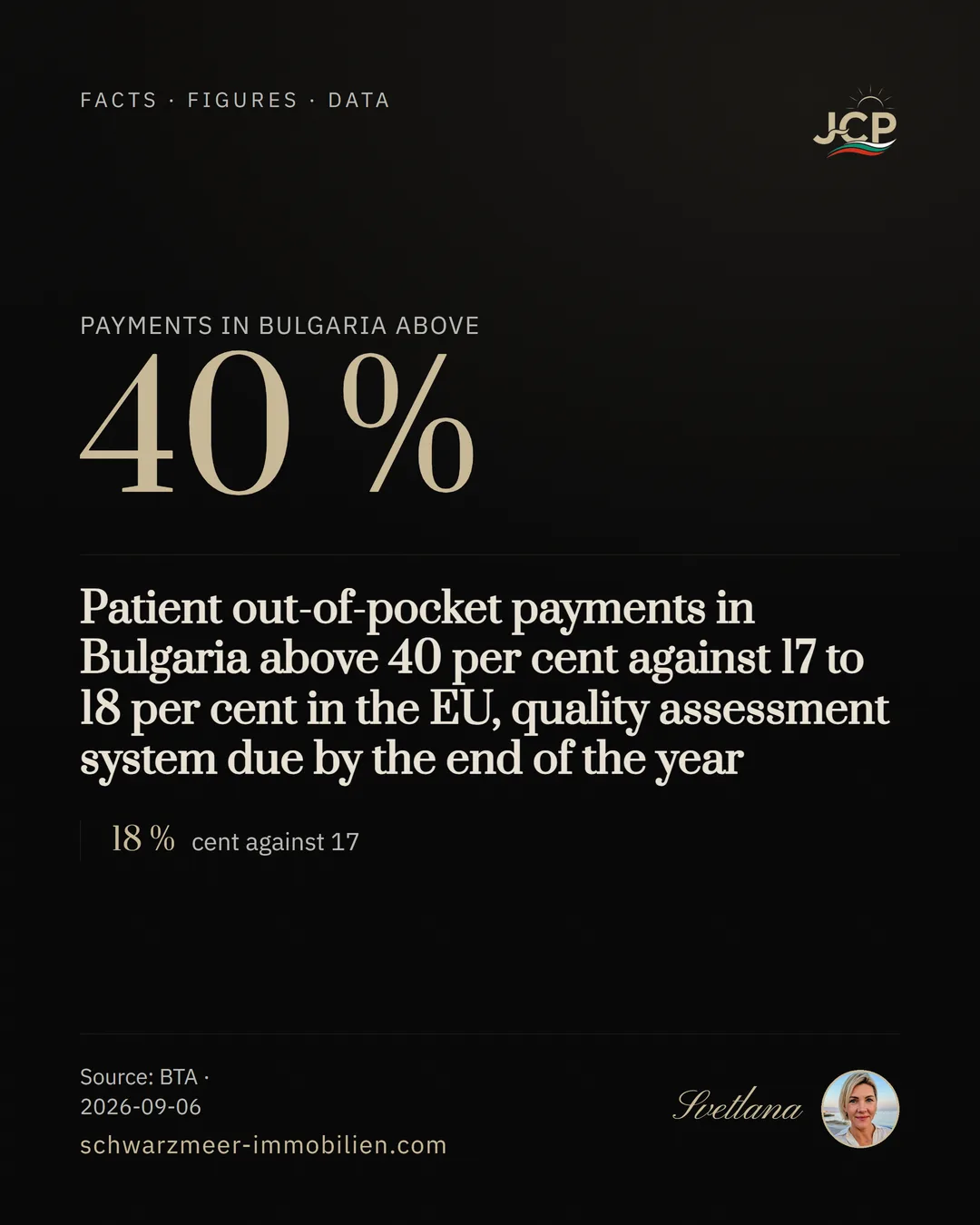
Patient out-of-pocket payments in Bulgaria above 40 per cent against 17 to 18 per cent in the EU, quality assessment system due by the end of the year
According to the health ministry, patients in Bulgaria pay more than 40 per cent of health expenditure out of their own pocket, against a European average of 17 to 18 per cent. A system for assessing treatment quality is to be adopted by the end of 2026; it is being agreed with the medical profession and is meant to make weak facilities visible. Greater transparency about payments outside compulsory insurance has also been announced, so that an insured person can see what they are entitled to, in cooperation with the National Health Insurance Fund. On the same account, the first hundred days advanced investments under the recovery and resilience plan, accelerated the emergency medicine project and produced draft legislation on full traceability of medicinal products and on central procurement.
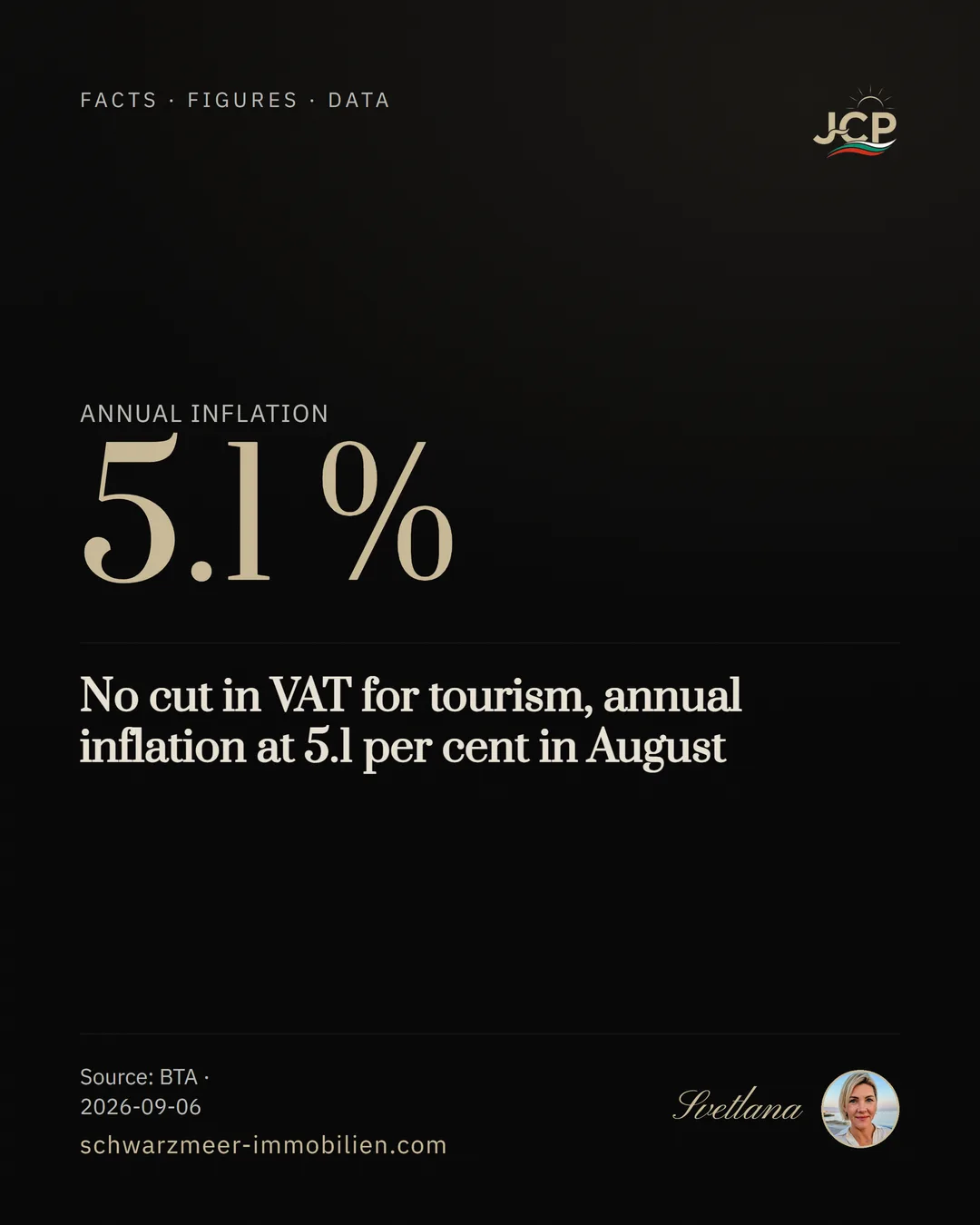
No cut in VAT for tourism, annual inflation at 5.1 per cent in August
Deputy Premier Atanas Pekanov said on 6 September that VAT for tourism will not be reduced. He argued that the sector had already received considerable concessions after the pandemic support and had incurred no additional costs that would justify higher prices. On his figures the services sector recorded the second largest price rise of all sectors in July and August; annual inflation stood at 5.1 per cent in August. Food prices, he said, have fallen since May following talks with the retail chains. For the coming season he called on restaurants to cut prices in nominal terms.
Assessment: For owners letting a flat on the coast this is news you can plan with: the reduced rate on accommodation stays where it is, and no further relief is to be expected for the 2027 season. Anyone doing the sums should read the expectation of nominally falling restaurant prices alongside it, because it shows where price pressure in coastal tourism is heading. I see in it an argument for properties with real quality rather than for premiums justified by location alone.
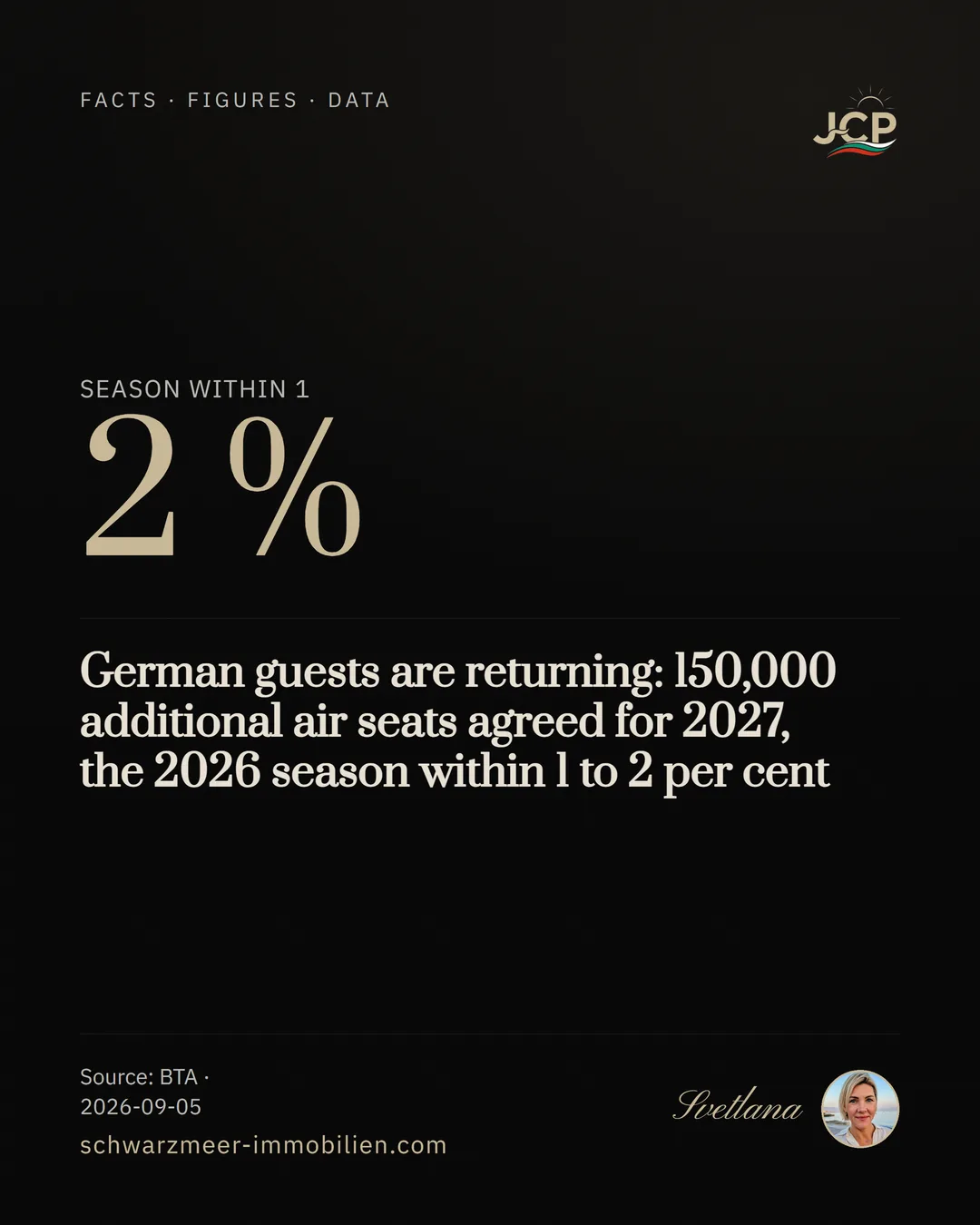
German guests are returning: 150,000 additional air seats agreed for 2027, the 2026 season within 1 to 2 per cent
The tourism ministry expects the 2026 summer season to end within one to two per cent of the previous year. May and June were weaker because around 200,000 air seats from the German market were missing; the shortfall was made up later in the season. For the coming season some 150,000 additional air seats have been agreed, from which the ministry considers 25 to 30 per cent more German guests than in 2026 achievable. German holidaymakers book charter flights with a minimum duration of seven days and arrive earlier, which lengthens the operating season of the hotels. On price levels along the Black Sea coast, results were good where mark ups stayed moderate. To tackle informal letting, the ministry wants short term rentals to be registered in the unified tourism information system and the properties linked to the booking platforms so that the tax is captured.
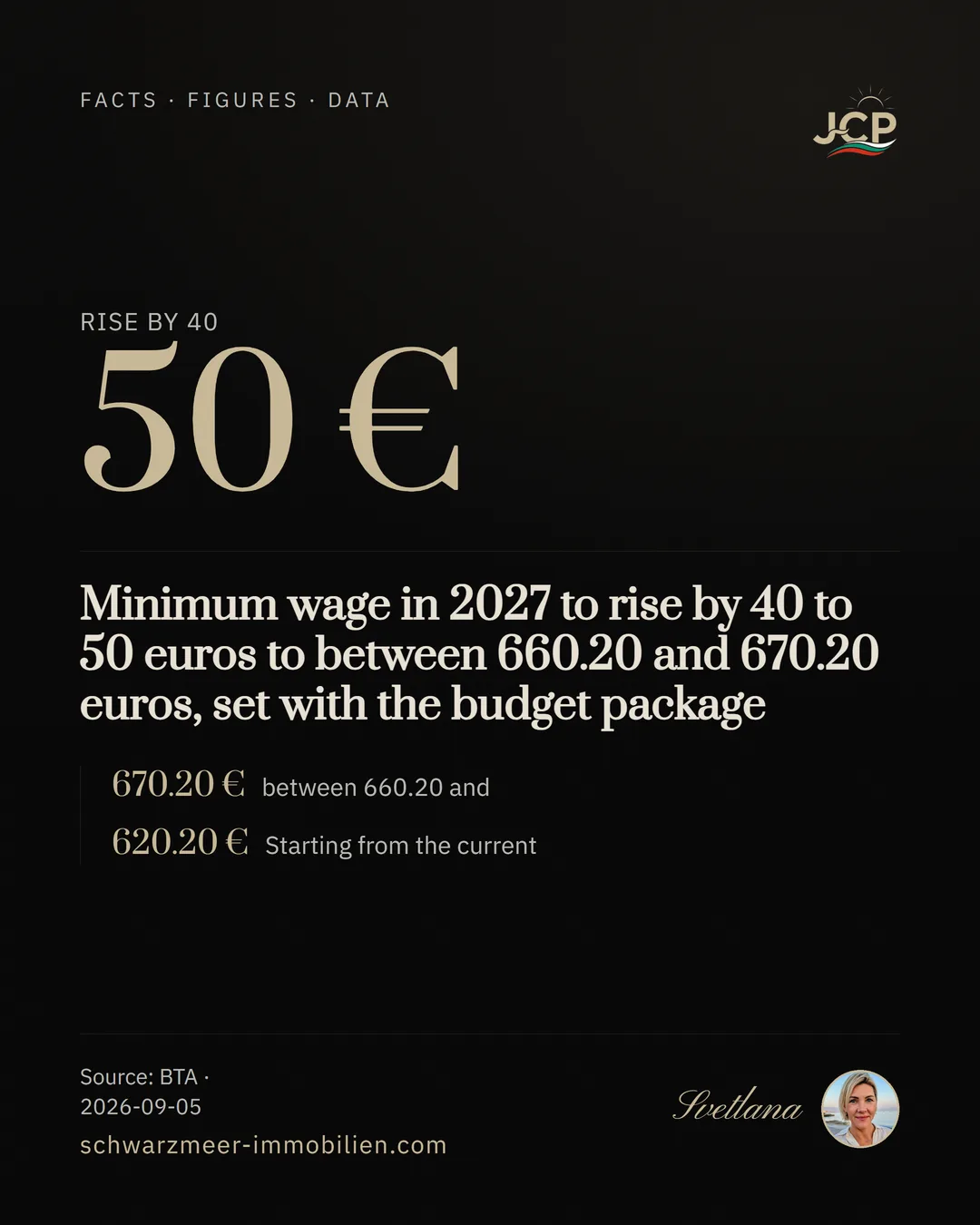
Minimum wage in 2027 to rise by 40 to 50 euros to between 660.20 and 670.20 euros, set with the budget package
The Labour and Social Policy Ministry regards a rise of 40 to 50 euros in the monthly minimum wage as the most realistic scenario for 2027. Starting from the current 620.20 euros that would give between 660.20 and 670.20 euros. The exact amount will be set with the 2027 budget legislation package; a higher upper limit was agreed between the cabinet, the trade unions and the employers' associations and complies with the requirements of EU law. Every three years the minimum wage will in future be measured against the cost of living, purchasing power, the development of the average wage and labour productivity. A final decision has not yet been taken.
Bulgaria close to leaving the FATF grey list: action plan substantially completed, decision due in Paris in October 2026
Bulgaria has been on the list of jurisdictions with strategic deficiencies in anti-money-laundering supervision kept by the Financial Action Task Force since October 2023. In June 2026 the task force recorded that the agreed action plan had been substantially completed; what remains is a final on-site assessment intended to show that the reforms hold. According to the Ministry of Justice the decision on removal falls in Paris in October 2026. The ministry states that the listing has significantly hindered foreign investment in Bulgaria.
Vertical Gas Corridor grows to nine countries, Bulgarian section due for completion on 1 October 2026
North Macedonia and Serbia have joined the Vertical Gas Corridor; the memorandum of understanding was signed in Thessaloniki on 4 September 2026 at the tenth Energy Forum for South East Europe. The project now covers nine countries: Bulgaria, Greece, Romania, Hungary, Slovakia, Ukraine, Moldova, North Macedonia and Serbia. Transmission operator Bulgartransgaz expects the facilities on Bulgarian territory to be completed on 1 October 2026. The operators involved intend to make joint use of existing infrastructure, identify additional capacity needs and improve cross-border transmission at regulatory, technical and commercial level.
Assessment: If you heat electrically on the southern coast, gas reaches you only through the electricity price, and that is where the lever sits. More supply routes mean more competition for the same customer; whether that shows up in the monthly price decision will only become clear over the winter. For properties with their own gas connection it is worth checking the contract now rather than looking for it in December.
Cutting red tape for business: 16 departments and 26 agencies table 102 proposals on digitising procedures and 101 on collecting data once
Sixteen departments and 26 agencies have submitted proposals for reducing the administrative burden on business: 102 concern the digitisation of procedures, 101 the principle of collecting data once and sharing it between authorities thereafter. The measures named include shorter processing deadlines, fewer documents to be filed, more electronic services, one-stop handling and the application of tacit consent, so that a missed deadline does not work against the applicant. The proposals are to be consolidated over the coming weeks and put to the National Assembly as legislative amendments. No firm dates for entry into force have been given so far.
The Chengene skele fishing settlement near Burgas is being prepared for the World Heritage List
At the International Forum on Maritime Heritage and Fishing Traditions in Burgas, Dr Irena Todorova, executive director of the Regional Centre for the Safeguarding of Intangible Cultural Heritage in South-Eastern Europe under the auspices of UNESCO, described the Chengene skele settlement on 4 September as a model of particular significance. What is meant is a living fishing community where fishing continues and the craft is passed to the next generation, combined with exhibitions and cultural tourism operations. Burgas municipality is pursuing inscription on the World Heritage List; deputy mayor Diana Savateva stressed that this is not only about preservation but about developing the cultural and tourism complex Chengene skele. Museum and academic specialists from nine countries took part in the forum. The initiative is carried by Burgas municipality, the Regional Historical Museum and the Burgas 2032 foundation.
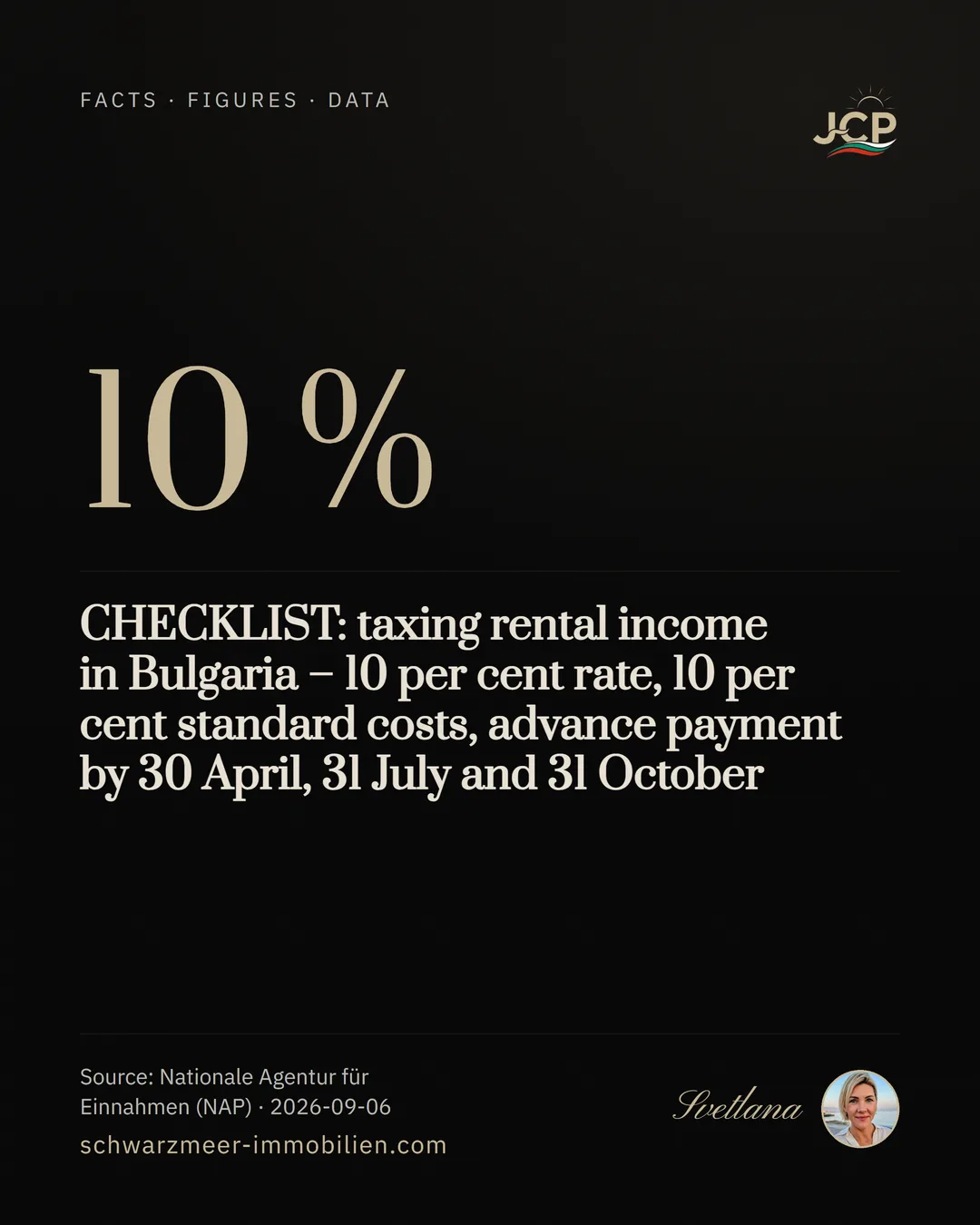
CHECKLIST: taxing rental income in Bulgaria – 10 per cent rate, 10 per cent standard costs, advance payment by 30 April, 31 July and 31 October
The National Revenue Agency sets the tax on income from letting at 10 per cent of taxable income. Before the calculation, 10 per cent of statutory recognised costs may be deducted; for properties in condominium ownership with joint management this deduction does not apply. If the tenant is a company or a self-insured person, the tenant withholds and remits the tax; if a private individual rents, the landlord pays it. Checklist: establish which of the two groups your own tenant falls into; submit the advance payment and declaration for quarters one to three by 30 April, 31 July and 31 October; file the annual return under Article 50 of the Personal Income Tax Act with annex no. 4 between 10 January and 30 April of the following year; request and keep the tenant's records of amounts withheld.
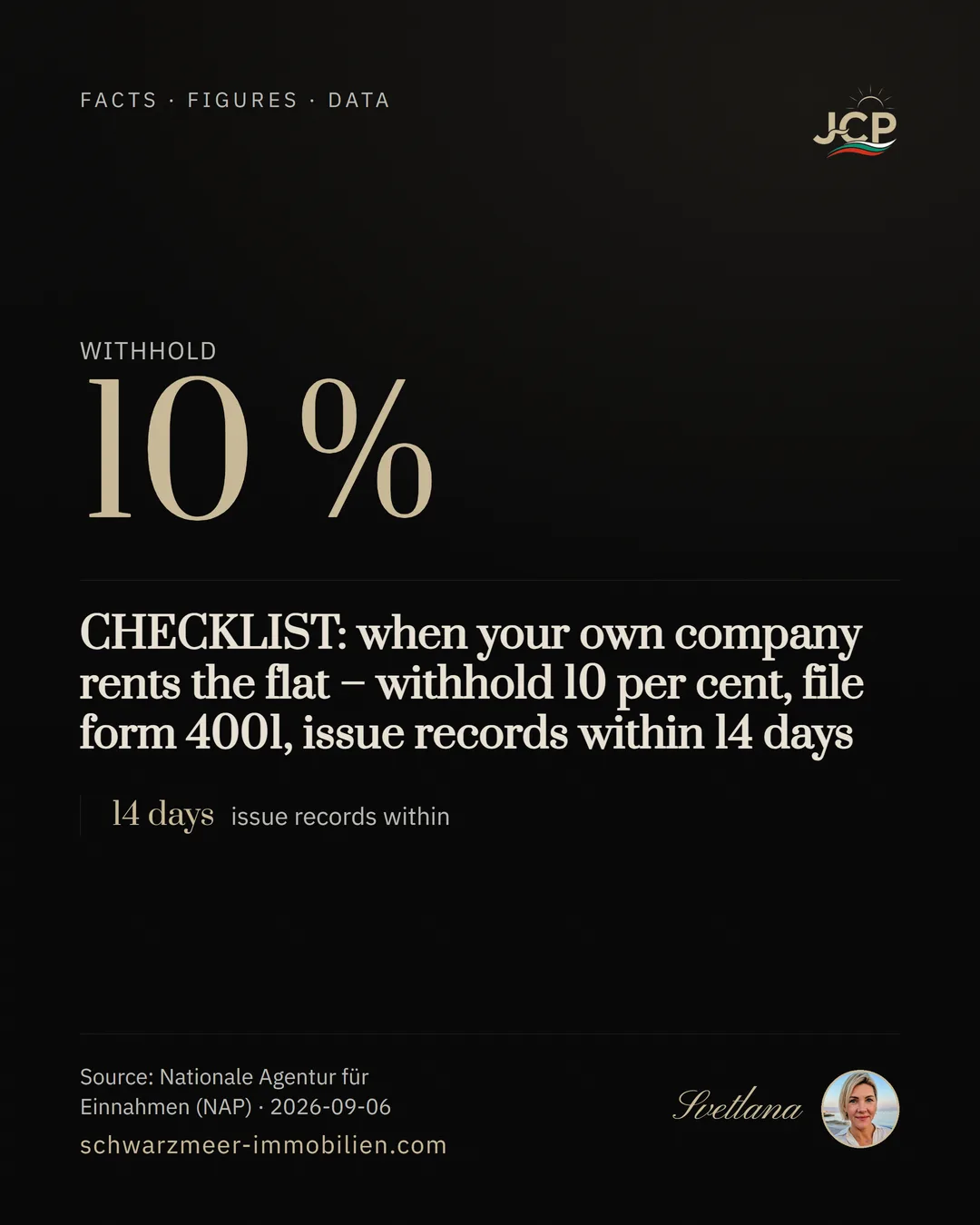
CHECKLIST: when your own company rents the flat – withhold 10 per cent, file form 4001, issue records within 14 days
Where a company or a self-insured person pays rent to a private individual, the duty falls on the payer, not on the recipient. The National Revenue Agency sets the rate at 10 per cent of taxable income and requires the declaration on form 4001, which rests on Article 55 paragraph 1 of the Personal Income Tax Act and Article 201 paragraph 1 of the Corporate Income Tax Act. Payment and declaration fall due by the end of the month following the quarter. Checklist: before the first transfer, establish whether your own company is the payer; set up the withholding in the accounts; file form 4001 quarterly; issue the record of amounts paid out within 14 days of a request.
Assessment: This constellation is more common than one might think: anyone who invests through a Bulgarian company and uses a room of their own flat for business becomes the payer and with it the party bound by the procedure. The mistake I see again and again is that an invoice is demanded which a private individual cannot issue at all. Plan the withholding and the form from the outset and the effort stays small, while the back payment that otherwise shows up at the first inspection is avoided.
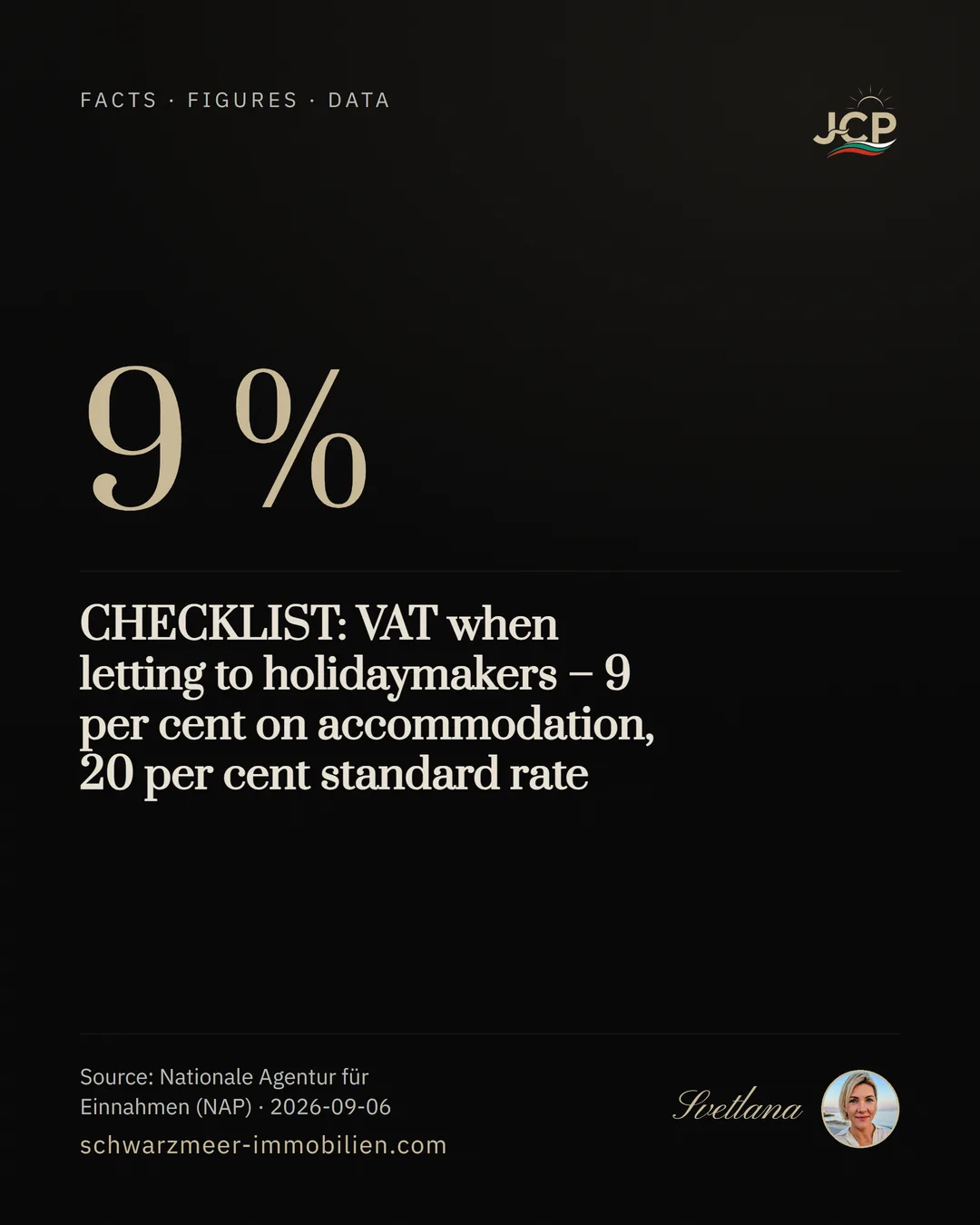
CHECKLIST: VAT when letting to holidaymakers – 9 per cent on accommodation, 20 per cent standard rate
Under Article 66 of the Value Added Tax Act the standard rate of VAT in Bulgaria is 20 per cent and applies to taxable supplies, imports and intra-Community acquisitions. Article 66a reduces the rate to 9 per cent, among other things for accommodation services in hotels and similar establishments, including the letting of holiday flats and camping sites. Article 66b sets a zero rate for the supplies listed in Articles 53, 64a, 140, 146 and 173. Checklist: establish whether your own letting counts as an accommodation service or as plain residential letting; fix the applicable rate before the first invoice; ask booking portals which rate they apply in their statements; have the classification confirmed in writing by your accountant.
CHECKLIST: applying for a D visa – 15 calendar days or 35 working days of processing, apply three months before travel
The official portal for electronic administrative services describes the issue of visas for long-term stay in Bulgaria on the basis of Article 9a paragraph 2 item 4 of the Foreigners Act. Required are a travel document valid for at least three months beyond the planned departure, a passport photograph, fingerprints, proof of the fee, medical insurance covering repatriation and emergency treatment, and evidence of the ground for the application and of the means available. Processing takes 15 calendar days or 35 working days depending on the ground, and the application must be lodged at least three months before the planned travel date; the fee follows tariff no. 3 of the Ministry of Foreign Affairs. Checklist: check the remaining validity of the passport before booking appointments; settle the ground for the application, because it determines the deadline; take out the insurance before the appointment; plan three months of lead time rather than four weeks.
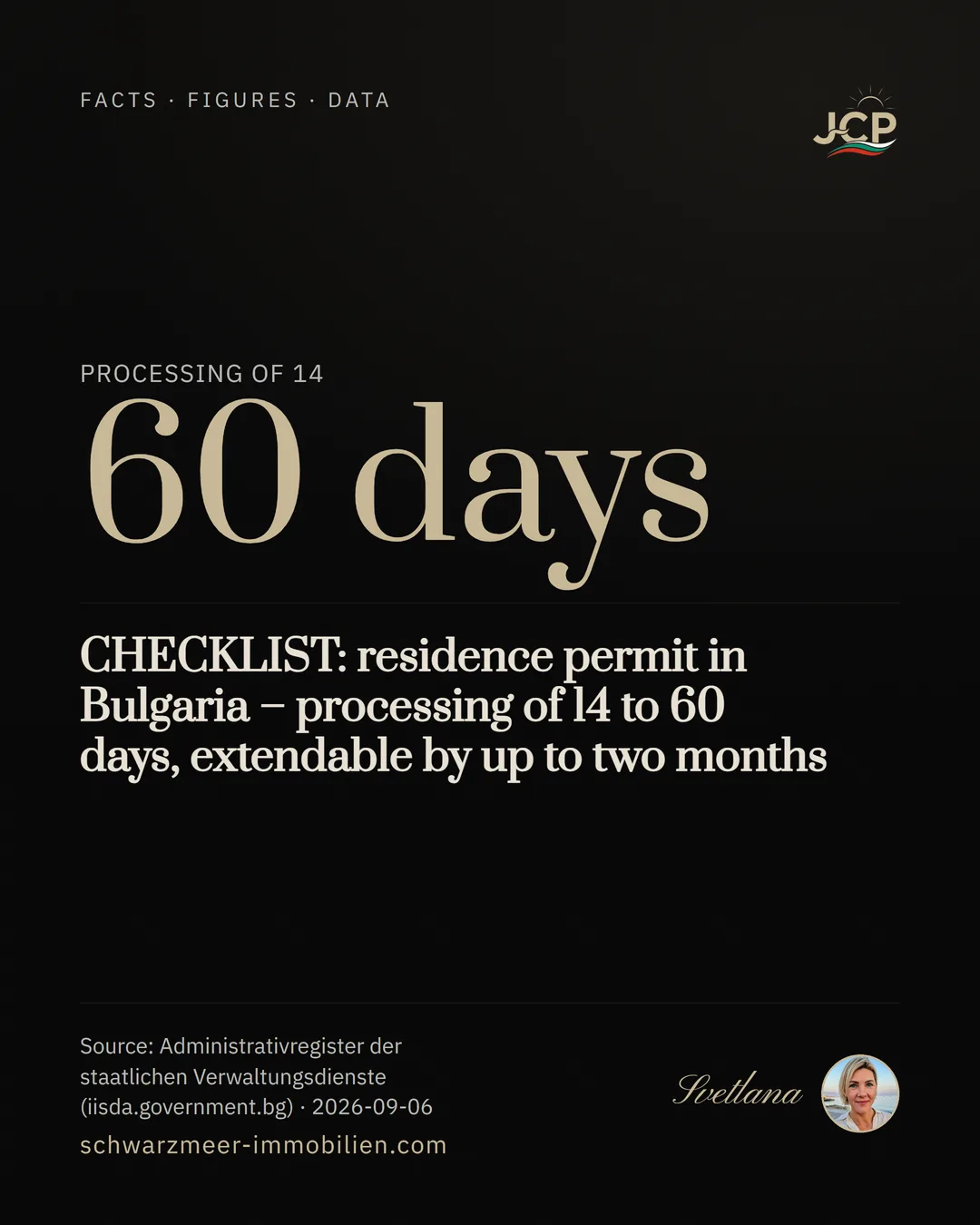
CHECKLIST: residence permit in Bulgaria – processing of 14 to 60 days, extendable by up to two months
The official register of administrative services lists service 238, the authorisation of long-term residence of foreigners, on the basis of Articles 24, 24b, 24v, 24e, 24i, 24k, 33a, 33k, 33p and 33r of the Foreigners Act. Required are a valid passport with entry stamp, proof of the fee paid, evidence of accommodation, medical insurance, proof of means of subsistence and, on a first application, a certificate of good conduct; where the applicant works, the employment agency's work permit is added. The processing period runs from 14 to 60 days and may be extended by up to two months in complex cases. Checklist: lodge the application while the D visa still has several weeks to run; assemble the documents on the list in full before the appointment; build the two-month extension into your own planning; obtain the accommodation evidence and the insurance early.